Sheltered by Mountains
Climate
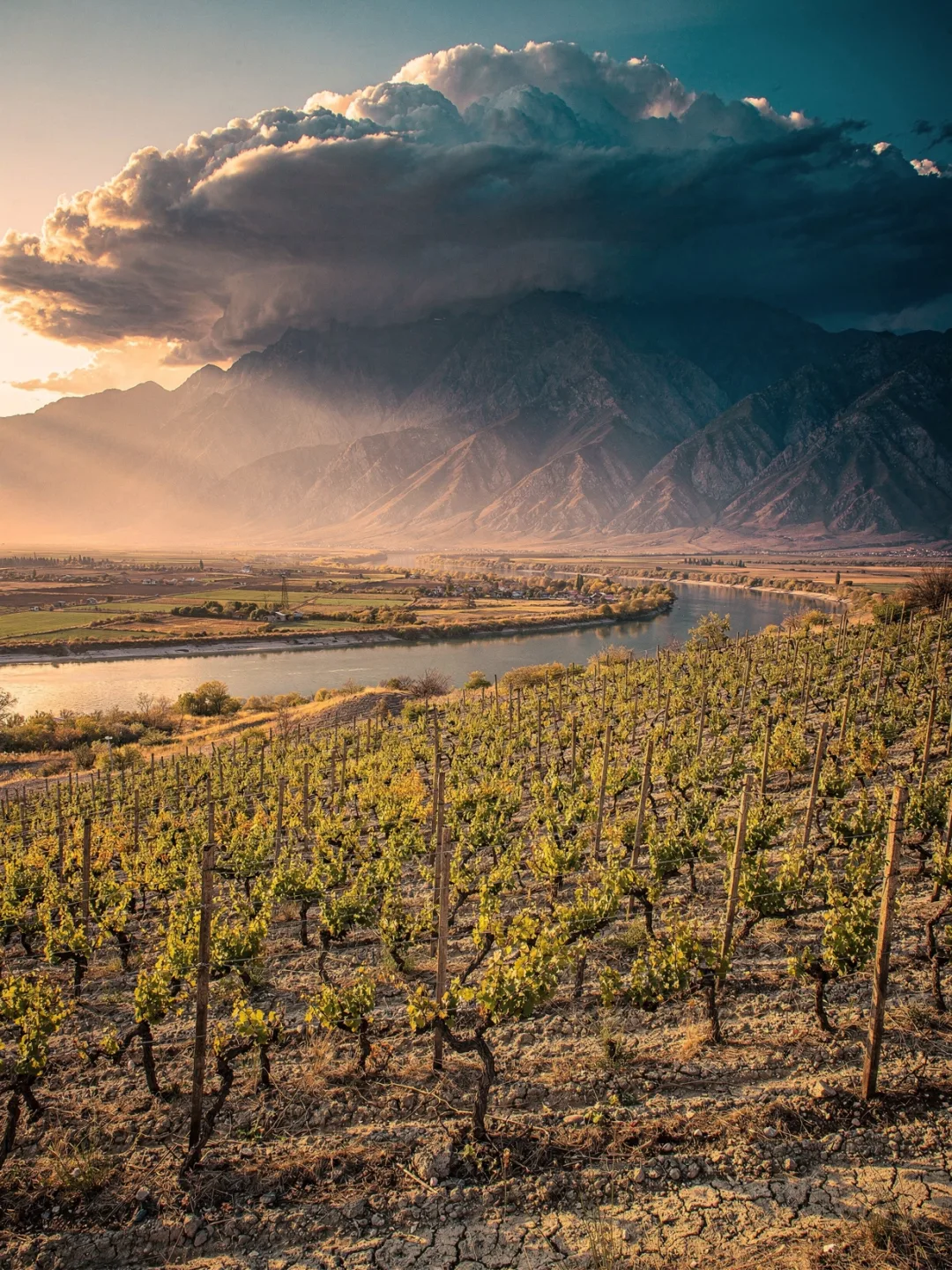
Mountains enclose Tbilisi on both sides, and this shapes the climate of the entire region. To the west, the Likhi Range holds back the moist air from the Black Sea. To the east, the Iori River and the Tsiv-Gombori Mountains separate Kartli from Kakheti, and what finally makes it through is dry and continental. Fog is rare here. This is exactly what keeps mildew at bay, a perennial worry in damper regions.
The vineyards themselves lie between four hundred fifty and seven hundred meters, along the Mtkvari, Liakhvi, and Ksani rivers. In the Ateni Gorge near Gori, they climb even higher, past six hundred meters, where the air is noticeably cooler than down in the valley. For Chinuri, the base of nearly every Kartli sparkling wine, this is crucial. Only cool nights allow the grape to retain the acidity that gives a sparkling wine its zip. Further south, in the hills of Bolnisi, narrow gorges create their own small-scale wind patterns — each valley tastes a little different there.
The average annual temperature in Kartli hovers around eleven degrees Celsius, but in the height of summer the mercury in Tbilisi climbs to thirty-five to forty degrees. Rain falls rarely throughout the year, averaging barely five hundred millimeters, sometimes as little as three hundred thirty, sometimes as much as seven hundred sixty. In the drier stretches of the Kvemo Kartli plain to the south, winemakers often must irrigate artificially. Frost, by contrast, is rarely the problem. It's more the sharp swings between a scorching afternoon and a cool night. These swings are good for acidity but also bring hail down from the Caucasus. In 2023, the harvest in Kartli, too, came in weaker after severe storms.
Harvest begins later in Kartli than in the warmer valleys of Kakheti to the east. Tavkveri and Shavkapito usually go to the press in mid-September. Chinuri follows only at the end of October, once acidity has dropped just enough that the future sparkling wine won't taste too sharp. Pick too early, and you risk a sour, thin wine. Wait too long, and you lose exactly the freshness for which Kartli has become known — a fine line that every winemaker here must judge anew, year after year, for each and every one of their vineyards.