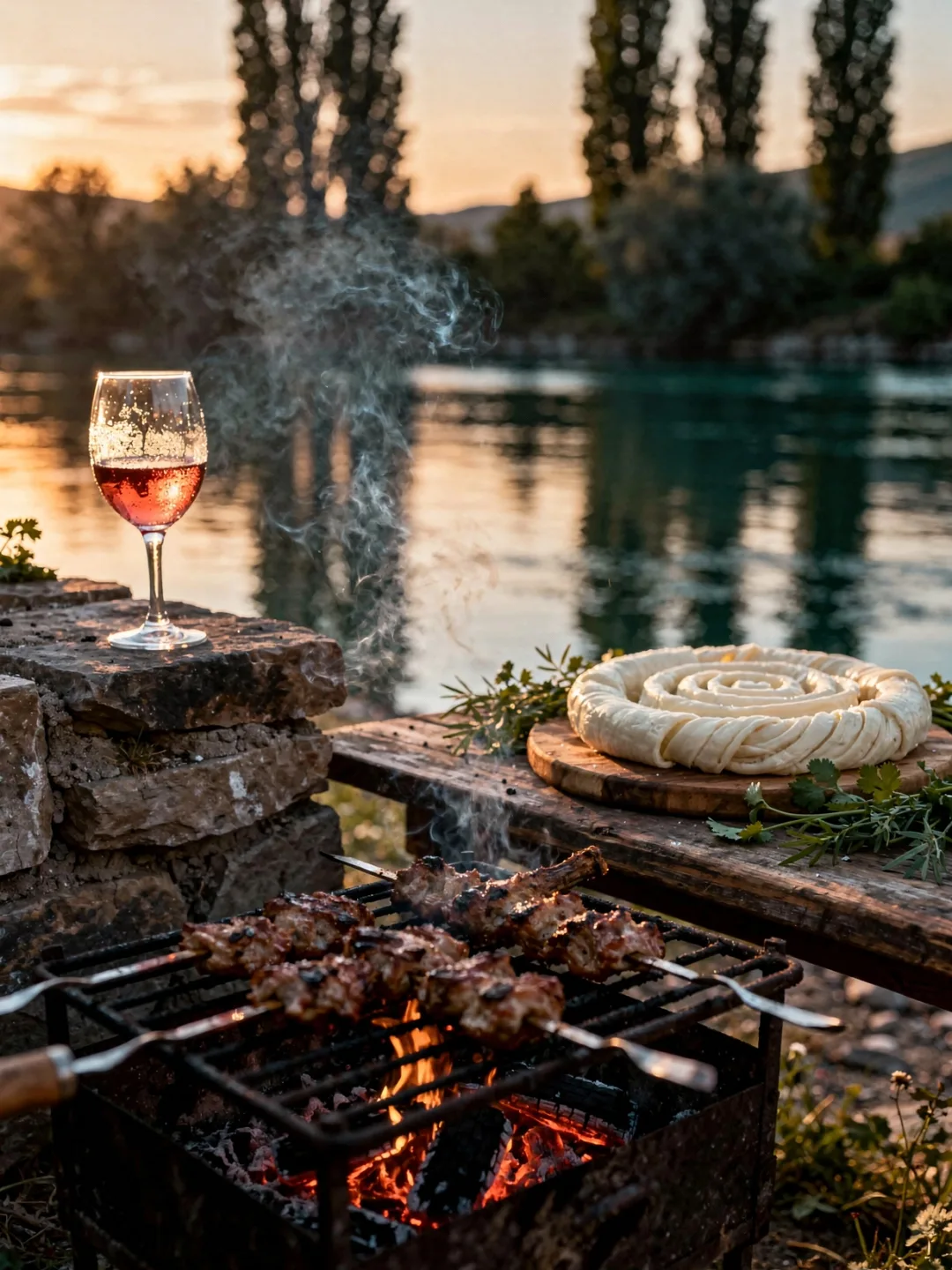
Mtsvadi on the Mtkvari
Wine & Food
Grilling happens along the banks of the Mtkvari. The dish is called mtsvadi: cubes of pork or veal skewered and cooked over glowing, dried grapevine cuttings, which lend the meat a subtly sweet smokiness. The best pairing is Tavkveri, served lightly chilled. Its acidity cuts through the fat without competing with the charred, roasted notes, while a fuller-bodied Shavkapito takes over that role with fattier pork or lamb, when the glass needs a bit more weight.
Khinkali belong to Kartli just as much as to the neighboring highlands. These are large dumplings filled with spiced minced meat and their own broth, which spills out at the first bite. They're eaten by hand — only the twisted knob you hold onto is left uneaten. A young, straightforward Chinuri or a blend with Goruli Mtsvane suits them well: cool, crisp, with little tannin, so it simply washes away the spiced fat of the filling.
Cheese reveals just how well a qvevri Chinuri handles salt. Tenili, a hand-pulled cheese from Kvemo Kartli and neighboring Samtskhe-Javakheti, is stretched until it separates into paper-thin strands — similar to mozzarella, but saltier and more pungent. Salt softens tannin, which is why the otherwise angular grip of Chinuri's tannin suddenly feels smooth alongside Tenili. Milder, younger cheeses, on the other hand, pair better with the simpler Chinuri and Goruli Mtsvane blend.
In the small town of Surami, they bake Nazuki, a sweet bread with cinnamon and cloves — better suited to afternoon tea than to wine. But the orchards of Shida Kartli, brimming with apricots and apples, provide enough natural sweetness to turn a semi-dry Atenuri into a dessert wine, with no outside additions needed. In the end, the same pattern always emerges in Kartli: a simple, often ancient dish meets a wine that seems to have been made for that exact moment at the table.