On a Chinuri
Tasting
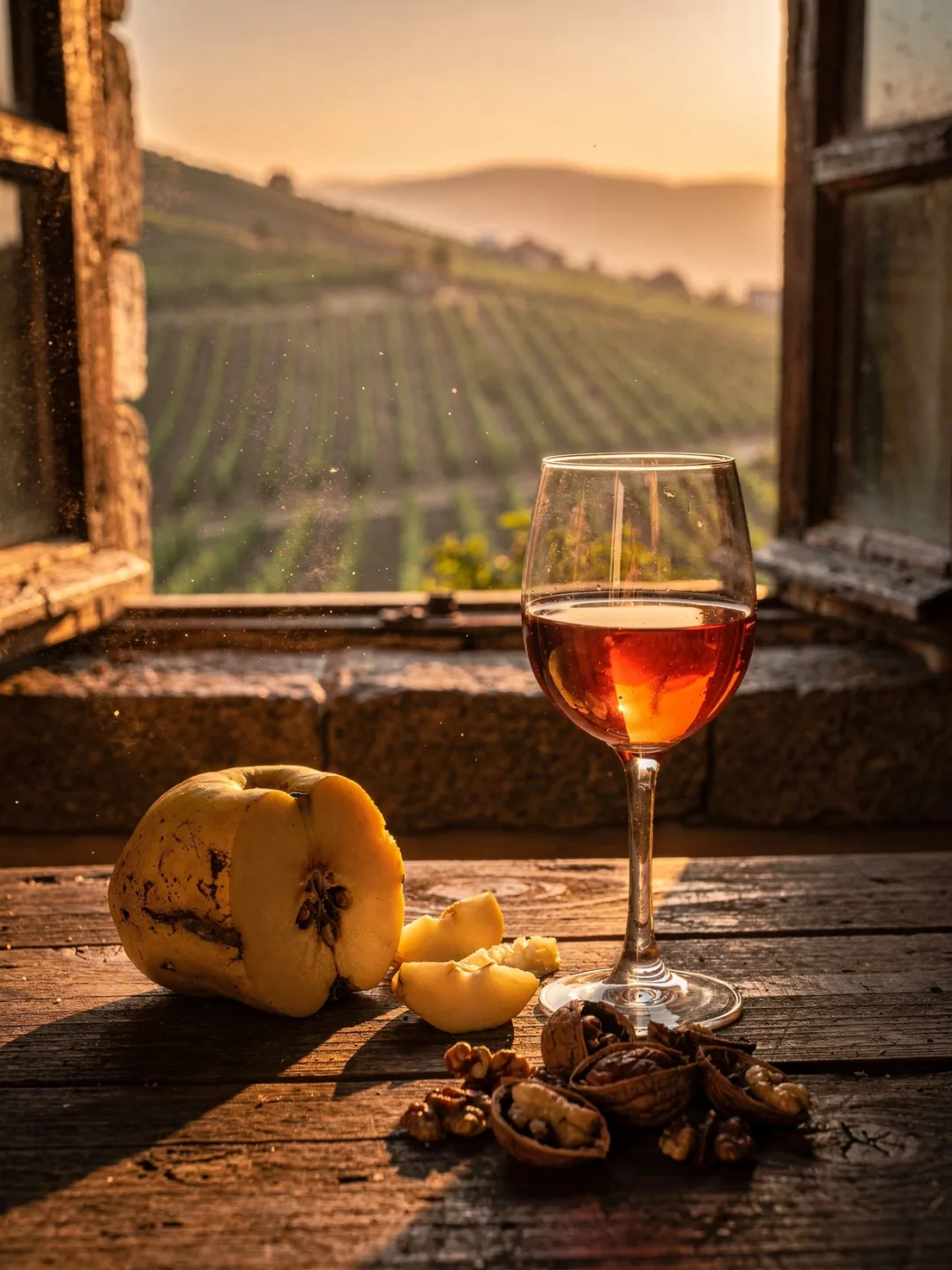
A glass of qvevri Chinuri gives itself away by color alone. It's amber to copper-red, not the pale yellow one expects from a white wine. This color comes purely from extended contact with the skins, not from any additive. A Tavkveri next to it looks almost timid by comparison — pale red, nearly translucent, more like a robust rosé than a red wine.
Smell it twice. In a still glass, a qvevri Chinuri often shows quince, sometimes ripe apple too, with a hint of beeswax — traces of the wax used to seal the clay vessel on the inside. After swirling, something nutty follows, almost like dried walnut, along with a faintly saline note. Shavkapito smells entirely different: cherry, pepper, violet. It lacks that waxy character altogether, since it never matures in clay.
On the palate, Chinuri's tannin is immediately noticeable — unusual for a white wine. It's felt as a slightly drying sensation on the tongue, a result of the long skin-contact time. Alongside it comes an acidity that has barely faded even after months in the qvevri. It's precisely this interplay of tannin and acidity that makes a good qvevri Chinuri a food companion rather than a solo performer. A wine that's too young often still feels angular; only after a year or two in bottle do tannin and acidity round out together.
With Atenuri, the perlage comes first: fine, persistent bubbles that come from genuine secondary fermentation, not artificial carbonation. On the palate, Chinuri contributes its acidity, taut and lively, while Goruli Mtsvane lends some roundness. Finally, count the seconds the flavor lingers after swallowing. With a simple Tavkveri, that's often just a few. With a well-aged qvevri Chinuri, it can be twenty seconds or more — and it's precisely this unusual length that, in the end, separates a mere everyday wine from one you'll still remember years later.