Clay or Steel
Production
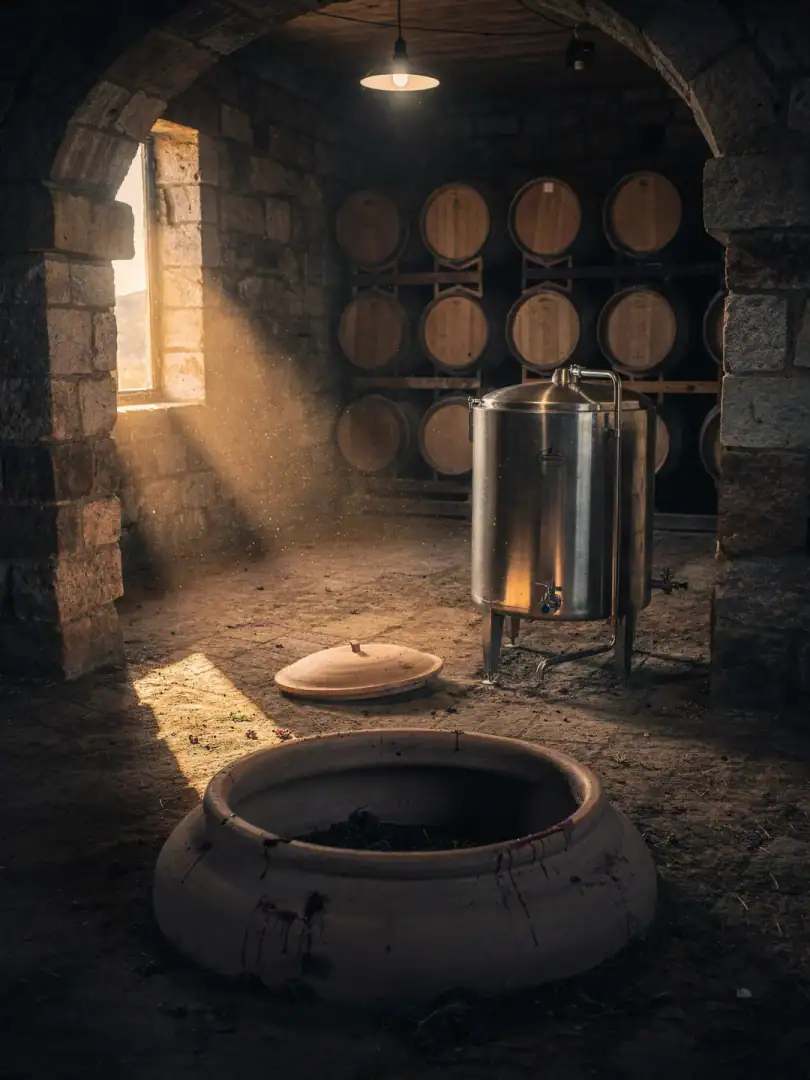
After harvest, grapes destined for a qvevri wine go into the clay vessel whole or only partially pressed. Juice, skins, sometimes even stems and seeds all go in together. In Kartli, the approach stays more restrained. Winemakers often work with roughly eighty percent juice and only twenty percent skins, and fermentation on the skins in most cellars rarely lasts longer than a full three months. This is precisely what sets it apart from a deep amber Rkatsiteli from the east.
Khidistavi takes things even further. There, winemakers ferment the white varieties Goruli Mtsvane and Chinuri on the skins of the red Tavkveri — white on red rather than white on white. The result is a wine with markedly more color and tannin than one would ever expect from an ordinary white grape, yet without the toasty notes that long barrel aging usually brings. It's a technique found only in this one valley.
Making Atenuri, the sparkling wine from Chinuri and Goruli Mtsvane, is an entirely different process. As early as the eleventh century, the village of Ateni is said to have had a royal vineyard whose sparkling wine was considered a drink fit for kings. In the 1950s, the Soviet Union built a proper factory there, producing nine hundred tons a year. It closed after 1991 and only revived after 2010. Two methods are permitted today: classic bottle fermentation in the Champagne style, or the faster tank fermentation known as the Charmat method.
How sweet the finished Atenuri tastes is decided by the dosage — the mixture of wine and sugar added to each bottle after riddling and disgorgement. Some houses keep it minimal and bottle brut. Others deliberately leave more residual sweetness, since Chinuri's high acidity keeps even a sweeter style tasting fresh. A dry Atenuri and an off-dry one, then, often come from the very same base cuvée — only that final addition in the cellar sets them apart.