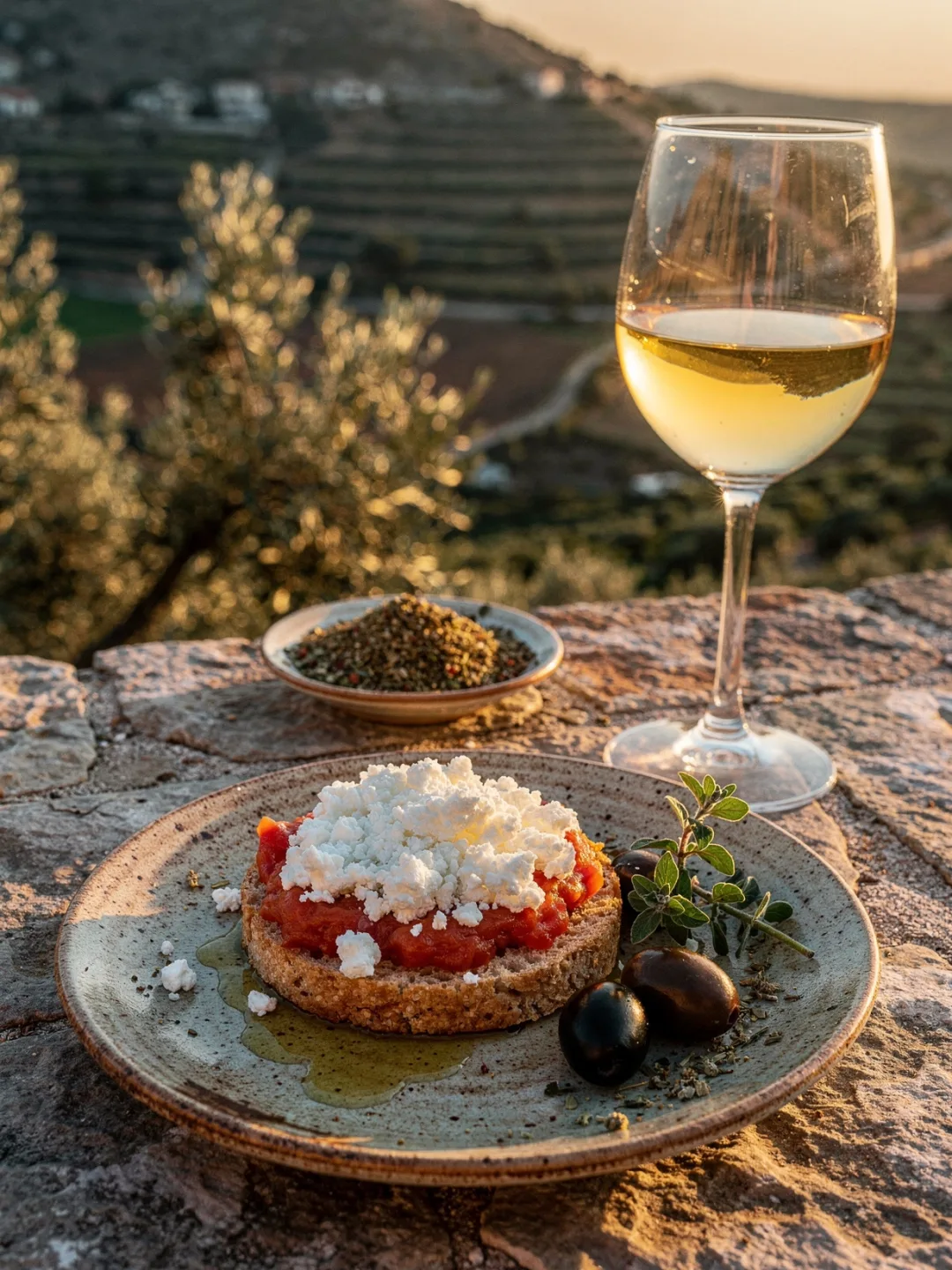
Dakos and Kotsifali
Wine & Food
In the 1950s, American scientist Ancel Keys sent assistants to Crete to find out why people there, despite eating so much fat, rarely died of heart disease, and his Seven Countries Study found the answer in olive oil rather than fat itself, along with plenty of vegetables, legumes, and little meat. Wine was always part of it. It wasn't a side note but the everyday drink with meals.
Dakos shows the principle at its simplest: a dry barley rusk, topped with tomato, crumbled mizithra cheese, and plenty of olive oil. Acidity suits the oil, cutting through it, and Vilana provides exactly that with its citrus freshness. A heavier white wine would just taste fatty next to the oil.
Kalitsounia, small pastry parcels filled with mizithra or wild greens, need more substance in the glass instead. Vidiano's apricot and chamomile notes sit alongside the mild cheese without overpowering it. The fuller body keeps pace with the pastry, which a thin wine would simply overlook.
For hearty dishes, the red blend takes over. Chochlioi boubouristi, snails fried in hot oil with vinegar and rosemary, and apaki, smoked pork with bay leaf, suit both Kotsifali's fruit and Mandilaria's acidity equally well. But with grilled lamb, the quintessential Sunday meal, you need Mandilaria's full tannic power to cut through the fat.
At the end of the meal, wine often gives way to tsikoudia, the Cretan pomace brandy. Those craving something sweet reach instead for sun-dried Liatiko from Sitia or Dafnes. Its fig and raisin notes pair beautifully with almost any pastry made with honey and nuts. Dry red wine alongside something sweet almost always tastes sour and thin, no matter how good the bottle was on its own.