Aspa & Phylloxera
Soils
Dig a hole in a vineyard near Pyrgos, and you'll hit nothing but pale ash. No clay, barely any humus. Instead, you find a loose, almost white mixture of volcanic ash, pumice, and sand that locals call aspa. It blankets the entire island, deposited by the very eruption that also buried Akrotiri.
This poverty of the soil is what saved the island's vines. Phylloxera, which destroyed nearly every vineyard in Europe by the late nineteenth century, needs moist, compact clay to travel from root to root. In the loose, free-draining aspa, it finds no foothold. As a result, Santorini's vines were never grafted onto American rootstock, as is now standard practice almost everywhere else. Some vines have stood on their own roots for over a hundred years.
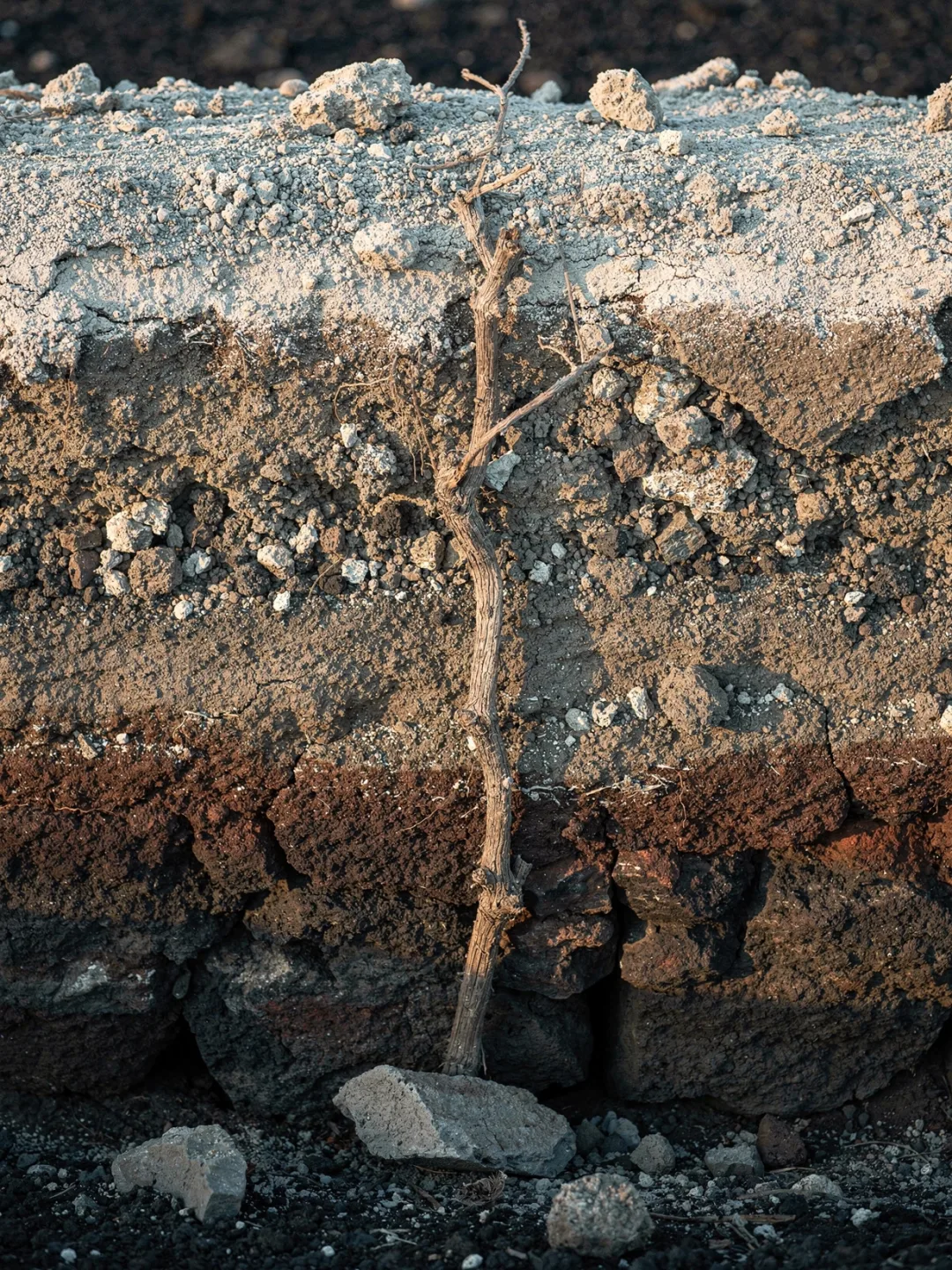
These roots have to go deep. Because Aspa holds almost no water, the vine drives several meters downward in search of moisture. Only in the compacted volcanic tuff does it finally meet rock that still holds a little water, long after everything above has evaporated. It's exactly this long journey that turns an Assyrtiko vine into a tough, undemanding plant.
In the end, what matters most is how little the vine actually produces. Old, unstaked vines sometimes yield just a few hundred grams of grapes for the whole year — tiny, thick-skinned berries with very little juice relative to their skin. A lean soil thus becomes a concentrated wine, not because the earth gives something extra, but because it withholds almost everything.
Fine, loose dust made of ash and pumice grains, almost white, with barely any organic matter.
The root: Here there's almost nothing for a root to hold onto. Wind and sun dry out this layer within hours.