From Akrotiri to Vinsanto
Region & History
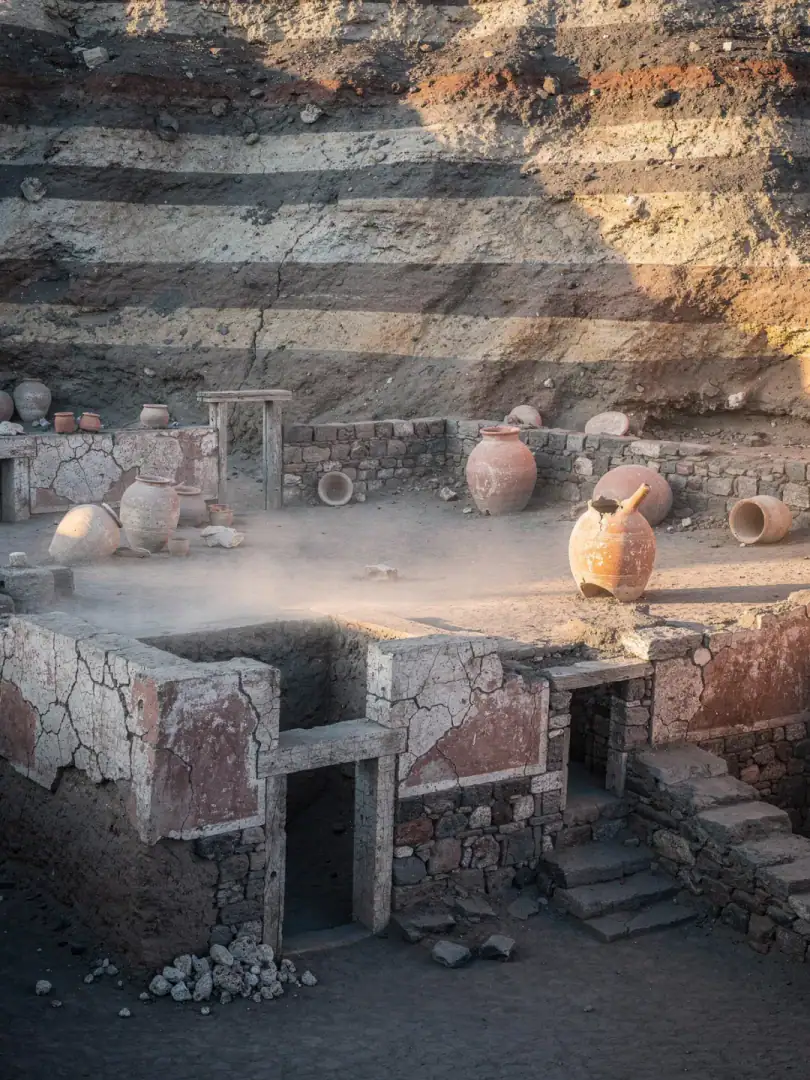
Beneath ten meters of pumice lies a city everyone managed to flee in time. Starting in 1967, archaeologist Spyridon Marinatos excavated a Minoan settlement at Akrotiri. He found three-story houses with frescoes, a drainage system, and storage jars filled to the brim — but not a single human skeleton. Foreshocks had apparently warned the residents, who took their valuables and left behind only furniture, tools, and wall paintings. Then, around 1600 BC, the volcano exploded in one of the most powerful eruptions of the last four thousand years, tearing open what is now the caldera. Among the ash, archaeologists also found grape seeds and vessels with spouts. Wine, it turns out, was being made here long before anyone invented the word sommelier.
The island's current name came much later. In 1207, the Venetian Marco Sanudo founded the Duchy of Naxos from the ruins of Byzantium. He handed Santorini to the Barozzi family, who ruled here until 1480. During this period, the name of a village church, Agia Irini, gradually displaced the ancient name Thera: Santa Irini became Santorini. Venetian merchants shipped the local sweet wine in barrels simply labeled vin di Santo. Over time, that label collapsed into a single word: Vinsanto.
In the eighteenth century, Russia in particular loved this wine. The Russian Orthodox Church bought it by the barrel for liturgical use, and trading ships carried it as far as Odessa. Santorini enjoyed a first golden age in the nineteenth century: vineyard area grew to around four thousand hectares. Then came phylloxera, which destroyed nearly every vineyard in Europe within three decades — except here, because the volcanic ash gave the pest nothing to grip onto. While the rest of the continent replanted from scratch, Santorini's roots stayed exactly as they were, and some vines still bear grapes today on their own roots, over a hundred years old.
In 1971, the island received its own appellation, PDO Santorini, which since then has applied only to white wine. Yet the vineyard area keeps shrinking. From the roughly four thousand hectares of the 1960s, half had already disappeared by 1980, and today only about eleven hundred hectares remain. Hotels pay more for the same land than any wine could ever earn, and what the ash preserved over millennia is now vanishing under concrete within a single generation.