Montepulciano & Pecorino
Grape Varieties
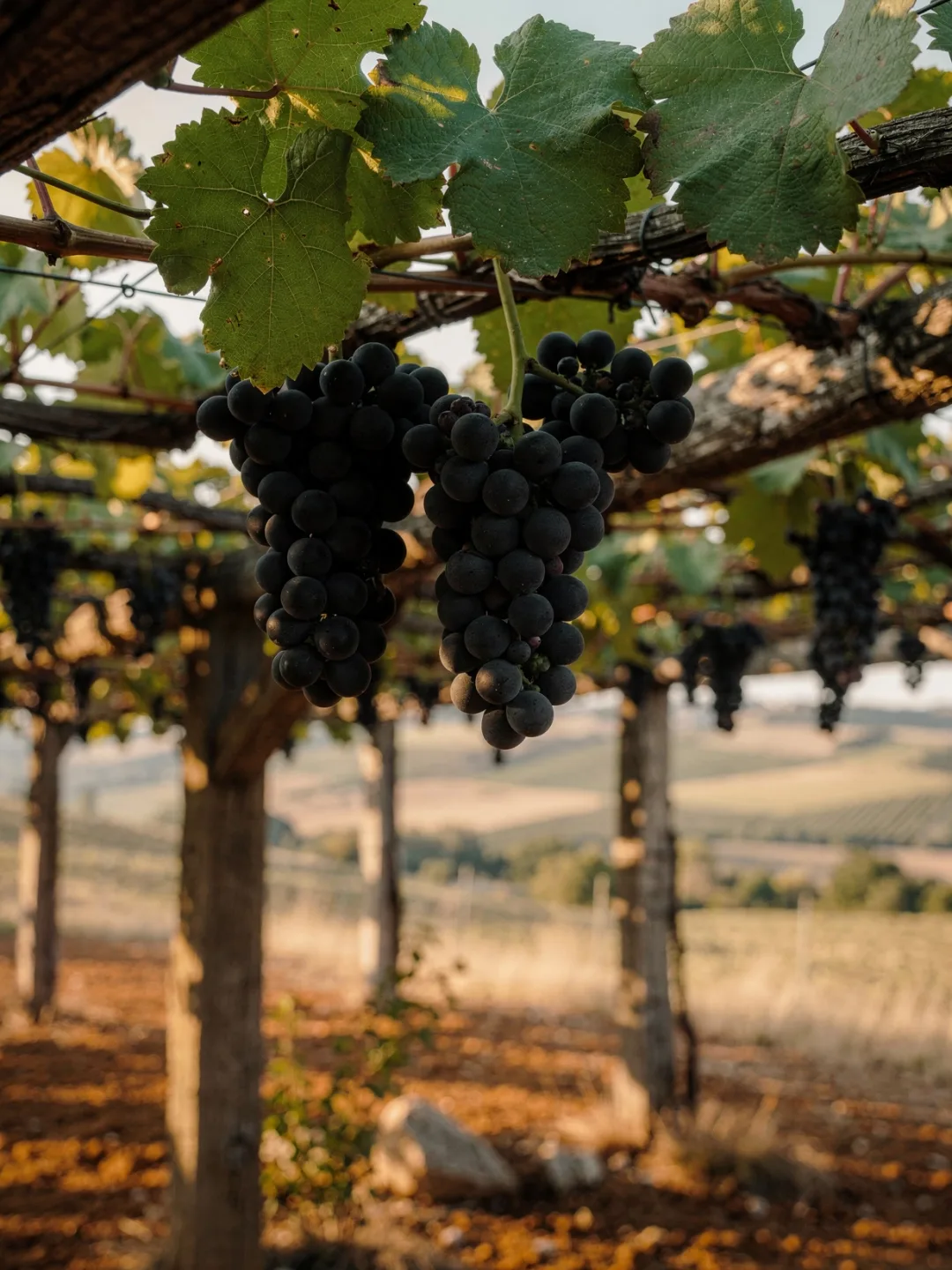
Montepulciano carries the main weight here. The wine is named after the grape, not after the Tuscan town of the same name. The berries are small, thick-skinned, and dark. This yields plenty of color and robust tannin, the rough grip that clings to the gums after a sip. Some labels use the old name Cordisco instead of Montepulciano, meant to ease the endless confusion with Tuscany.
With the white counterpart, the confusion runs even deeper. Trebbiano d'Abruzzo sounds like a regional variant of Tuscan Trebbiano, yet geneticists still disagree on whether the grape is actually more closely related to Bombino Bianco. Since 1994, both clones have been allowed in the same bottle, which has settled the question in practice. In the hands of winemakers like Edoardo Valentini, it nonetheless became one of Italy's longest-lived white wines — dense, almost oily, and still fresh after twenty years.
Pecorino owes its name to the sheep that liked to nibble the sweet, early-ripening grapes on their way to the summer pastures — pecora means sheep. The variety nearly vanished entirely during the vineyard restructuring of the 1970s. It was only in 1983 that winemaker Guido Cocci Grifoni rediscovered a few surviving vines, located in the Marche, near the border with Abruzzo. In 1996, Luigi Cataldi Madonna in Ofena bottled the first wine in Abruzzo whose label explicitly stated Pecorino. Today the variety is considered one of central Italy's most distinctive whites: plenty of acidity, a salty herbal note, with little fruit up front.
Three more white varieties mostly keep to themselves. Passerina comes from the area around Controguerra near Teramo and yields floral, sprightly wines with a slender structure. Cococciola grows in only a few villages of the province of Chieti. In Villamagna, for instance, it produces wines with vivid citrus freshness, often made as sparkling wine too. The most distinctive is Montonico: it grows on the slopes of the Gran Sasso. It has so much acidity that Napoleonic soldiers around 1798 nicknamed it petit champagne, yet it remains largely unknown outside the region.