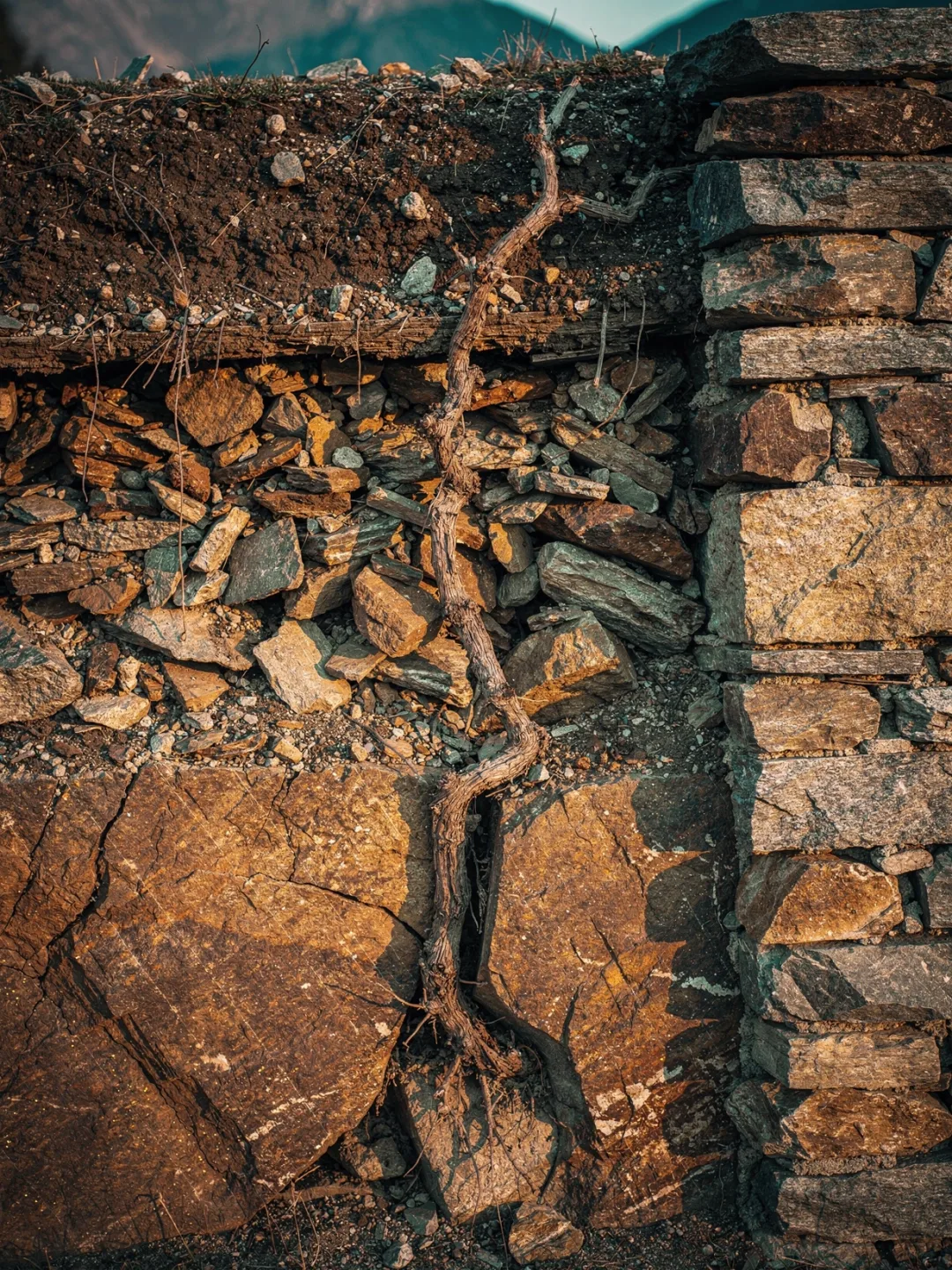
Terraces above Donnas
Soils
Climb into a vineyard above Donnas and look down. You're not standing on natural ground, but on a terrace that human hands piled up centuries ago. Muretti a secco, dry-stacked stone walls, keep the thin soil from sliding down the steep slope.
Beneath this soil, bedrock begins almost immediately. The valley sits in a geologically unusually complex zone of the Alps. As the mountains folded, rock from great depths was pushed up to the surface here: mica schist and gneiss, often rust-brown in color, hard and low in water. Roots that want to go deeper here have to force their way through rock rather than soil.
That's exactly what drives them. Where water is scarce and nutrients are rare, the vine grows downward instead of outward, resulting in small, concentrated berries. A Picotendro from these terraces often tastes denser than many a Nebbiolo from the far more fertile Piedmont, even though the cellar craft behind them is often the same.
Further west, near Morgex and La Salle, the picture changes completely. There, the vineyards sit on sandy, granitic soils found only at the foot of Mont Blanc. This sand is so permeable and low in minerals that phylloxera was never able to gain a foothold here. Prié Blanc therefore still grows ungrafted, on its own roots, to this day—something almost unheard of in Europe.
Between Donnas and Morgex, in the broader middle section near Nus and Chambave, moraine-laden alluvial soils take over instead: gravel and clay, spread by Ice Age glaciers and further sorted since then by the Dora Baltea. Here, Vien de Nus roots deeper than the surface would suggest, finding enough water in this mixture to survive even dry summers.
Hand-piled earth behind the dry stone wall, dark and mixed with rock fragments. Rarely more than a hand's width thick.
The root: This is where the fine roots sit. They draw up whatever the scarce rain brings, and they're the first to dry out.