Pergola over Stone
Production
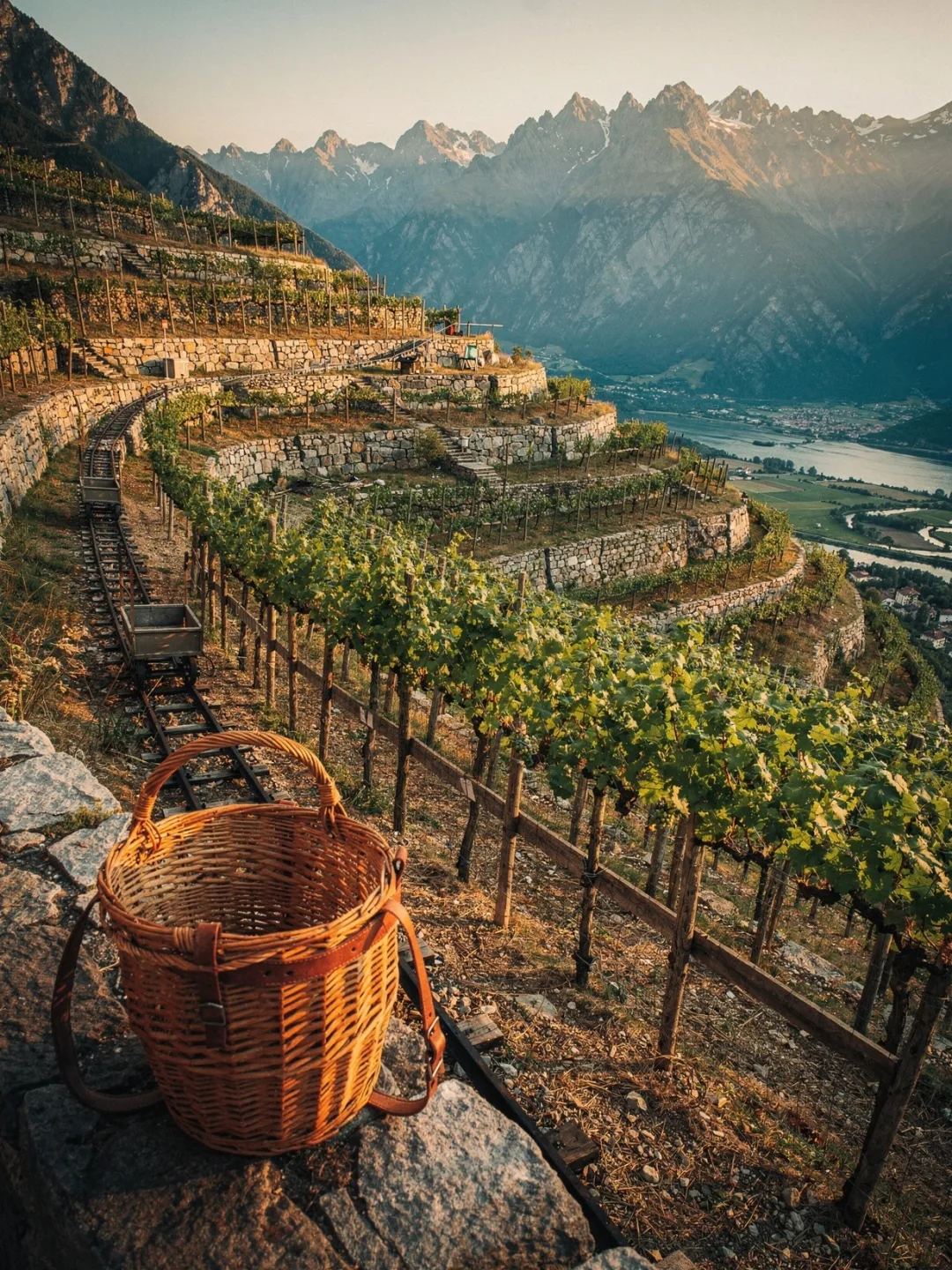
The work here begins with a problem few other regions know: steep slopes where no machine can operate, with gradients over thirty percent common across much of the valley. Workers therefore carry the grapes down to the nearest paths in the gerla, a backpack basket. Some estates even built narrow monorail systems, called monorotaie, for this purpose.
The vine is usually trained on the pergola bassa. This low structure of wood or concrete hangs fifty to a hundred forty centimeters above the ground, spreading the leaves widely over the grapes and protecting against late frost, since warm air rises from the stone ground underneath. It also holds up when snow settles on it in winter.
During fermentation, the valley splits into two worlds. Petit Rouge and Torrette spend noticeably less time on the skins than Fumin, preserving the fruit and making the wine drinkable as early as the following year. Fumin, by contrast, stays on the skins much longer. This lets color and tannin migrate fully into the wine, which only becomes truly approachable after several years in the cellar.
Donnas demands even more patience from Picotendro: at least twenty-four months of aging before release, at least ten of them in wood, quite similar to the rules for Nebbiolo in neighboring Piedmont. With Blanc de Morgex et de La Salle, almost everything runs the opposite way, and fast. The Prié Blanc is pressed without much skin contact and is usually bottled that same winter.
One single winery in the valley, Cave Mont Blanc near Morgex, ferments the Prié Blanc a second time in the bottle, using the traditional method. This produces a sparkling wine with intense mineral notes—an answer to a shortfall, since the grapes, due to the cold above a thousand meters, often reach only low alcohol levels.