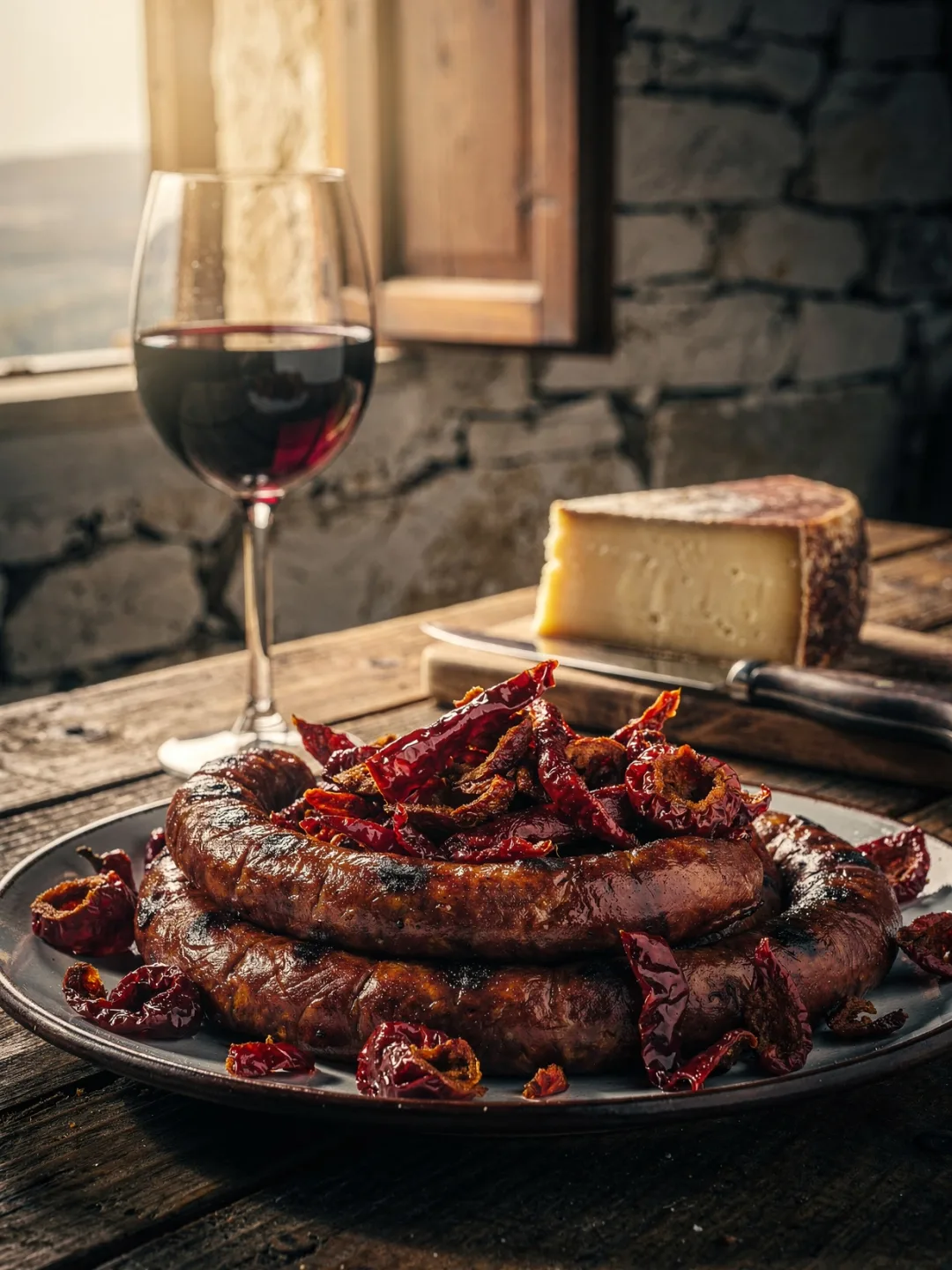
Cruschi and Caciocavallo
Wine & Food
The cuisine of Basilicata is a cuisine of the mountains. It's shaped by pork, legumes, and one ingredient that turns up almost everywhere: dried peppers. A wine with plenty of tannin and plenty of acidity pairs especially well with this. Both cut through fat and smoke rather than being overwhelmed by them.
Peperoni cruschi are the dried, sun-ripened pods from Senise, strung together and then fried until crisp. They're known as the red gold of Lucania. With their slightly sweet, never truly spicy flavor, they're sprinkled over pasta, served alongside Baccalà alla lucana (salted stockfish), or eaten plain as a snack. Their smoky, roasted aroma meets its match in the glass with the dark, similarly smoky notes of a young Aglianico.
Even older is Lucanica, a sausage made from coarsely chopped pork, seasoned with wild fennel and chili. Roman writers such as Varro and Apicius already mentioned it by this name, noting that they had learned the recipe from the Lucanians, the inhabitants of this region. Nearly every European sausage traces its roots back to it in the end. Grilled and rich with fat, it calls for a wine that won't back down: a powerful Aglianico from the Vulture.
With cheese, a second effect comes into play. Caciocavallo Podolico is made from the milk of freely grazing cattle of the ancient Podolica breed. Young, it tastes sweet and buttery; with age, it turns sharp and pungent from the wild herbs the animals graze on. Salt and aging soften hard tannin, which is why a young, still-angular Aglianico suddenly feels approachable next to a mature Caciocavallo. Pecorino di Filiano, a sheep's milk cheese from the mountains west of the Vulture, works on the same principle.
The main course often brings Cutturidd to the table, a slowly braised mutton stew. Tomatoes and potatoes go into it, along with the bulbs of a wild hyacinth called Lampascioni and earthy-tasting Cardoncelli mushrooms. Hours of slow braising make the meat tender and the sauce dense — exactly the texture that calls for a robust, aged Aglianico alongside it, not a light wine that would get lost in it.
To finish, often only bread appears on the table: Pane di Matera. It has a thick crust and a yellowish interior of twice-milled durum wheat semolina, baked to the same recipe for generations. This, too, suits the wine — both are simple, both endure, and both taste of the bare, volcanic earth they come from.