Volcano, Orazio, Albanians
Region & History
Remains of a Roman wine press still lie today in Rionero at Monte Vulture. They were found near that extinct volcano which gives the region both its soils and its most important wine. They show that grapes were already being pressed here some two thousand years ago. Greek settlers likely brought the first vines with them when they landed on the coasts of southern Italy from the eighth century BC onward. The poet Orazio, born in 65 BC in nearby Venosa, later praised the wine of his homeland in his poems. Almost everything here is old.
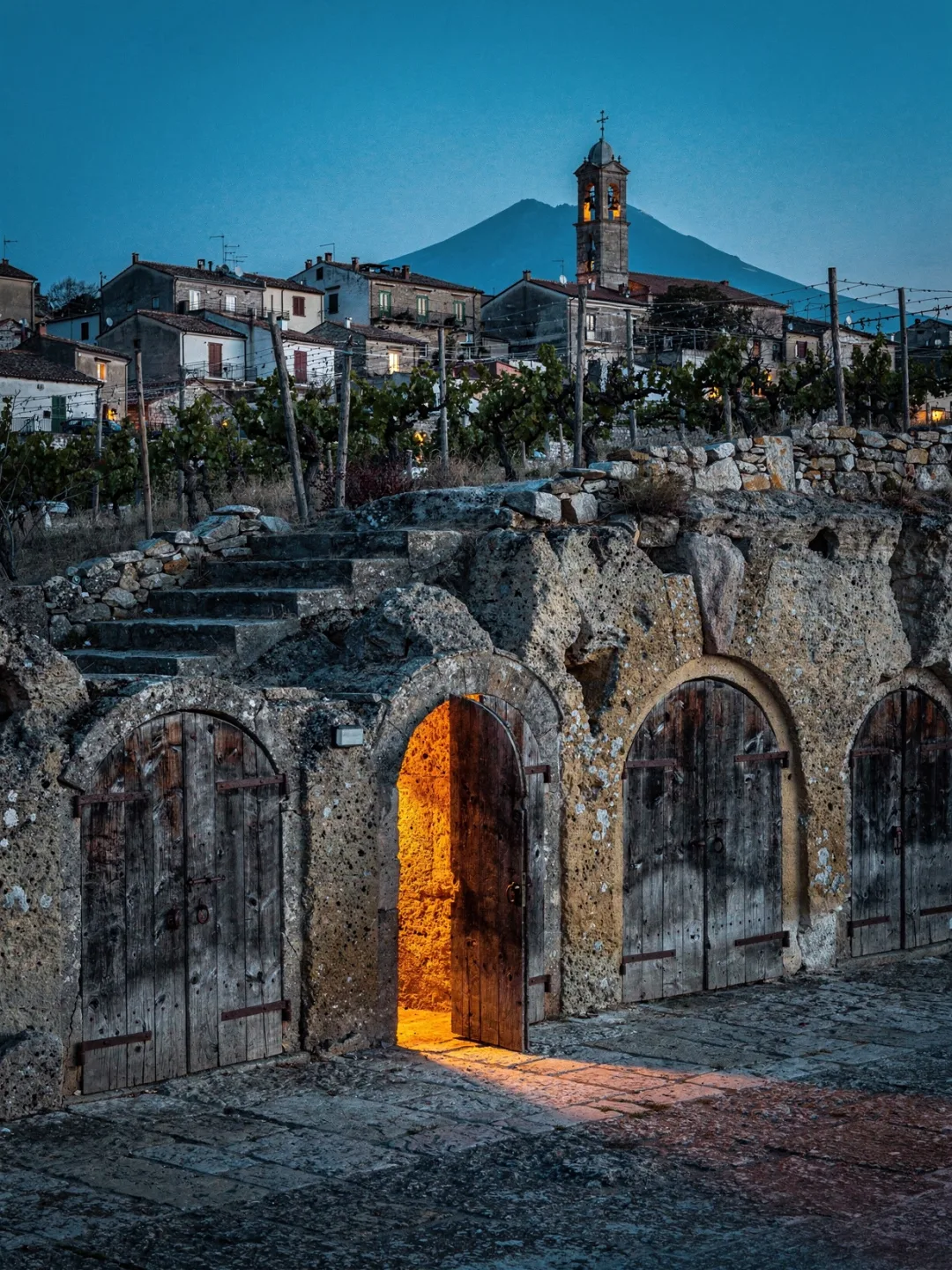
In the nineteenth century came phylloxera, a pest that destroys the roots of vines, and it wiped out large parts of the vineyards around the Vulture too. Recovery took decades. Meanwhile, a different story had already unfolded here back in the sixteenth century. Between 1533 and 1534, Albanians fled the Ottoman conquest of their homeland and founded the villages of Barile, Ginestra, and Maschito at the foot of the volcano. To this day they partly speak their own language, Arbëresh. They worship according to the Greek-Byzantine rite, and beneath their villages they found a stone that could be hollowed out with simple tools: volcanic tuff. In the Rionero area alone, generations of farmers dug more than fifteen hundred such cellars into the rock.
Well into the twentieth century, Aglianico usually left the region in barrels, sold as anonymous blending wine for the north. That changed when the D'Angelo family began bottling wine under their own name in Rionero in the 1920s. Other producers followed. In 1971, Aglianico del Vulture received DOC status, one of the first appellations in southern Italy — the mid-tier of Italy's wine classification system. Nearly forty years later, in 2010, the top version, Aglianico del Vulture Superiore, was promoted to the highest tier, DOCG. Between these two dates lies the real transformation: from bulk wine to sought-after red grown on volcanic soil.
Today many wineries make use of exactly those tuff caves that were once carved out as refuges or storage rooms. In Barile, an entire quarter of such grottoes has become an open-air museum, named after the Albanian word for 'place.' More than a hundred and thirty chambers lie there in the rock, some five hundred years old, and Aglianico still ages in their steady, cool air. Director Pier Paolo Pasolini even shot scenes of his film about the Gospel of Matthew in these very cellars in 1964. What began as emergency shelter has become a winery.