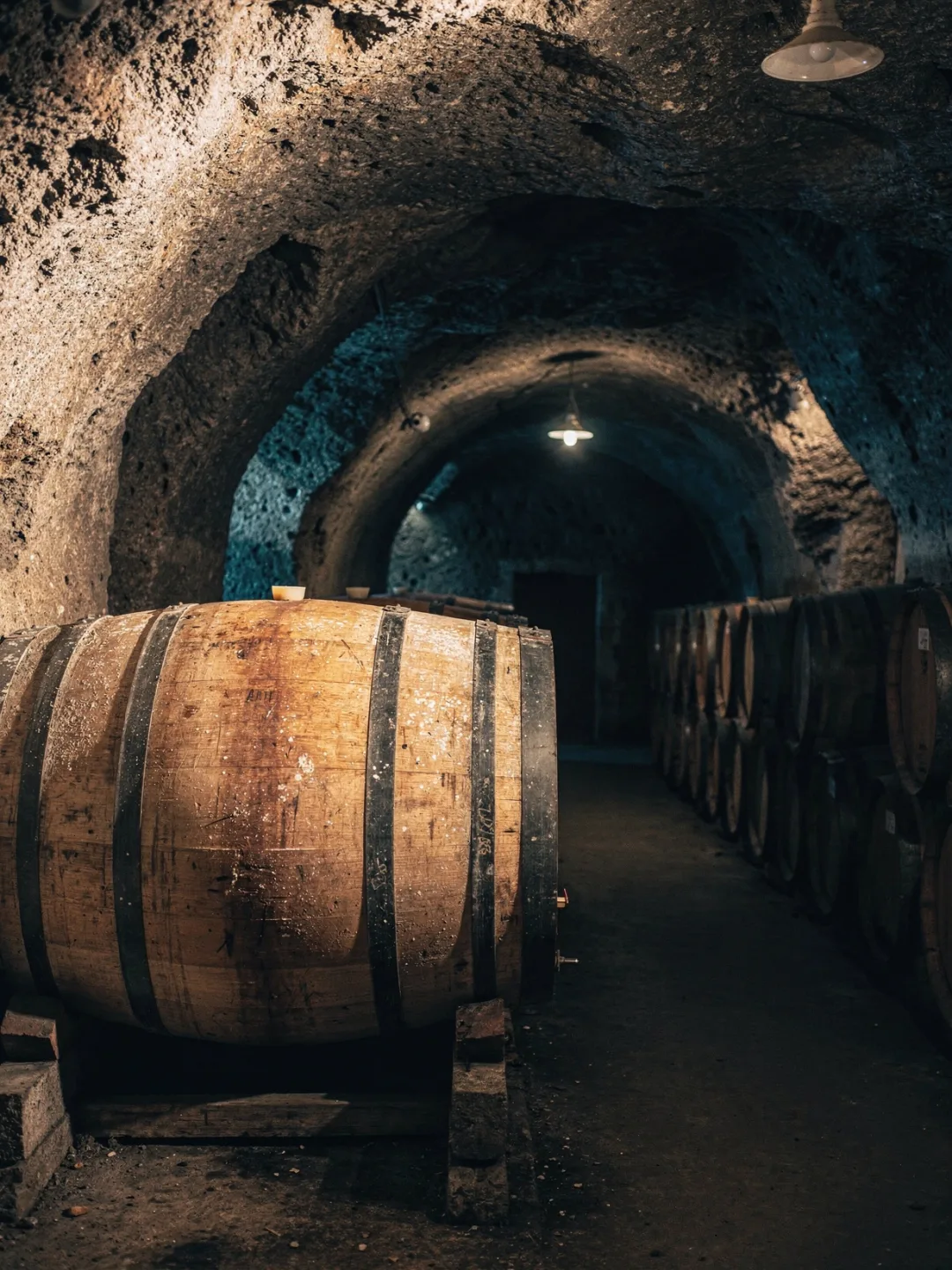
Tuff cellar and barrel
Production
It all starts with color, and that sits entirely in the skin of the Aglianico berry. Press the grapes immediately and the juice stays almost pale; let the skins ferment along with the must, and the wine draws color, tannin, and much of its aroma from them. For Aglianico, this time on the skins typically lasts two to three weeks — long enough to really extract everything from that thick skin.
The rules here are strict. Aglianico del Vulture became a DOC in 1971, one of the very first controlled appellations in all of southern Italy, made almost entirely from the grape variety of the same name. In 2010 the top version, Aglianico del Vulture Superiore, was promoted to DOCG, Italy's highest tier. Yield is capped at eight tonnes of grapes per hectare. From one hundred kilograms of grapes, no more than sixty-five liters of wine may be produced — press more out and you lose the right to the appellation.
The basic DOC tier requires just one year of aging, but at least three for the designation vecchio, two of them in wood. For riserva it's five years, likewise with two years in barrel. Producers in a hurry can sell sooner — but then these additional designations are missing from the label.
Even stricter deadlines apply for DOCG. Aglianico del Vulture Superiore can be sold no earlier than the first of November of the third year after harvest. At least twelve months in wood are required, plus a further twelve in bottle. The Riserva needs at least twenty-four months in barrel and just as long in bottle. It may not reach the market before the first of November of the fifth year — so a wine from 2020 comes onto the market at the earliest at the end of 2026.
Many producers still age their wine today in the very same places their grandfathers used. Generations of farmers dug these cellars into the soft tuff beneath Rionero and Barile. Under Rionero alone lie more than fifteen hundred such grottoes, with steadily cool, humid air that needs no air conditioning. The D'Angelo winery, for instance, ages its wine in an underground vault covering five hundred square meters — technology older than any regulation.