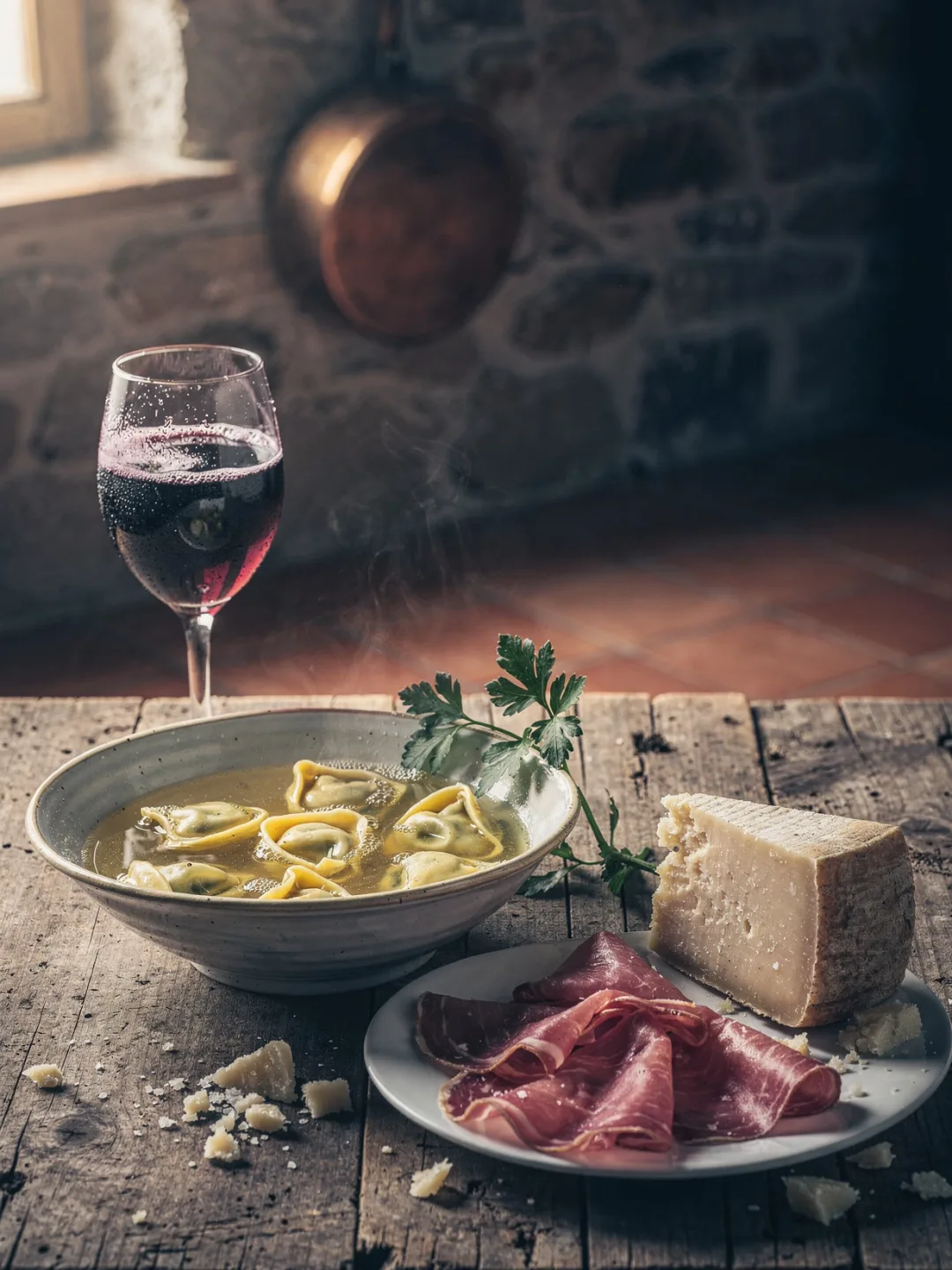
Tortellini and Culatello
Wine & Food
The cuisine between Bologna and Modena is considered one of the richest in Italy. Almost everywhere it rests on the same combination: plenty of fat, plenty of salt. That calls for a wine with carbonation and acidity to cut through both. This is no coincidence — Lambrusco and Emilia grew up together.
With Tortellini in Brodo, cooked in capon broth, or with Tagliatelle al ragù, a light, dry Lambrusco di Sorbara or a young Sangiovese di Romagna usually suffices. Both dishes are already rich enough on their own and don't need a heavy wine alongside them. With Zampone and Cotechino — both stuffed, cooked pork sausages — served with lentils, the classic New Year's Eve dish, the more robust Lambrusco Grasparossa di Castelvetro is the better match. Its acidity slices through the fat like a sharp knife.
Parmigiano Reggiano, aged at least twelve months and often considerably longer, calls for a wine that can catch its saltiness — and the paper-thin slices of Prosciutto di Parma served alongside it demand exactly the same thing. A young Lambrusco works just as well here as a Pignoletto from the hills around Bologna. A few drops of Aceto Balsamico Tradizionale di Modena, aged at least twelve years across a succession of wooden casks, go over the aged cheese. Sweet, sour and syrupy all at once — a single spoonful is enough.
On the coast near Comacchio, eel is what people eat. It comes from the Valli, the lagoons of the Po Delta. A light, barely alcoholic Fortana suits it far better than any heavy red wine. Further inland, Piadina Romagnola — a flatbread cooked on a hot stone — is filled with Squacquerone, a soft, almost creamy fresh cheese, and Culatello di Zibello, that prized cut of ham cured in the mists of the Bassa Parmense. A young, chilled Lambrusco Reggiano, served without much fuss, is the best match.
In November, chestnuts are roasted, and Cagnina di Romagna comes to the table. It's a young, violet-tinged sweet wine made from the Terrano grape, traditionally drunk for just a few short weeks. With Ciambella, the simple ring-shaped cake, or with aged cheese, Albana passito once again proves the perfect match. It's the only wine here with enough sweetness to stand up to even the richest dessert.