Fog, Plain, Hills
Climate
The Po Valley sits like a bowl. Alps to the north and west, Apennines to the south, open only toward the Adriatic. Moisture comes in and settles. That's exactly what shapes the wine here.
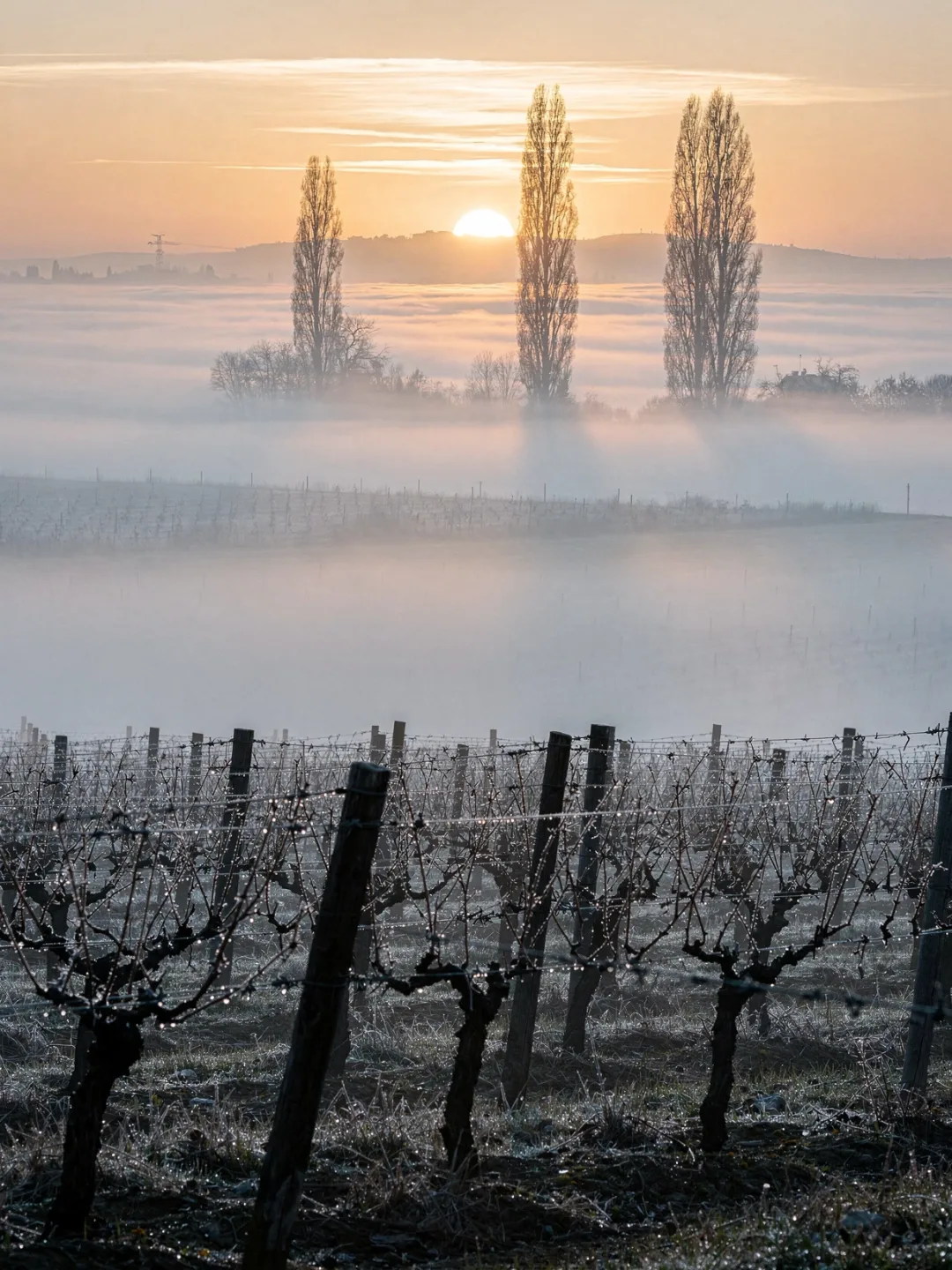
In autumn and winter, this produces the famous Nebbia, the dense ground fog of the Po Valley. On clear, still nights the soil cools faster than the air above it, and water vapor condenses. By morning a white wall hangs over the fields between Modena and Ferrara — sometimes so thick you can barely see the next row of vines. For the grapes, long since harvested, this no longer matters. For the soil it does: the moisture keeps the vines alive through winter.
Summers are the opposite: hot and muggy, with humidity that troubles winemakers in Sorbara and Castelvetro alike. Anyone planting in the plain fights fungal pressure and sluggish nights in which acidity barely drops.
Altitude helps, as it does everywhere. The Sangiovese hills of Bertinoro, Predappio, and Modigliana sit at the transition between plain and Apennines, between a hundred and nearly six hundred meters. There the nights are noticeably cooler than down by the river, and that day–night swing preserves a freshness you wouldn't expect at such a southerly latitude.
On the coast, meanwhile, near Comacchio and in the Bosco Eliceo, the sea moderates both extremes: less frost in winter, but also fewer heat spikes in summer, along with salt-laden wind sweeping over the sandy soils. Three climate zones in a tight space — plain, hills, coast — and from them come three completely different wine styles.