Steel Tank or Amphora
Production
In the cellars of Friuli, two nearly opposite philosophies diverge, and both produce award-winning wines. One aims for maximum control. Grapes are pressed gently, the juice runs off the skins immediately, and fermentation takes place in stainless steel tanks at a cool sixteen to eighteen degrees Celsius. This is how the fresh, clear Friulano and Ribolla Gialla you'll find in nearly every wine bar in the region come to be.
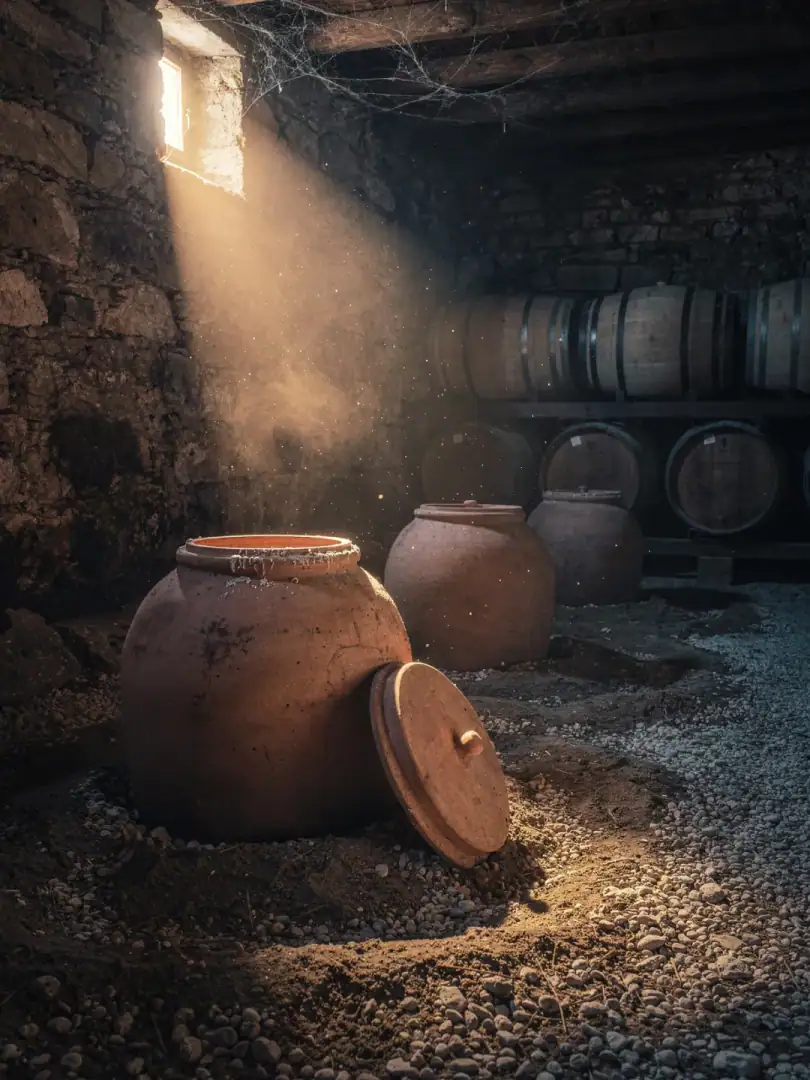
The other philosophy does the opposite. It comes straight from Oslavia. Ribolla Gialla stays in contact with skins and seeds for weeks or even months, ferments spontaneously with wild yeasts, and then often ages in large clay vessels buried in the ground. Josko Gravner began bringing these vessels from Georgia starting in 2000, where they're called qvevri, letting the clay regulate temperature entirely without any cooling technology.
With sweet Ramandolo, the process runs differently still. After the late-October harvest, the Verduzzo grapes are first left hanging on the vine and partly shrivel, before drying further on wooden racks in the cellar. A slow, cool fermentation converts only part of the sugar into alcohol. The result is sweet, but never cloying, thanks to firm tannins from the skin.
Picolit demands the same patience, with an added challenge. Because so many of its blossoms fail to set fruit anyway, the vines carry very few grapes. The few that do ripen are further hand-selected and dried. A single hectare often yields only a fraction of what a normal vineyard would produce.
With the reds, finally, time in wood matters most. Refosco usually ages in large used barrels that give off little aroma and simply round off its strong acidity. Pignolo, on the other hand, with its thick skin and firm tannin, can handle smaller barriques as well, and often needs three to four years before it's even drinkable.