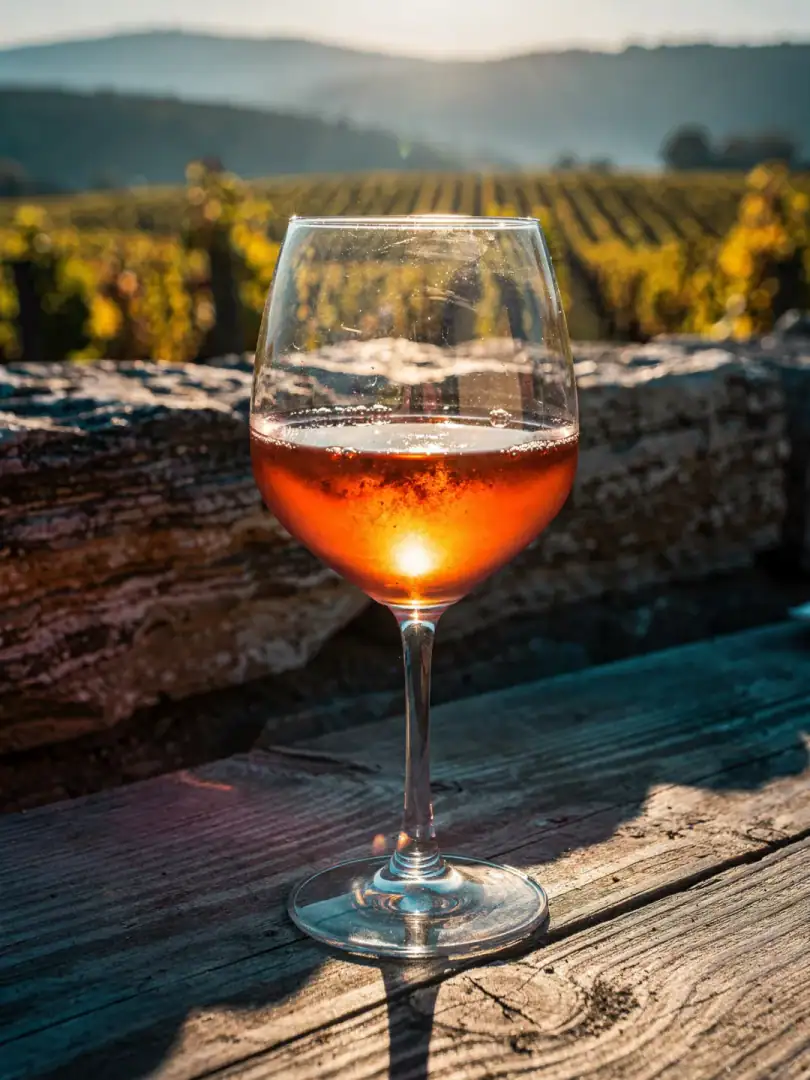
Amber in the Glass
Tasting
Take a glass of Ribolla Gialla made as orange wine and hold it up to the light. The color instantly reveals what happened in the cellar: not the yellow of an ordinary white wine, but a warm amber to copper hue, sometimes almost like a pale sherry. That comes entirely from the weeks spent on the skins, not from age, not from oak.
Smell it first, without swirling. Dried apricot usually comes forward first, followed by a touch of honey, and if you pay close attention, you'll catch a hint of black tea too. After swirling, a second layer opens up: nuts, a little orange peel, sometimes a smoky note from contact with the amphora's clay. None of this exists in a classic white wine.
In the mouth, texture is the first surprise. A normal white wine feels smooth; this one has noticeable tannin, a slightly drying grip on the tongue that you'd otherwise only associate with red wine. The acidity is still there, felt along the sides of the tongue. Together, both qualities make the wine feel weightier than any Friulano from a steel tank.
If you're tasting a classic Friulano instead, pay close attention to the finish. Fruit and floral aromas fade quickly after swallowing. What lingers is a bitter almond note that clings to the palate, not a flaw or a sign of unripe grapes, but the signature mark of the variety. Without that bitterness, it wouldn't be true Friulano.
In the end, it's worth comparing both wines side by side, ideally from the same estate. It shows just how much a single decision in the cellar can transform the character of a grape. The same Ribolla Gialla, once young and sharp as a lemon, once amber-colored and tannic like tea steeped too long.