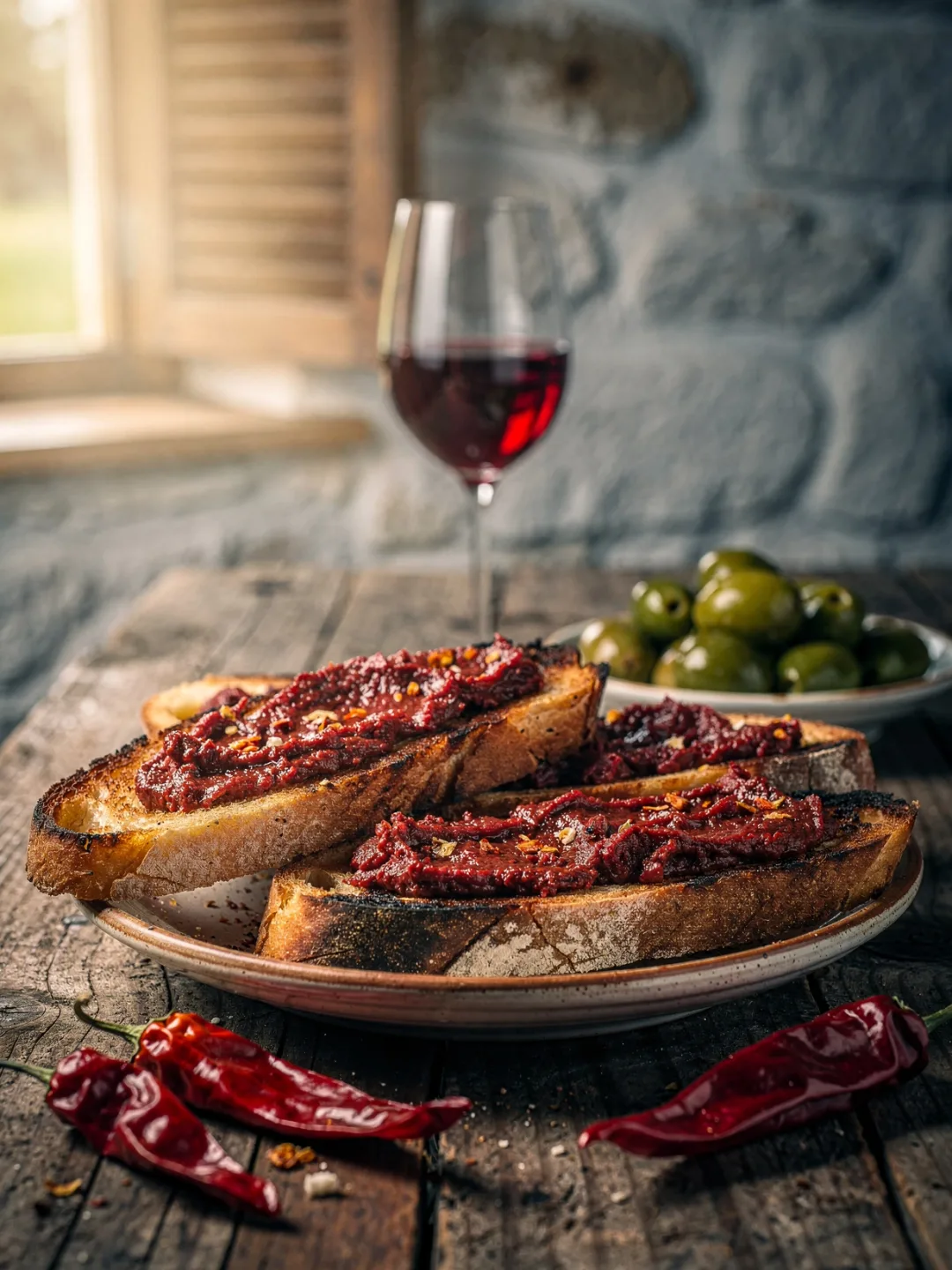
'Nduja and Stocco
Wine & Food
Calabrian cuisine is fiery. That's no accident, but climate: in the heat, chili was easier to preserve than fresh meat, and out of this necessity grew an entire culinary culture. The wine to accompany it always had to be robust enough to stand up to heat and fat without disappearing itself.
'Nduja from Spilinga is the most famous example. This spreadable pork sausage is so packed with chili that it needs no preservatives at all. A young Cirò Rosso, firm in tannin and high in acidity, is the classic answer. It washes fat and heat from the tongue instead of being overwhelmed by them—exactly what Gaglioppo is built for.
Along the coast between Bagnara and Scilla, swordfish are still hunted today. A felucca serves as a lookout perched on a tall mast, paired with a small rowboat for the harpoon—a technique almost unchanged since antiquity, now protected as cultural heritage. Grilled swordfish from the Stretto di Messina calls not for a heavy red but rather a Cirò Rosato or a dry Cirò Bianco made from Greco Bianco: light enough for the fish, salty enough to echo the sea nearby.
Another dish reveals Calabria's other side—the mountains rather than the sea. Stocco alla mammolese takes its name from the town of Mammola. Dried stockfish is braised for hours with potatoes, red onions from Tropea, olives, and capers in a clay pot. This calls again for a Gaglioppo, though a somewhat more mature one this time. Salt and the mild sweetness of the Tropea onion soften its tannin, much as salt does with cheese.
To finish, the sweet counterpoint: Greco di Bianco, the passito from the coast near Reggio Calabria, with notes of honey, apricot, and almond. It pairs beautifully with pastries flavored with citrus zest. Ideally, a touch of bergamot joins in—a fruit that grows almost exclusively along this coast. A dry wine would seem thin and sour next to such sweetness. The passito, by contrast, carries it effortlessly—sweeter than the dessert itself, as it should be.