Gaglioppo & Relatives
Grape Varieties
One variety carries almost the entire red-wine weight here. Gaglioppo covers more vineyard area than any other grape in Calabria and grows almost exclusively here — elsewhere in Italy you'll find it, at most, in scattered experimental plots. It stands thickest along the central and northern Ionian coast, precisely where Cirò lies.
For a long time, the story went that Gaglioppo was a gift from the ancient Greeks, brought over from the Aegean more than two thousand years ago. A DNA analysis from 2010 disproved this. Using fifty-two genetic markers, researchers found that Gaglioppo is a cross between Sangiovese and the white variety Mantonico. Both are Italian, not Greek imports. The myth was lovely. The truth is more Italian than anyone thought.
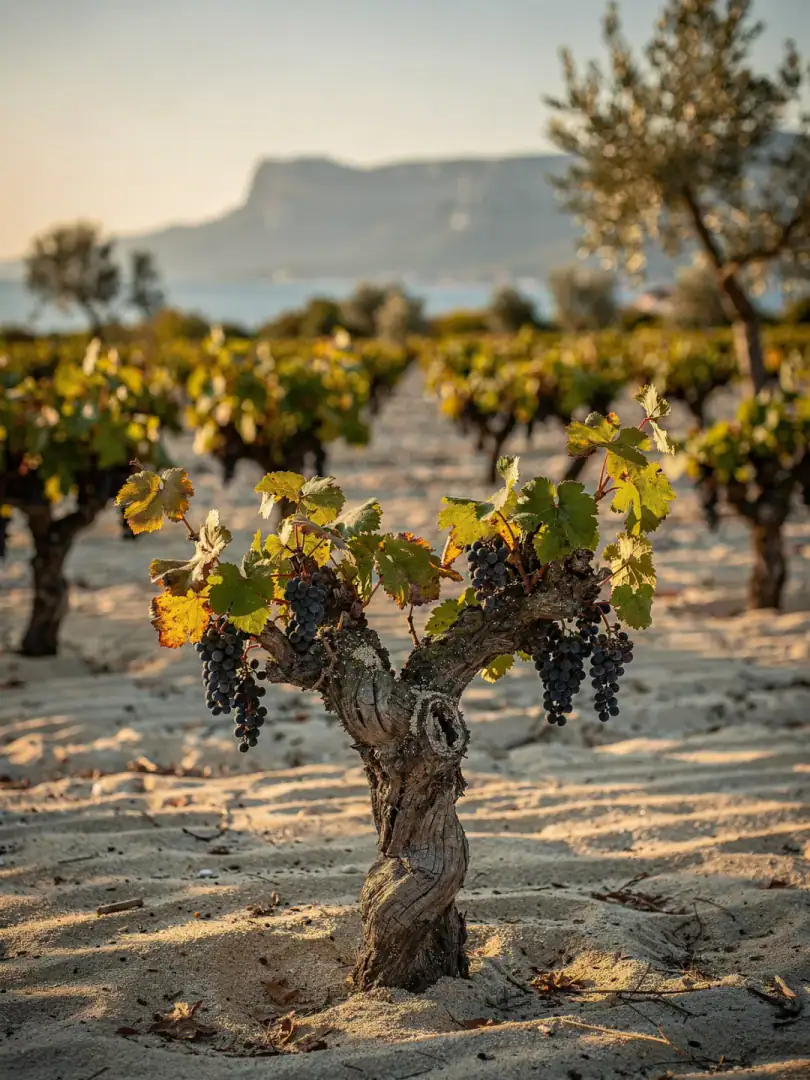
In the vineyard, Gaglioppo ripens late, often not until the end of September or early October. Small, thick-skinned black berries retain surprisingly high acidity even in hot years. In the glass it appears pale for a red wine, ruby with a tinge toward garnet, while the palate promises the opposite: warm, dry, with firm tannin. Cherry and pomegranate rise on the nose, along with dark spices, violet, and a balsamic note reminiscent of bay leaf.
A small family of relatives surrounds Gaglioppo. Magliocco Canino, found mainly on Calabria's Tyrrhenian side, delivers deeper color and more power there. Magliocco Dolce, also known as Arvino in the Cosentino, grows in the Crati valley and yields softer, dark-berried wines with sweet spice. Greco Nero rounds out the family. For the new Cirò Classico DOCG, Magliocco and Greco Nero together may make up no more than ten percent of the blend. No more than that — the rest must remain Gaglioppo.
On the white side stands Greco Bianco, named after the Greek colonists who, according to tradition, brought it along in the seventh century BC. It is the source of the Passito of Bianco, a town on the coast near Reggio Calabria. The grapes are partially dried after harvest before fermentation, yielding a sweet, concentrated white wine. Mantonico, the quiet father of Gaglioppo, is also made into its own Passito, though it usually remains in the shadow of its famous offspring.