Between Two Seas
Climate
Calabria is narrow. At its narrowest point, the Istmo di Catanzaro, only about thirty-five kilometers separate the Tyrrhenian coast from the Ionian. Yet two entirely different climate zones lie between them. To the west, toward the Tyrrhenian Sea, damper air brings milder summers and more rain. To the east, toward the Ionian Sea, conditions turn drier and hotter — and it's exactly there, on the Ionian side, that the heart of Gaglioppo cultivation lies.
Between the two rises the Sila, a high plateau of dense forest that climbs to 1,928 meters at Monte Botte Donato. Up here a moderate-to-cool climate prevails, quite unlike the coast below. Average annual temperature runs only between seven and twelve degrees Celsius. In the warmest month it averages sixteen to twenty-one degrees, in the coldest just two to three. For vines, that's really too cold. Almost everywhere.
Almost — because in Longobucco, at a spot called Cava di Melis, sits Europe's highest vineyard at 1,300 meters. Winters there bring temperatures down to minus twenty-five degrees. In summer, daytime heat exceeds thirty degrees, while nights drop to just three — an extreme site. The vine struggles for every drop of sugar there, but in return it holds on to acidity and aroma at a concentration lower-lying vineyards never reach.
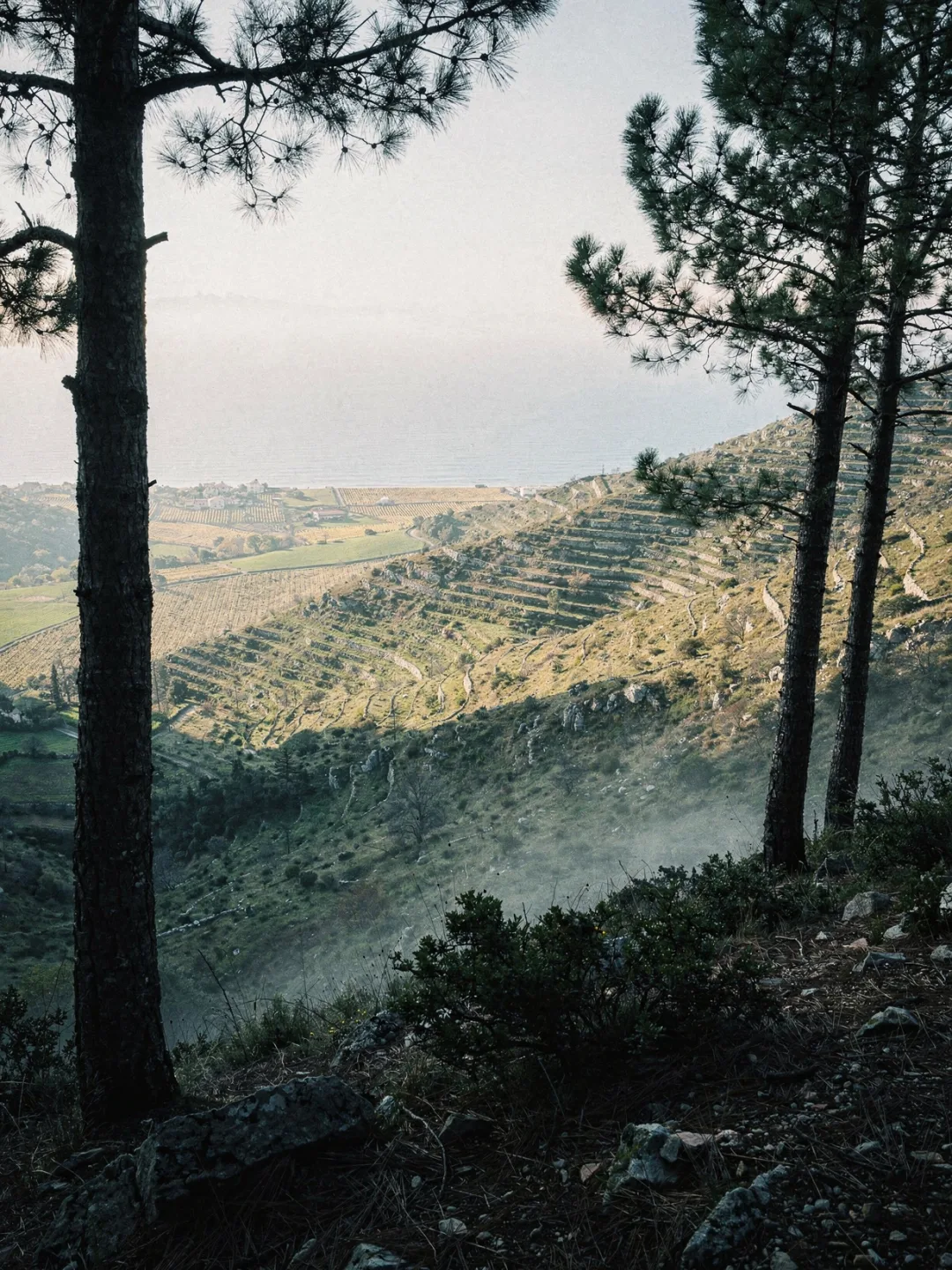
On the Ionian coast, where Cirò lies, the picture looks different again: hot, dry summers, mild winters, hardly any risk of frost. Yet the hills between coast and Sila foothills capture enough elevation to let Gaglioppo ripen slowly instead of scorching in the heat. It's precisely this delay — late ripening despite a hot site — that preserves the wine's acidity. After all, the sun here is far more intense than in, say, northern Italy.
Climate change is shifting this balance too. Summers like that of 2026 already count as exceptionally hot and dry in Calabria. Harvest now begins earlier than it did twenty years ago. Winegrowers in the Cirotano are responding by replanting higher-altitude parcels and returning to the old bush-vine pruning method, which shields the vine from evaporation. What has always held true on the Sila — altitude as protection against heat — is now becoming a strategy on the coast as well.