Pesto and Acciughe
Wine & Food
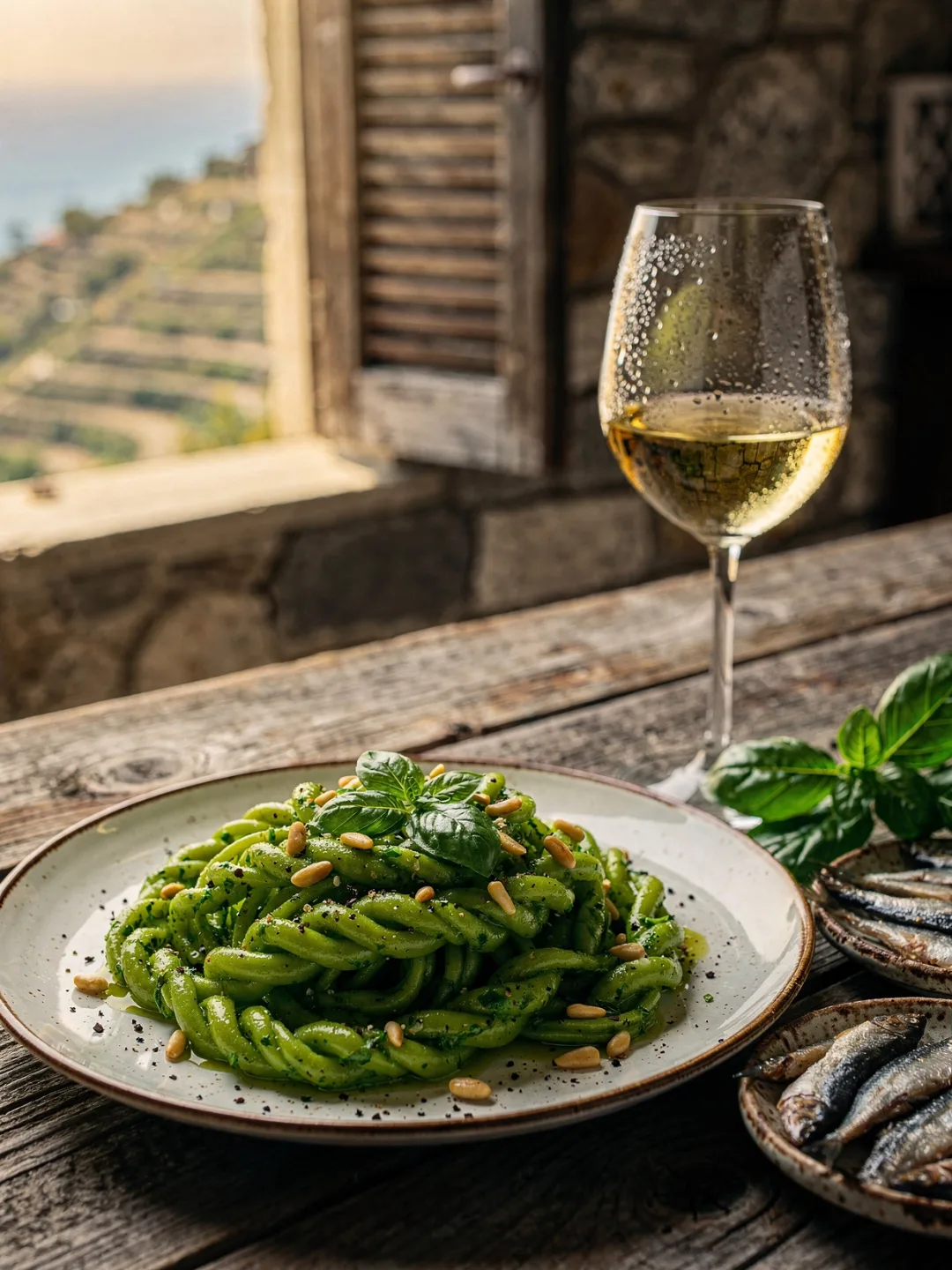
When someone in Genoa talks about pesto, they mean a specific motion: turning, not chopping. Since 2005, Basilico Genovese has been protected EU-wide as a DOP. In a stone mortar, it's crushed and turned together with garlic and pine nuts — chopping or blending instead destroys the fragrant oils in the leaf veins. Only afterward do Parmigiano, Sardinian Pecorino, and olive oil get added. A heavy wine doesn't suit this aroma. A Pigato or Vermentino works better, its own herbal note mirroring the basil rather than masking it.
The pesto is usually served over trofie, small twisted pasta shapes. Their name comes from the Ligurian strufuggià, to rub, just as the dough is twisted between the palms. This cuts through the oil in the pesto. Just as with fish, the salty acidity of Pigato keeps the palate from feeling heavy after the second forkful.
Quite different, yet equally typical, is Focaccia di Recco, registered EU-wide as an IGP since 2013. Two paper-thin sheets of dough enclose a soft fresh cheese, usually Crescenza or Stracchino, and are baked in the oven until crisp, with the cheese almost oozing out. Vermentino suits this better. Its acidity balances the fat of the cheese without pushing the herbal note to the forefront, unlike Pigato.
Along the coast, much revolves around the acciuga, the anchovy. Off Monterosso, fishermen still catch them at night to this day. They use the lampara, a light source that makes plankton glow and lures the fish, right by the cliffs of the Cinque Terre. Once salted, the anchovies mature for weeks in earthenware vessels and are known in the old dialect as u pan du ma, the bread of the sea. A dry Pigato holds up effortlessly against the salt, while a heavy red wine wouldn't stand a chance.
With meat dishes like Cima alla Genovese, a veal breast stuffed with egg, peas, and marjoram, Rossese is the better match. It has enough acidity to cut through the richness, yet too little tannin to overwhelm the delicate flavors of the filling. To finish, Sciacchetrà goes into the glass. Dense, sweet, and the only wine at this table, it waits just as patiently as the dish it accompanies, whether dried fruit or a slice of chestnut cake.