Granite & Dry Stone Walls
Soils
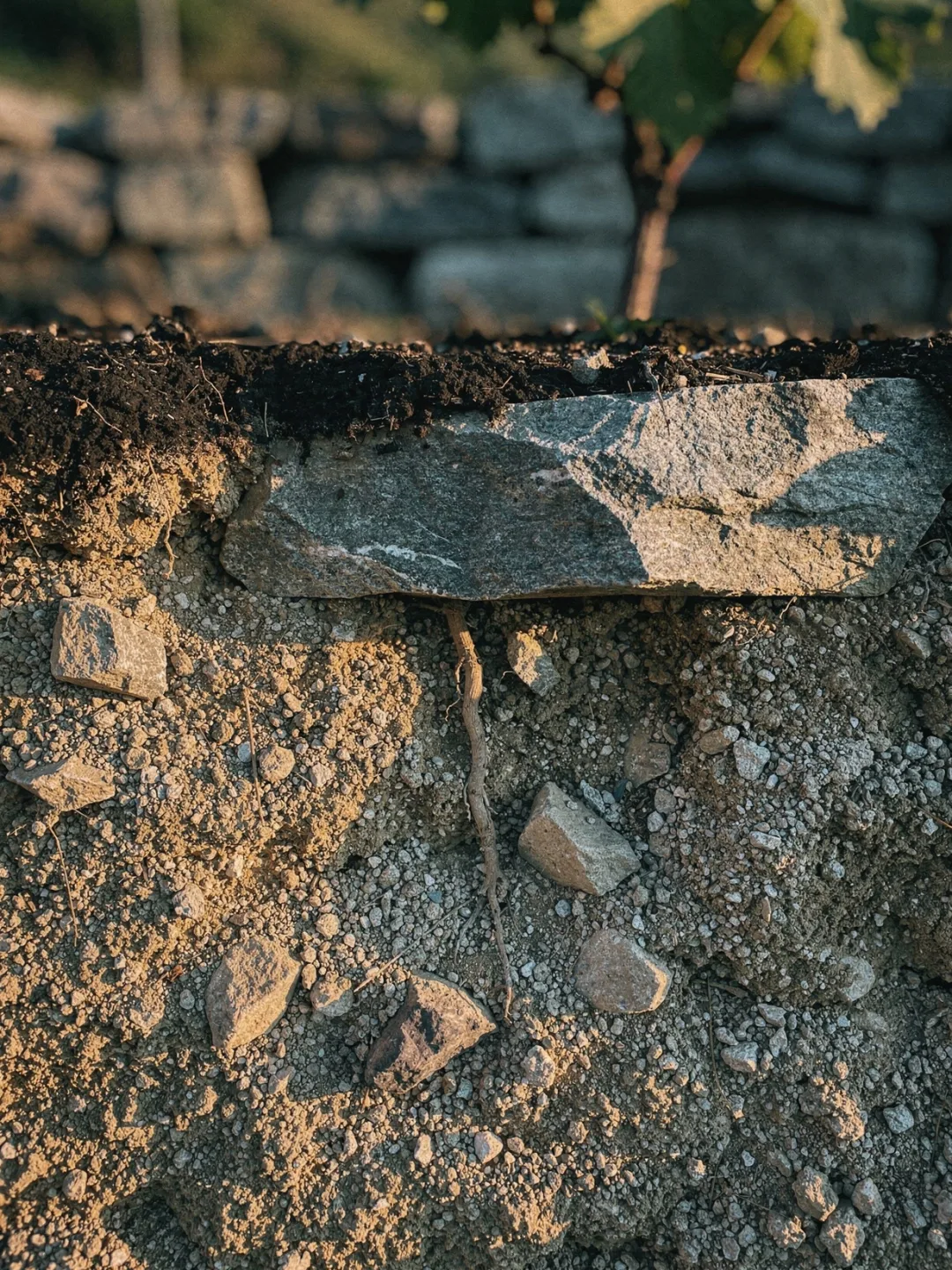
Dig a hole in one of Valtellina's terraces, and you won't get far. After just a handful of soil, the shovel hits pale, grainy rock: weathered gneiss and granite that has been crumbling into coarse sand here for thousands of years.
This sand is almost devoid of nutrients. Water drains through quickly, with hardly anything retained. The vine's roots must therefore dig deep into the cracks of the rock just to find anything at all. This very effort is what ultimately concentrates the aromas in the berry, since a stressed vine bears less fruit, but denser fruit.
For vines to grow on this steep, rocky slope at all, generations of winegrowers have built terraces and supported them with dry stone walls — no mortar, just stone upon stone. Over 2,500 kilometers of these walls now wind through the valley. That's enough, by the numbers, to stretch all the way across Italy and back. They do more than just hold up the slope: during the day the stones store heat and release it to the roots at night.
At Lake Iseo, an entirely different story lies beneath the surface. Twelve thousand years ago, a glacier pushed rubble, gravel, and clay together into a broad ring of moraine hills, mixed in colorful disorder and without the orderly layers of normal soil. In Franciacorta, nearly every vineyard carries this blend of limestone, sand, and rounded gravel.
So there are two soils here, two entirely different origins. One, in Valtellina, is rock only just beginning to break down into sand. The other, at Lake Iseo, has long since broken down and been pushed across the land by a glacier. Both force the vine to work hard, just in very different ways.
A thin, dark layer of decomposed leaves, root remnants, and the little soil that the terrace walls manage to hold back.
The root: This is where the fine roots sit. They take whatever the rain happens to bring — and on the terrace, that isn't much.