Drying and Bottle Fermentation
Production
At Lake Iseo, the work in the cellar begins just as it does in Champagne. A still base wine made from Chardonnay, Pinot Nero, and Pinot Bianco is blended with sugar and yeast and bottled. The bottle is then sealed, and the second fermentation — the one that actually creates the sparkle — takes place entirely inside that bottle, which is why it's called the Metodo Classico.
Then comes the waiting. Every Franciacorta must rest on its own lees for at least eighteen months before it can be sold. A Millesimato from a single vintage needs at least thirty months, a Riserva as much as sixty. During this time, the dead yeast slowly releases its aromas: bread, pastry, roasted nuts.
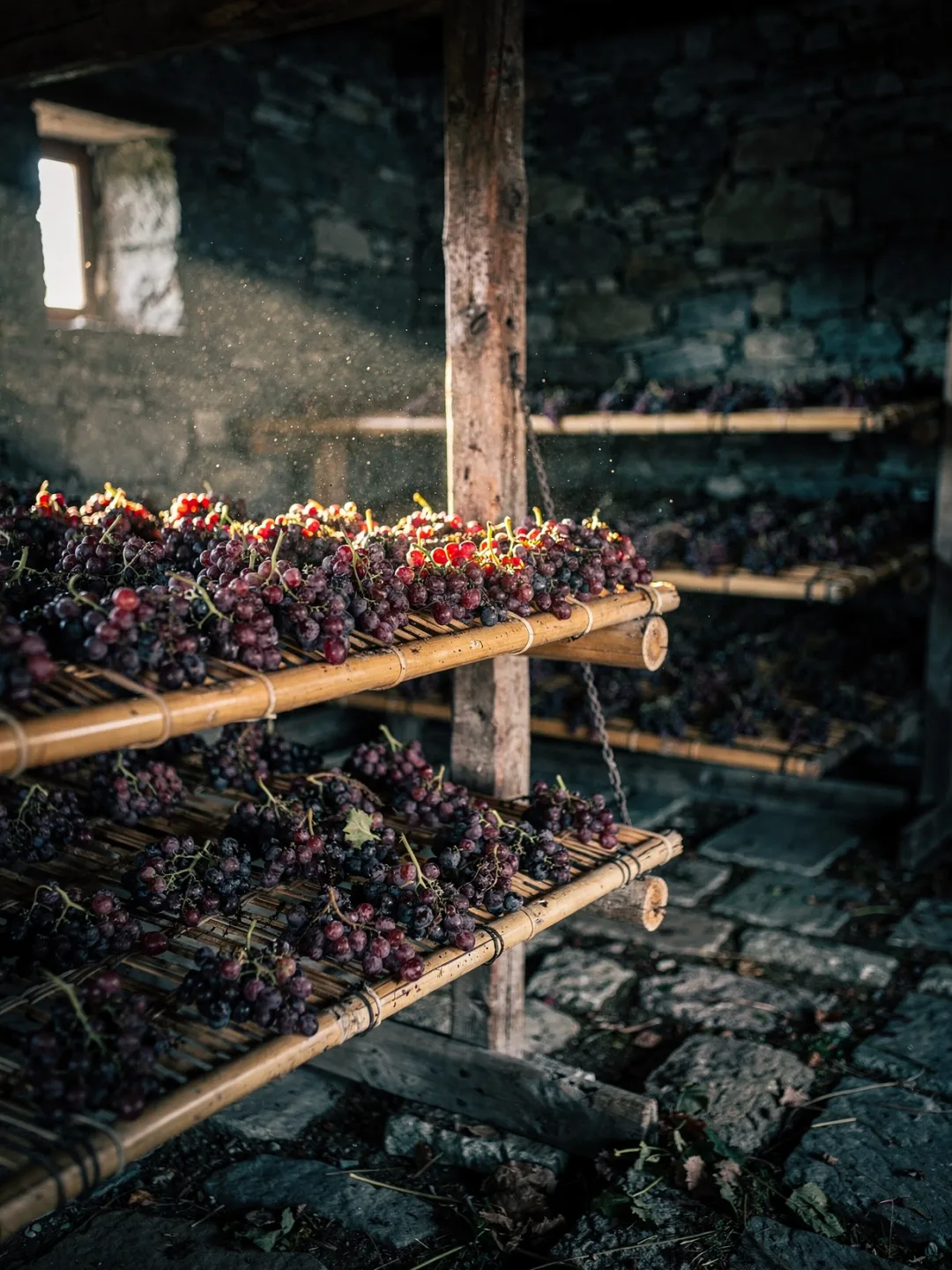
In Valtellina, by contrast, everything revolves around drying rather than fermentation in the bottle. For Sforzato, the ripest grapes are not pressed immediately after harvest. Instead, they're laid out on wooden racks in cool, well-ventilated rooms called fruttai.
There they lose water over roughly 110 days, until the sugar content rises to twenty-six or twenty-seven percent — almost like a raisin, only slower and more controlled. Only then are the grapes pressed and fermented. The finished Sforzato ages for at least twenty months, a good year of which is spent in oak, before it may leave the winery.
Two methods, two entirely different concepts of time: one counts months on the lees in a dark cellar, the other counts days in dry mountain air. In the end, one yields sparkle, the other concentration.