Clay, Limestone, Sandstone
Soils
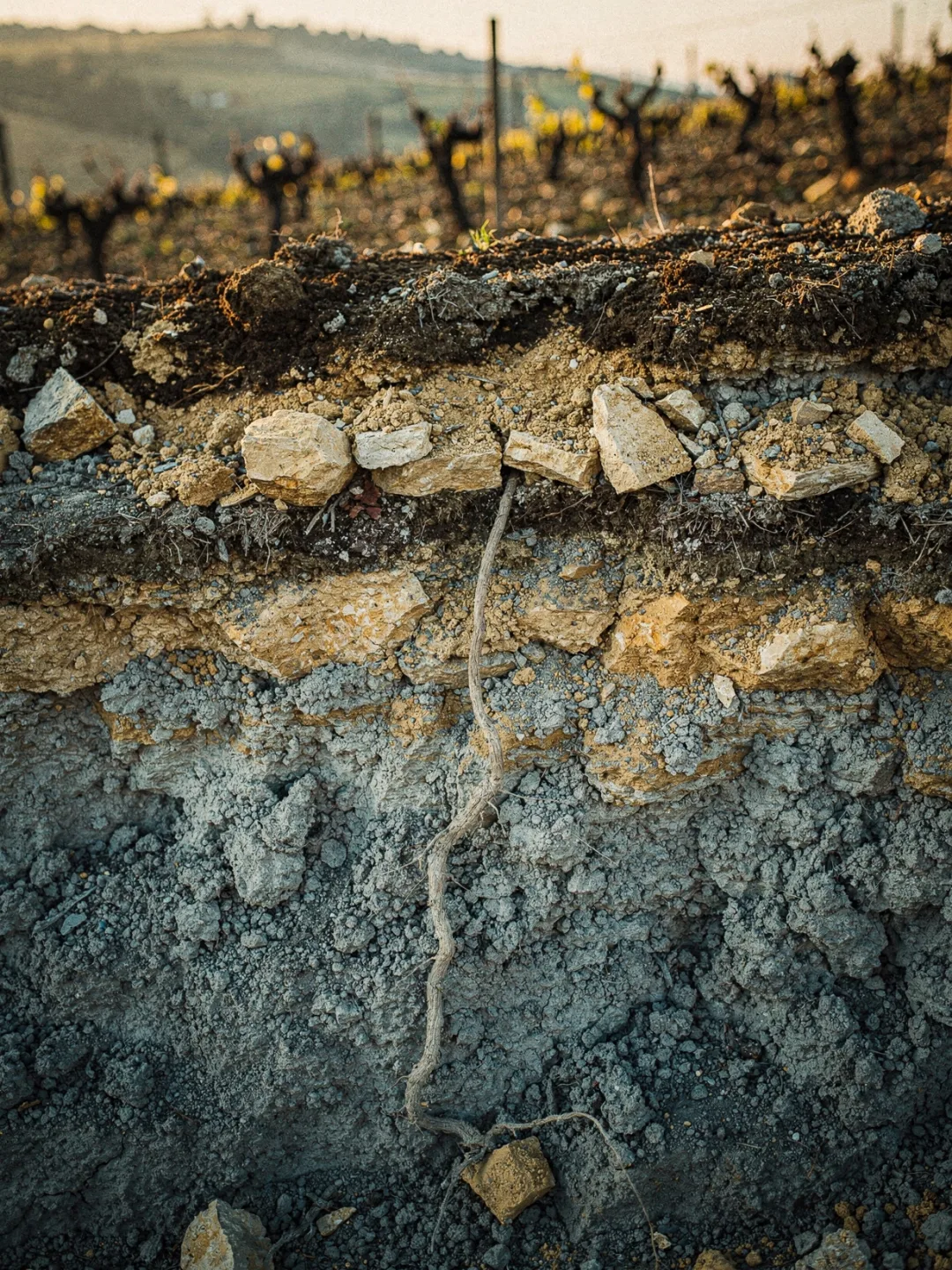
Dig a hole in a vineyard of the Castelli di Jesi, thirty centimeters deep. You'll hit clay, blue-gray, fine and slightly sticky between your fingers. Geologists call this layer Argille Azzurre, blue clays, deposited around five million years ago on the bed of a shallow sea that today separates the Po Valley from the Adriatic. Back then, water lay here. Today, Verdicchio lies here.
This clay holds water tightly, far longer than sandy soil could, and that's exactly what carries the vine through the dry summer weeks. At the same time, it's rich in calcium carbonate, which lets the roots draw nutrients only slowly and naturally curbs yield without the winemaker needing to intervene. Below, usually starting at a depth of one meter, the blue clay gives way to a paler, harder sandstone, a so-called arenaria of compacted Miocene sea sand. Roots that reach that far still find water in August.
Twenty kilometers further east, right on the sea, the soil looks completely different. Monte Conero is not clay but a limestone cliff, the only one on the entire Italian Adriatic coast between Trieste and the Gargano. Its rock is made of the compressed shells of ancient sea creatures, hard and fissured rather than soft and pliable. Montepulciano has to force its way through narrow cracks just to find water at all. That costs effort. Later, that effort ends up as tannin in the glass.
In Matelica, in the enclosed valley behind Monte San Vicino, the two mix: calcareous clay, but stored drier than on the coast, because the valley itself acts almost like a natural drain. The Verdicchio from there therefore tastes leaner and saltier than the one from Jesi, even though both come from the same grape variety and are separated by only fifty kilometers.
A thin, dark layer of decomposed leaves and worked earth. In the hills of the Castelli di Jesi, rarely more than a hand's breadth deep.
The root: This is where the fine roots sit, absorbing the rain of recent weeks — and the first to dry out in high summer.