Brodetto and Vincisgrassi
Wine & Food
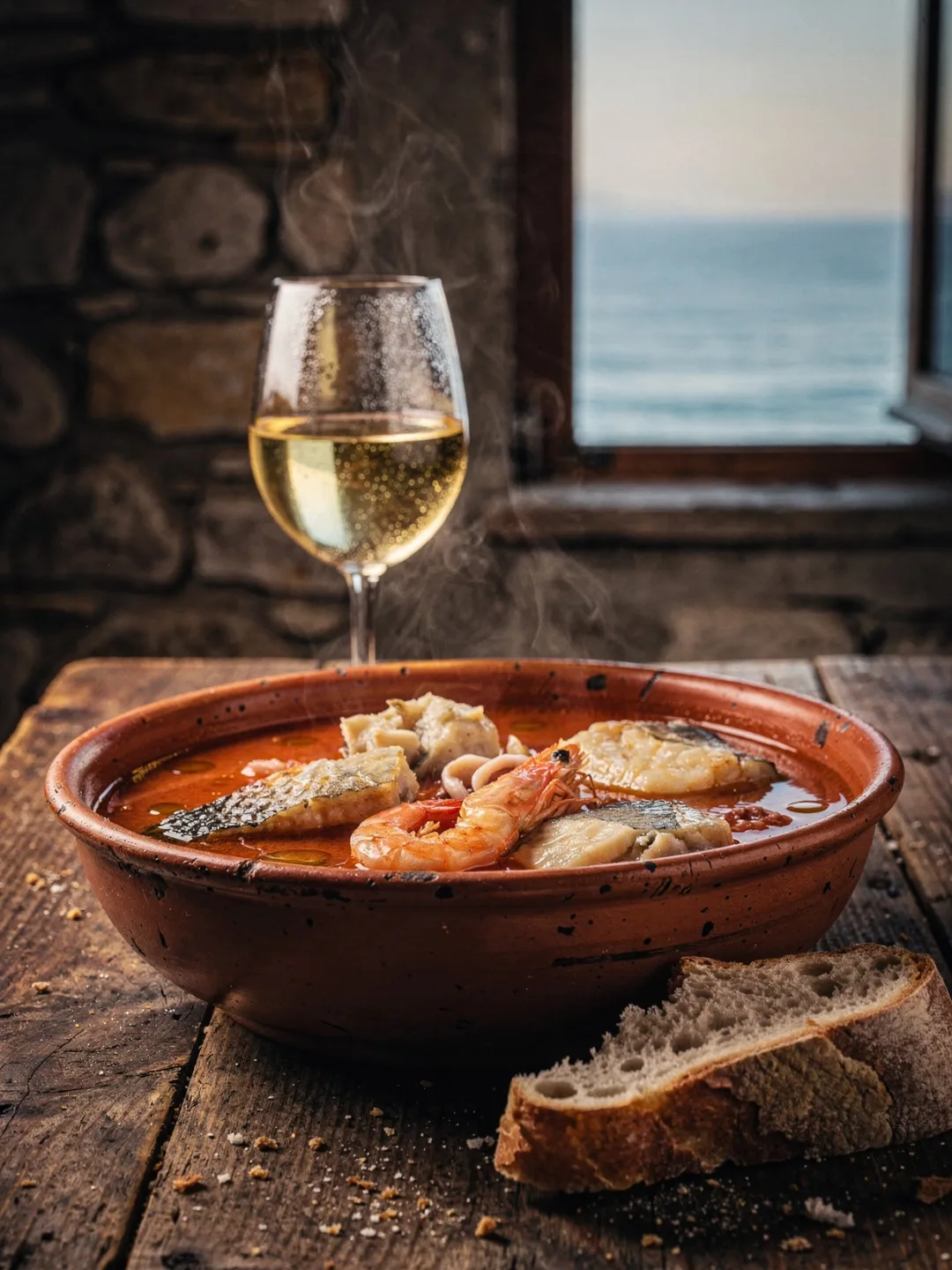
Brodetto all'anconetana is Marche's oldest fish soup, originally cooked on board, made from whatever couldn't be sold anymore. Up to thirteen kinds of fish go into it — monkfish, sole, ray — along with cuttlefish and shrimp, seasoned with vinegar instead of white wine, unlike the custom in neighboring towns. It's exactly this acidity in the pot that calls for a wine with enough acidity of its own. Otherwise it tastes flat. A young Verdicchio from the Castelli di Jesi therefore pairs better than almost any other white wine in Italy.
With Olive all'Ascolana, the principle is similar, only with fat instead of acidity as the counterpart. The green olives of the Ascolana Tenera variety are filled with ground meat and Parmesan, breaded, and fried—a snack from Ascoli Piceno that has been served for roughly two hundred years. Oil and fat from the deep fryer need a wine that can stand up to them. Once again, it's the acidity of Verdicchio that wipes the palate clean between bites.
The moscioli of Portonovo are wild mussels that grow on the rocks beneath Monte Conero. Unlike almost all mussels in Italy, they aren't farmed but hand-dived. Their flavor is delicate and slightly salty. A Verdicchio with oak notes would overwhelm them. Here, the simplest, youngest vintage belongs in the glass—no aging, no barrel whatsoever.
Vincisgrassi is the counterpart: a lasagna of seven or eight layers of pasta, meat ragù, and béchamel, hearty enough for a Sunday feast. No white wine can keep up with this. It calls for Rosso Piceno or a young Rosso Conero, with enough acidity to cut through the béchamel—just without the heavy tannin of a Riserva.
With Ciauscolo, the spreadably soft salami made from pork belly, shoulder, and back, a simple Lacrima or a young Verdicchio suffices, served chilled on warm bread. And for dessert—say, with a honey pastry—the sweet, sparkling Vernaccia di Serrapetrona is the natural choice. It's the only red sparkling wine of the Marche, made precisely for this final course.