Verdicchio & Montepulciano
Grape Varieties
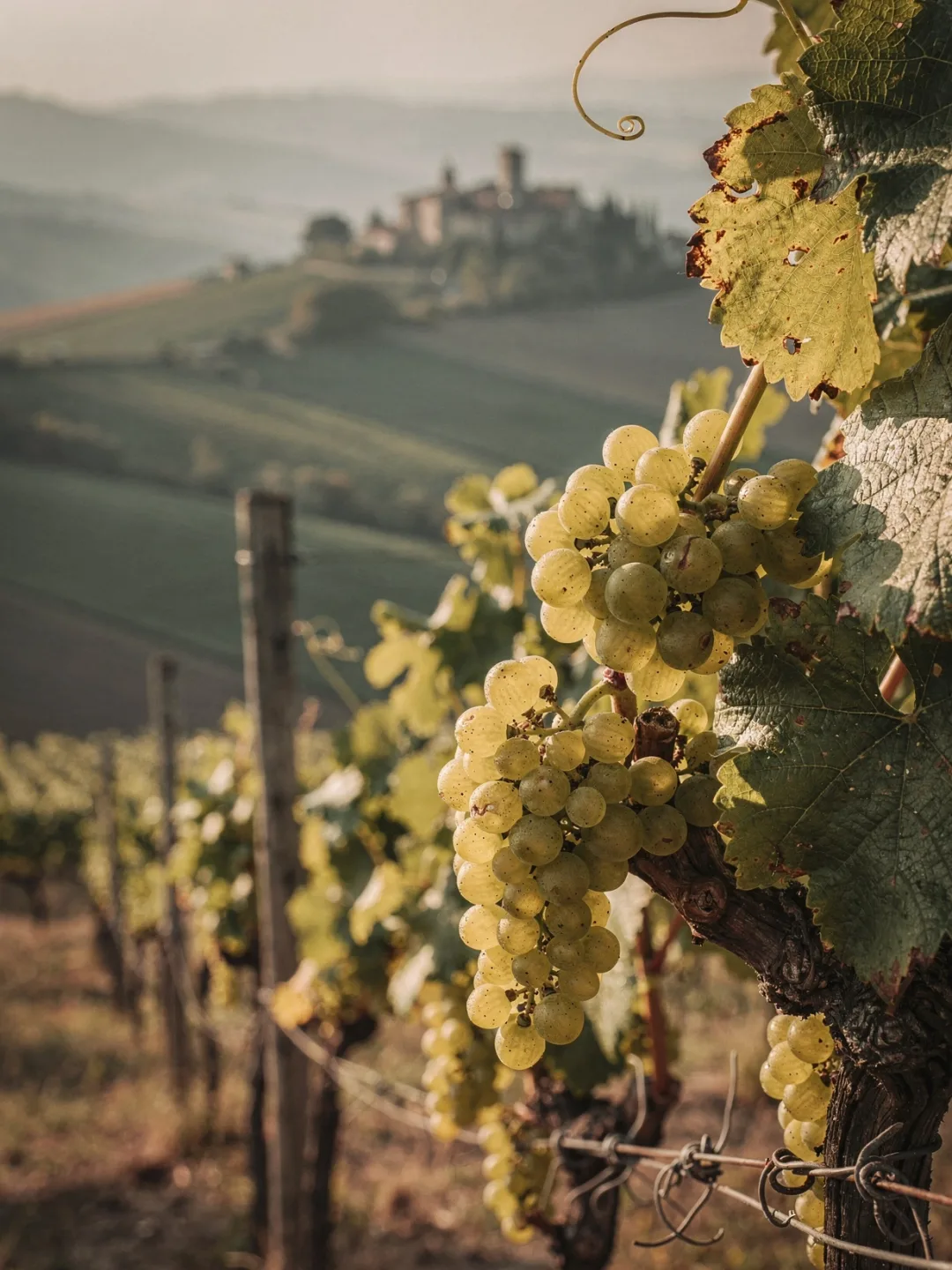
In Marche, two varieties share the stage, one white and one red, and both sound unfamiliar to most wine drinkers. The white one is called Verdicchio, named after the greenish color of its berries, and it grows in such quantity almost nowhere else in Italy. The red one is called Montepulciano. Not to be confused with the Tuscan town of the same name, which produces an entirely different wine from Sangiovese.
Verdicchio is tough. Its skin is thick, which keeps fungal diseases at bay, and even at full ripeness the acidity stays high — unusual for a white wine from such a warm coastal region. In the glass it often smells of green almond and citrus peel, sometimes salty, almost iodine-like, as if it had picked up the scent of the nearby sea. This combination of acidity and thick skin explains why Verdicchio, unlike most Italian white wines, can age for decades.
Among reds, Montepulciano dominates, usually complemented by Sangiovese. The grape has thick, dark skins, ripens late, and needs warmth. That's why it thrives best on the coast around Conero, where the limestone holds the day's heat and releases it again at night. On its own, Montepulciano produces Rosso Conero. Blended with Sangiovese in a ratio of thirty-five to eighty-five percent to fifteen to fifty percent, it produces Rosso Piceno, the region's most widely planted red wine.
A third variety stands apart. Lacrima grows almost exclusively around the village of Morro d'Alba, on an area you could walk around in an hour, and it smells of roses and wild blackberries. Responsible for this is a molecule called geraniol, the same one that gives Gewürztraminer its scent. In the 1960s, the variety came close to extinction, as farmers replaced it with higher-yielding vines. Only a handful of growers brought it back into the vineyard.
The rarest variety carries a misleading name. Vernaccia Nera has nothing to do with the Tuscan Vernaccia di San Gimignano. It's a distinct red variety that grows only around Serrapetrona, at elevations between four hundred fifty and six hundred meters, on clayey, well-drained soil. There it's made into a red sparkling wine for which there's hardly a second address in all of Italy.