From Nuraghi to DOCG
Region & History
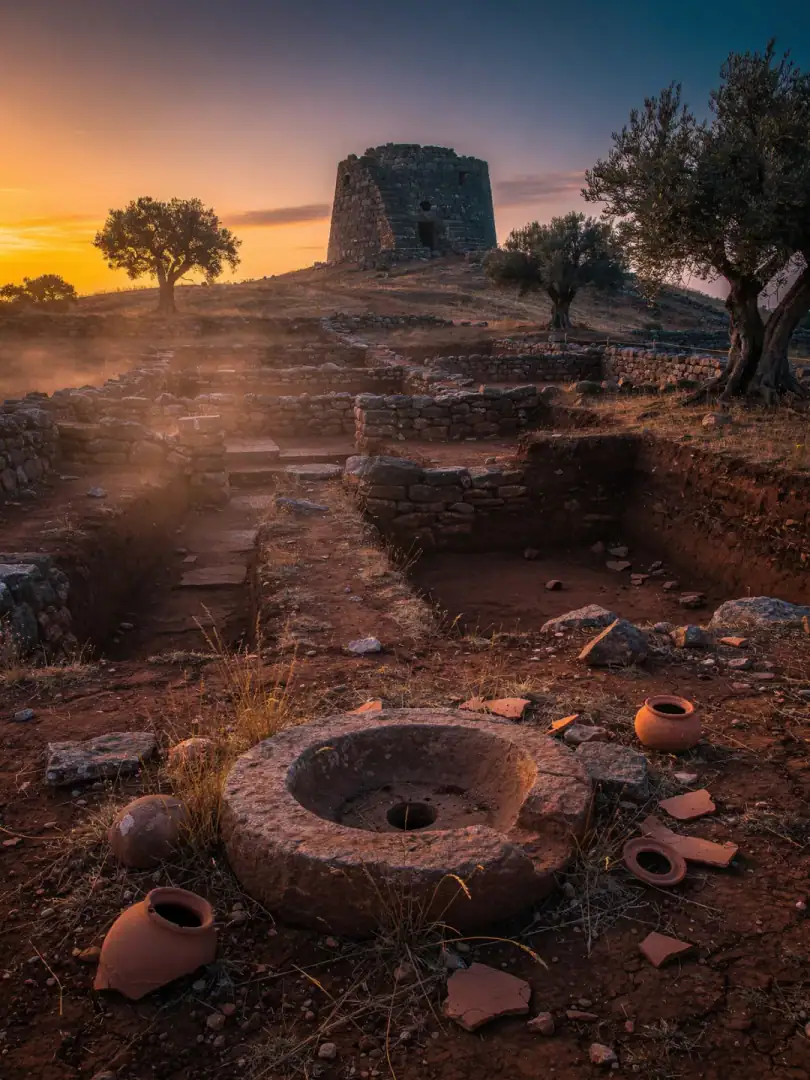
Wine has existed on Sardinia since the Bronze Age. Near Monastir, not far from Cagliari, archaeologists discovered a stone wine press as early as 1993 in the nuragic village of Monte Zara. Only in 2016 did researchers from the University of Cagliari publish an analysis of the organic residue found inside: tartaric acid from the ninth to eighth century BC, making it the oldest known wine press facility in the entire Mediterranean. Even older are traces of a wild vine from a cave at Monte Meana near Santadi in the south of the island, estimated at around four and a half thousand years old. Wine existed here long before it needed a name.
The Phoenicians came later. They still left a lasting mark on what followed, founding Karalis, today's Cagliari, as a trading post on the south coast and bringing their own vines with them. One of these still carries a name that recalls the stone towers found all over the island: Nuragus. Whether it really derives from the nuraghi or from a Phoenician word for fire remains disputed among experts to this day. Wine was already part of daily life long before anyone thought about designations of origin.
Foreign powers then ruled Sardinia, most recently the Crown of Aragon for almost four hundred years. An Aragonese army landed on the island in 1323, though the city only fell definitively in 1326, following a naval battle off Cagliari. Only in 1720 did the island pass to the House of Savoy. Cannonau, today the island's most important red grape variety and genetically identical to Spain's Garnacha, is said to have arrived with the Spanish during this period. More recent finds of grape seeds across the island now call this narrative into question. Cannonau could just as easily have travelled from Sardinia to Spain rather than the other way round. Neither direction has been proven so far.
The first wine to receive official recognition is one that hardly anyone knows today. Vernaccia di Oristano became the very first Sardinian wine to be awarded DOC status in August 1971, even though grape seeds from the variety had already been found in the nuragic village of Sa Osa, dating back some three thousand years. Cannonau di Sardegna followed in 1972, Carignano del Sulcis in 1977. Vermentino di Gallura in the north received DOC status in 1975 and rose in 1996 to become the only Sardinian wine so far to reach Italy's highest category, DOCG.
Anyone travelling across the island today sees this history almost everywhere. In the south, centuries-old, never-grafted Carignano vines stand in the sand of Sant'Antioco, while in the north, Vermentino carries the wind from the granite of the Gallura. In the mountainous Barbagia, people have been drinking Cannonau with every meal for generations. The oldest Cannonau subzone lies particularly around Oliena. This same area is today considered one of the world's few Blue Zones, where an unusually high number of people live to an old age.