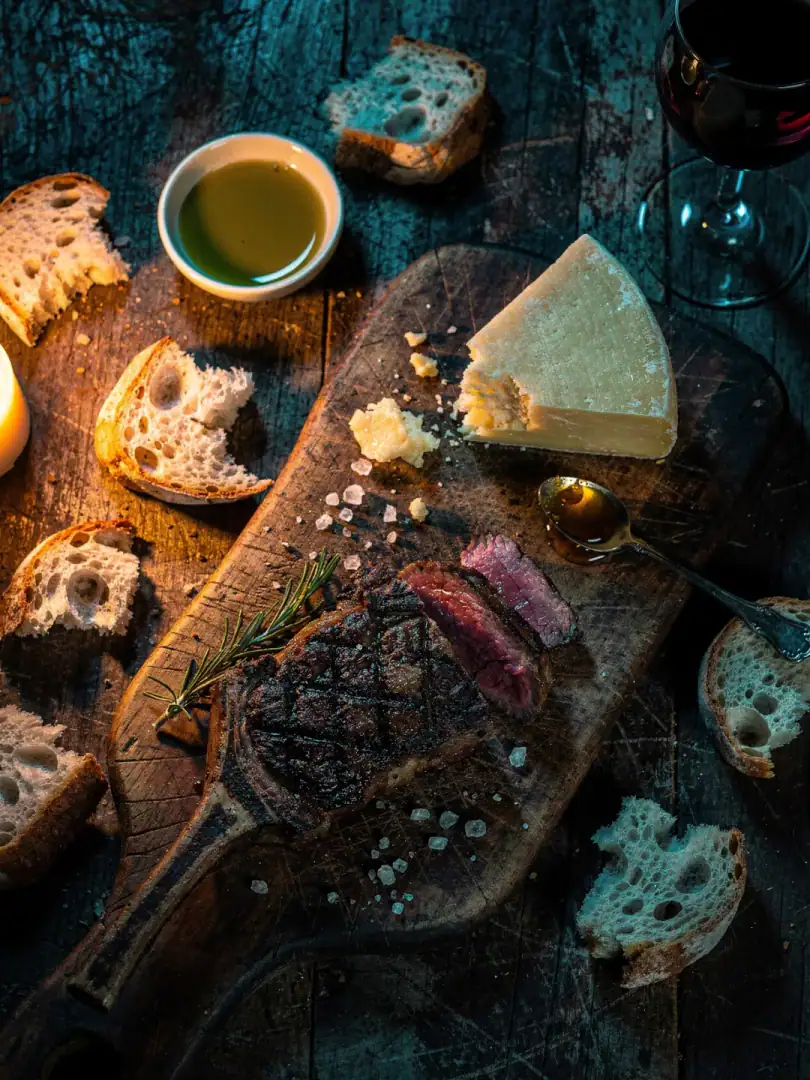
Bistecca and Pecorino
Wine & Food
Tuscan cuisine and Tuscan wine developed side by side, and you can taste it. What lands on the table here is hearty, salty, and often rich; the wine that accompanies it has plenty of acidity and plenty of tannin. That's no coincidence — it's four hundred years of adaptation.
Acidity cuts through fat, the same way a squeeze of lemon does on a cutlet. That's why bistecca alla fiorentina works so well — a hand-thick steak from Chianina beef, charred outside, rare inside, seasoned with nothing but salt and olive oil. A soft, low-acid wine would simply disappear next to it.
With Pecorino, a second rule kicks in. Salt softens and rounds out tannin, which is why a young, still-edgy Chianti suddenly feels approachable alongside aged sheep's milk cheese. A spoonful of chestnut honey on the side amplifies the effect, since sweetness does the same thing salt does.
Not everything works. With Ribollita, the thick bread-and-bean soup, a heavy Riserva is too much — what's needed there is a young, lighter Chianti, ideally about a year old. With Cinghiale, braised wild boar with juniper, the opposite applies: bring out the boldest wine in the house. And with Panforte, the dense spiced cake from Siena, red wine doesn't work at all: what you drink with it is Vin Santo, the sweet straw wine it's traditionally dipped into.
If you only remember two sentences, make them these. Fat and salt make a tough wine more approachable. Sweetness in food, on the other hand, makes a dry wine taste thin and sour — which is why dessert always calls for a wine sweeter than the dessert itself.