Drying, Ripasso, Charmat
Production
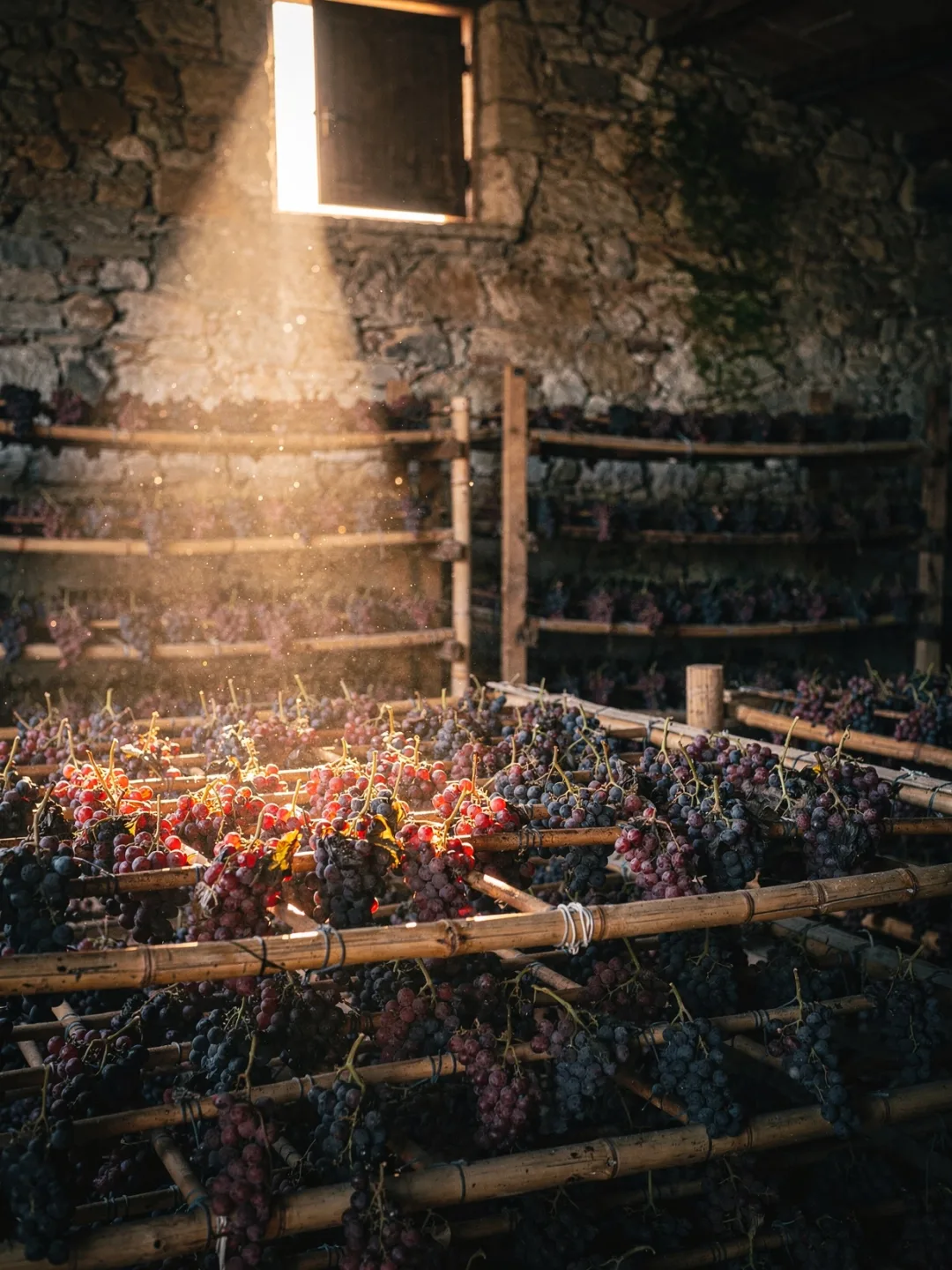
Amarone doesn't begin in the cellar, but in the loft. After the harvest, the best grapes of Corvina, Corvinone, and Rondinella are spread out. They're laid on wooden racks called arele or hung in airy rooms known as fruttai, where over one hundred to one hundred and twenty days they lose up to forty percent of their weight in water. What remains is concentrated sugar, acidity, and color in a shrunken, almost raisin-like berry.
Only after that may pressing begin, no earlier than the first of December, as required by DOCG rules. Because of the high sugar content, fermentation often takes weeks rather than days, until the yeasts are exhausted and a dry wine with fifteen percent alcohol by volume or more remains. Amarone then ages for at least two years, the Riserva for at least four.
From the same leftovers comes a second, more affordable idea: Ripasso. Young, simple Valpolicella is poured over the freshly pressed pomace of Amarone or Recioto, up to fifteen percent of the volume. There, it undergoes a second fermentation for another two to three weeks. This gives it more body, more color, and a hint of its big brother's cherry sweetness — at a fraction of the price.
Far to the northeast, production works entirely differently. For Prosecco Superiore, the Glera wine undergoes a second fermentation not in bottles but in large steel tanks called autoclaves — the so-called Martinotti method, named after the Italian chemist who patented it in 1895. The tank must remain under pressure for at least thirty days. Many producers leave it for two to three months, some even longer, so the carbon dioxide and aromas can combine gently.
The difference from classic bottle fermentation, as used in Champagne, lies in both speed and purpose: the tank aims to preserve Glera's fruit character, not bury it under yeasty notes. How much sugar is added at the end is called the dosage. It determines whether the same base wine becomes an extra brut or a milder extra dry.