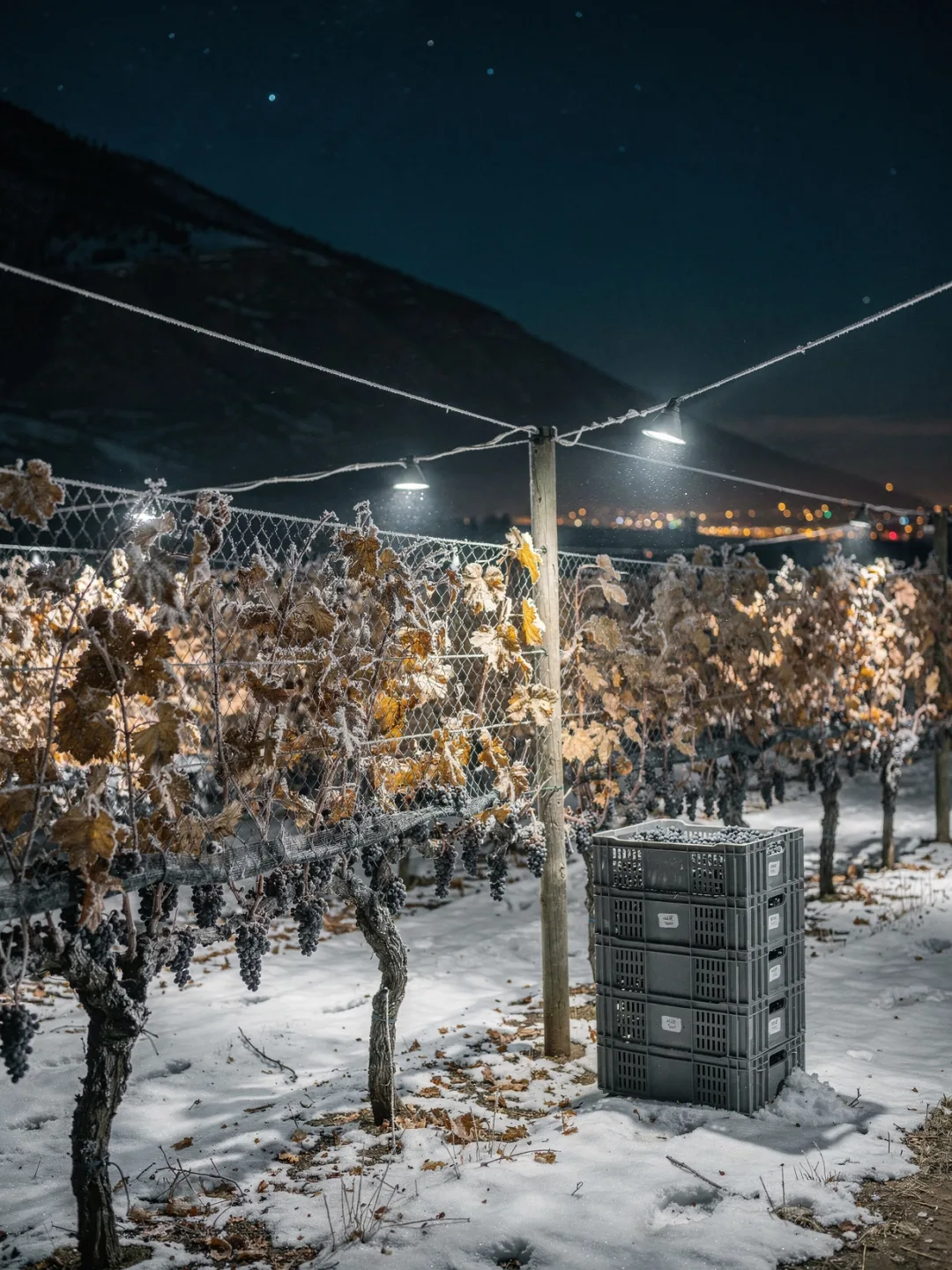
A Frozen Harvest
Production
Hardly any other wine region harvests the same vintage twice, months apart, the way the Okanagan Valley does. The first harvest begins in late August and wraps up by October, once Merlot, Chardonnay, and Pinot Noir have reached ripeness. The second begins where the first leaves off, and can stretch into January.
For ice wine, selected grapes are simply left hanging on the vine. Nets protect them from birds while everything around them is already picked and pressed, and the winemakers wait for the first hard cold snap. Every year, they risk losing the entire batch. A storm, a hungry deer, or rot can destroy the grapes before the cold arrives.
Under the rules of the BC Wine Authority, the grapes may only be picked and pressed once the air temperature reaches minus eight degrees Celsius or colder. This often happens in the middle of the night. Frozen, the berries yield almost no juice. A ton of grapes often produces only a tenth of the must that would normally result. That must, however, is brutally concentrated: at least 32 degrees Brix, a measure commonly used in North America for sugar content in grape juice, straight from every pressing, averaging 35 in practice.
This sweetness ferments only reluctantly. Wild and cultivated yeasts fight their way through the thick must for weeks, sometimes months, at cool cellar temperatures. Only once the alcohol level climbs high enough do the yeasts finally give up, leaving much of the sweetness unfermented. In the end, an ice wine must contain at least 100 grams of residual sugar per liter, measured at bottling, or it isn't allowed to carry the name.
The red wines from the warm south, from the Golden Mile Bench or the Black Sage Bench, go through a more familiar process by comparison. Skin-contact fermentation for two to three weeks, followed by aging in oak barrels. Yet the biting cold still serves them well. Many cellars leave their barrels unheated for a short stretch in winter, since the cold causes excess tartaric acid to crystallize out as tartrate crystals, small harmless crystals at the bottom of the bottle, with no need for expensive cooling technology.