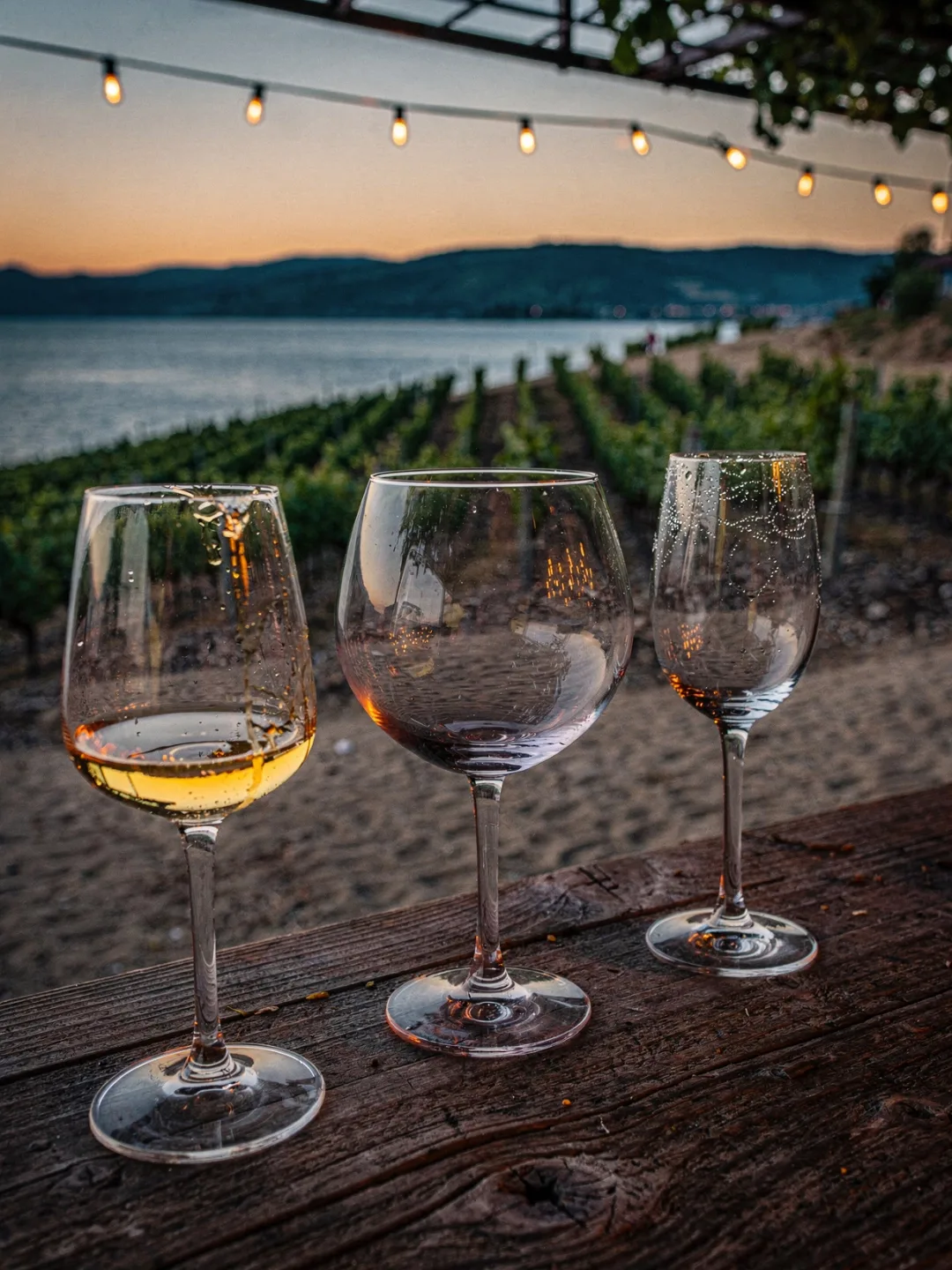
A Glass for Every Zone
Glassware
A single glass won't do in the Okanagan Valley, and that's not a matter of showing off. Barely a hundred and fifty kilometers separate the valley's coolest vineyards from its warmest. In between, wines emerge that differ so much that a glass flattering to one will overwhelm the other.
For the bold Bordeaux blends from the Golden Mile Bench and the Black Sage Bench, a large, straight-sided glass with a wide opening suits best. The broad bowl gives these wines room to breathe. And they need it: their tannin, the compound from skin and seeds, often feels rough when young, and oxygen smooths it out within minutes. Serve these wines at sixteen to eighteen degrees Celsius, noticeably cooler than most living rooms these days.
For Pinot Noir from the Naramata Bench, almost the opposite applies. It needs a bowl-shaped glass that narrows toward the top, one that gathers the delicate aromas of cherry and forest floor rather than letting them scatter. Twelve to fourteen degrees Celsius is plenty as a serving temperature; any warmer and this pale, restrained red quickly loses definition.
With ice wine, everything centers on concentration. Every bottle holds at least 100 grams of residual sugar per liter, balanced by acidity that carries the sweetness rather than letting it feel cloying. A small, slender glass with a narrow rim is all you need, barely bigger than a double shot glass, because just a few milliliters release plenty of aroma and sweetness at once. Serve it cold, at eight to ten degrees Celsius, straight from the fridge.
Pour size follows the same logic in the opposite direction. A Bordeaux blend gets a generous hundred and fifty milliliters, so it can breathe. With ice wine, fifty milliliters is already a generous pour. Use one glass for the other, and you'll fail to properly taste either the fruit of the red wine or the balance of the ice wine.