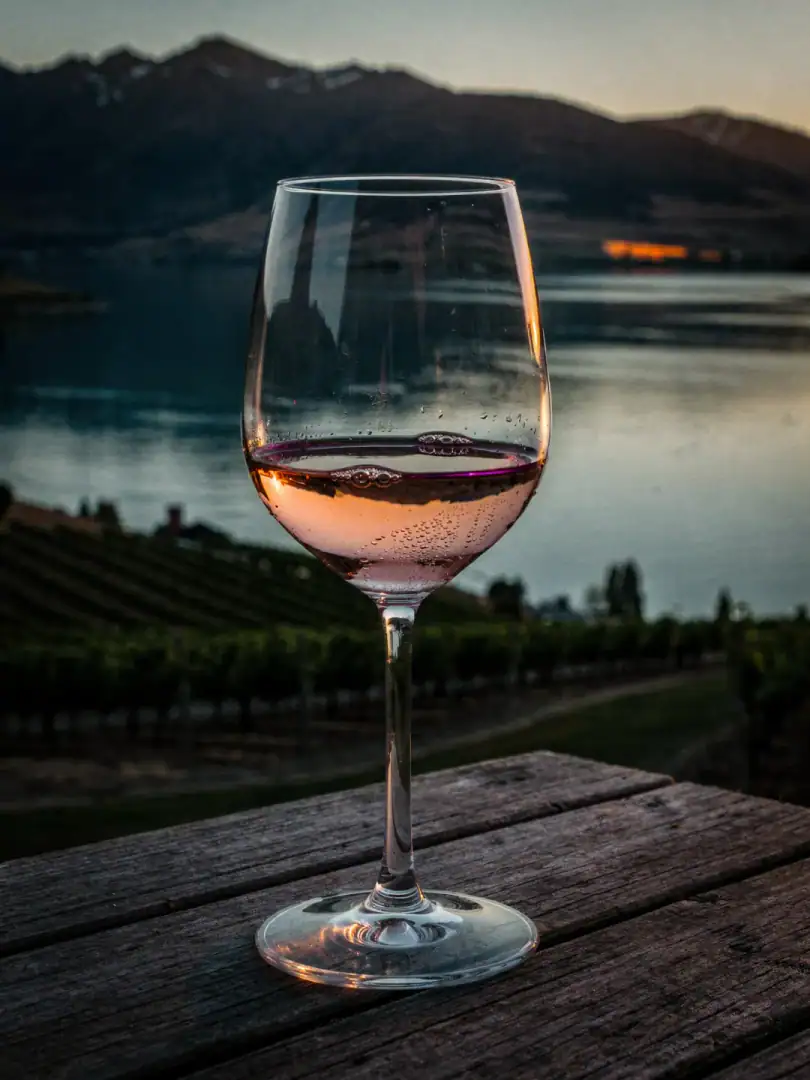
On a Bannockburn Pinot
Tasting
Tilt the glass and look at the rim: a Central Otago Pinot Noir reveals its age before you even taste it. A young vintage glows violet-ruby, while a ten-year-old wine has already shifted toward brick red. The color runs paler than a Cabernet's but often deeper than a Burgundy's, a hint at all the sunshine hours behind the fruit.
Smell it twice: once with the glass still, once after swirling. In the still glass, cherry rises first, since its aromatic molecules evaporate most readily. Only after swirling does the rest emerge, a spicy, sometimes almost wild note that many describe as thyme or dried herbs, and rarely found this pronounced in any other Pinot Noir region.
In the mouth, pay attention to two things separately. You'll feel the acidity along the sides of the tongue; it gets the saliva flowing and keeps the wine fresh despite its ripeness. The tannin, by contrast, shows up as a slightly rough coating on the gums, usually finer than in wines from Bannockburn or Bendigo, where more whole clusters and more sun build a coarser structure.
The alcohol reveals itself as a slight warmth in the throat, a few seconds after swallowing. This is exactly where the valleys diverge. A Gibbston Pinot stays lean and cool, while a Bannockburn Pinot feels denser and warmer on the finish, even though both come from the very same grape.
Count how long the flavor lingers after you swallow. Two seconds is short, twenty is a lot, and professionals call this the finish, something that's hard to fake in the cellar. In a good Central Otago Pinot Noir, it's often that same cherry note that lingers at the end. It's the same cherry the whole tasting began with, only quieter now, with a final whisper of herbs.