Mussels and Salmon
Wine & Food
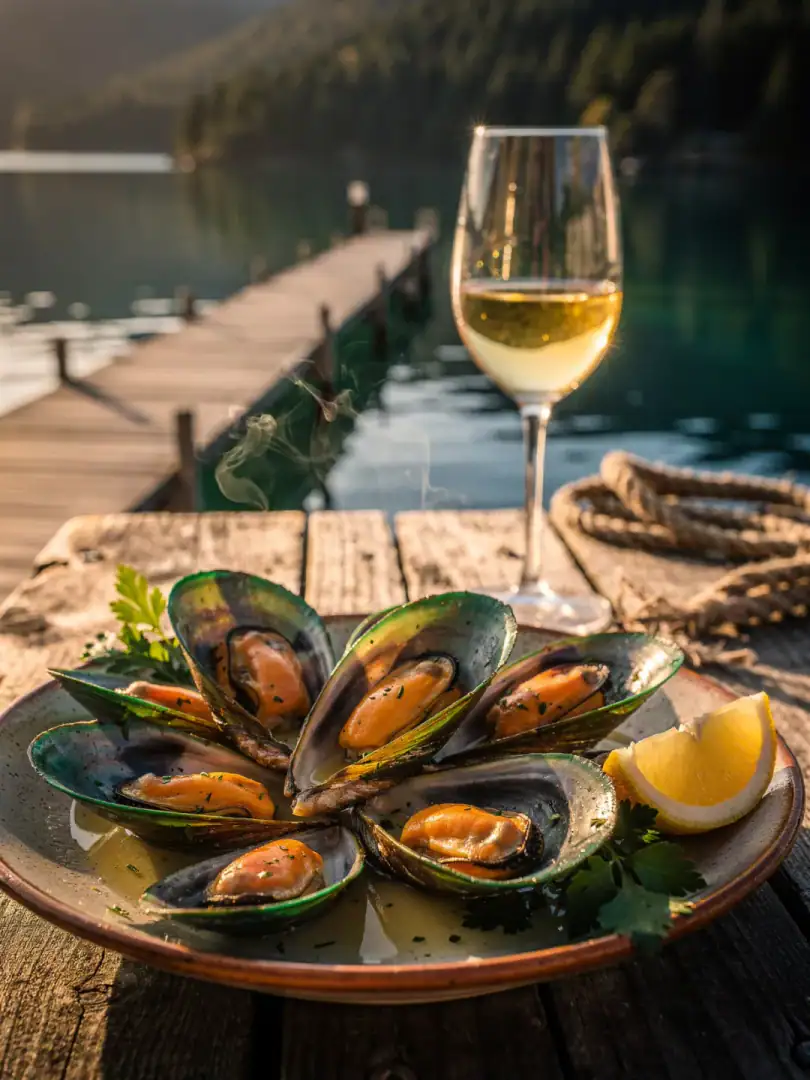
On the quay at Havelock, a small port town on the Marlborough Sounds, stands a sign proclaiming the place the "Greenshell Mussel Capital of the World." It's a self-appointed title, but not an unfounded one. New Zealand's green-lipped mussels grow on long ropes suspended from rafts in the calm, nutrient-rich bays of the Sounds. A large share of the country's entire harvest comes from precisely these waters.
The same sheltered fjord arms are also well suited to salmon farming. In net pens across Tory Channel, Queen Charlotte Sound, and Pelorus Sound, much of New Zealand's King Salmon grows to maturity in cold, clear water pushed twice daily through the narrow sounds by the tides. It's a rich, deep-red variety of salmon, regarded in New Zealand as a premium product.
Both pair with Sauvignon Blanc for the same underlying reason. The wine's acidity cuts through the mussel's slightly salty, briny richness. The green bell pepper note in the wine echoes the parsley in which mussels are traditionally steamed in New Zealand. A softer, warmer white wine would fall flat by comparison; the taut acidity from the Wairau brings the two together beautifully.
With the richer King Salmon, another Marlborough wine often takes over: a cool-climate, light-bodied Pinot Noir from the Awatere Valley. Its delicate red fruit doesn't overpower the fish's richness, yet brings enough acidity to lift it. The salmon is classically served either briefly seared or raw as sashimi, with little more than a touch of soy sauce and ginger. That's really all it needs.
What ties these pairings together is proximity: mussels, salmon, and wine all grow here within just a few kilometers of one another as the crow flies. Rarely do producer and glass sit so close together as they do on this coast.