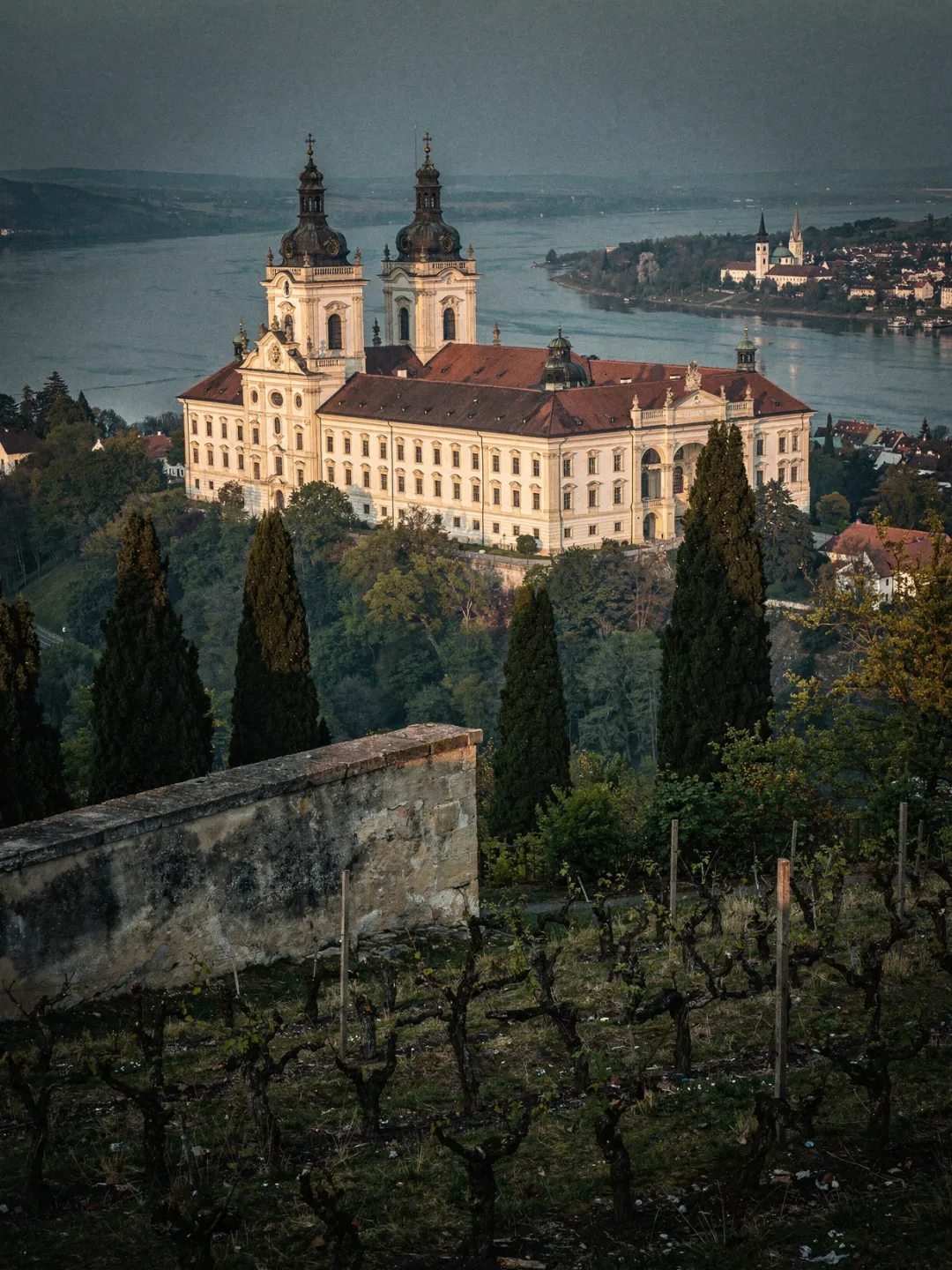
Monastery, border, cooperative
Region & History
Krems first appears in the historical record in the year 995, in a document issued by Emperor Otto III, who names the place Chremisa. Vines likely grew on the surrounding slopes even earlier, but no one recorded who planted the first vineyard. What follows is better documented: Krems and Stein, on the opposite bank, grew into one of the most important trading towns on the upper Danube, complete with its own wine market. That was long before anyone used the term wine region in today's sense.
The real boost came from a monastery. In 1083, Bishop Altmann of Passau founded Stift Göttweig high above the Danube, less than ten kilometers west of Krems. In 1094 he handed it over to the Benedictines. The monks worked the steep slopes all around, and by the 14th century a flourishing wine culture had developed that continues unbroken to this day — the abbey still makes wine.
Geographically, this is where the Wachau ends. The narrow Danube valley with its terraces of primary rock extends as far as Furth bei Göttweig and Krems. Then the valley opens up, and the Kremstal begins. The border is no mere formality. Wachau grapes may, under strictly defined conditions, be processed in the neighboring regions of Kremstal and Traisental, but in the glass they remain two separate wine regions with their own rules.
In 1938, the winegrowers of Krems and Stein joined forces to form the Winzer Krems cooperative, headquartered in the Sandgrube, one of the town's best vineyard sites. The property had previously belonged to the Jewish wine merchant Paul Robitschek, who was forced to flee that same year. His mother, Johanna, was deported to Theresienstadt in 1942 and died there. The cooperative only came to terms with this history in 2018, adding a memorial plaque in 2019.
The most recent chapter is the DAC. On December 10, 2007, a regulation established that Grüner Veltliner and Riesling from the Kremstal could be sold as Kremstal DAC starting with that vintage. It was the first classic wine region along the Danube to receive this status. Since the 2016 vintage, a three-tier origin pyramid has been added. Gebietswein and Ortswein sit below, and at the top is Riedenwein, named after a single vineyard site.