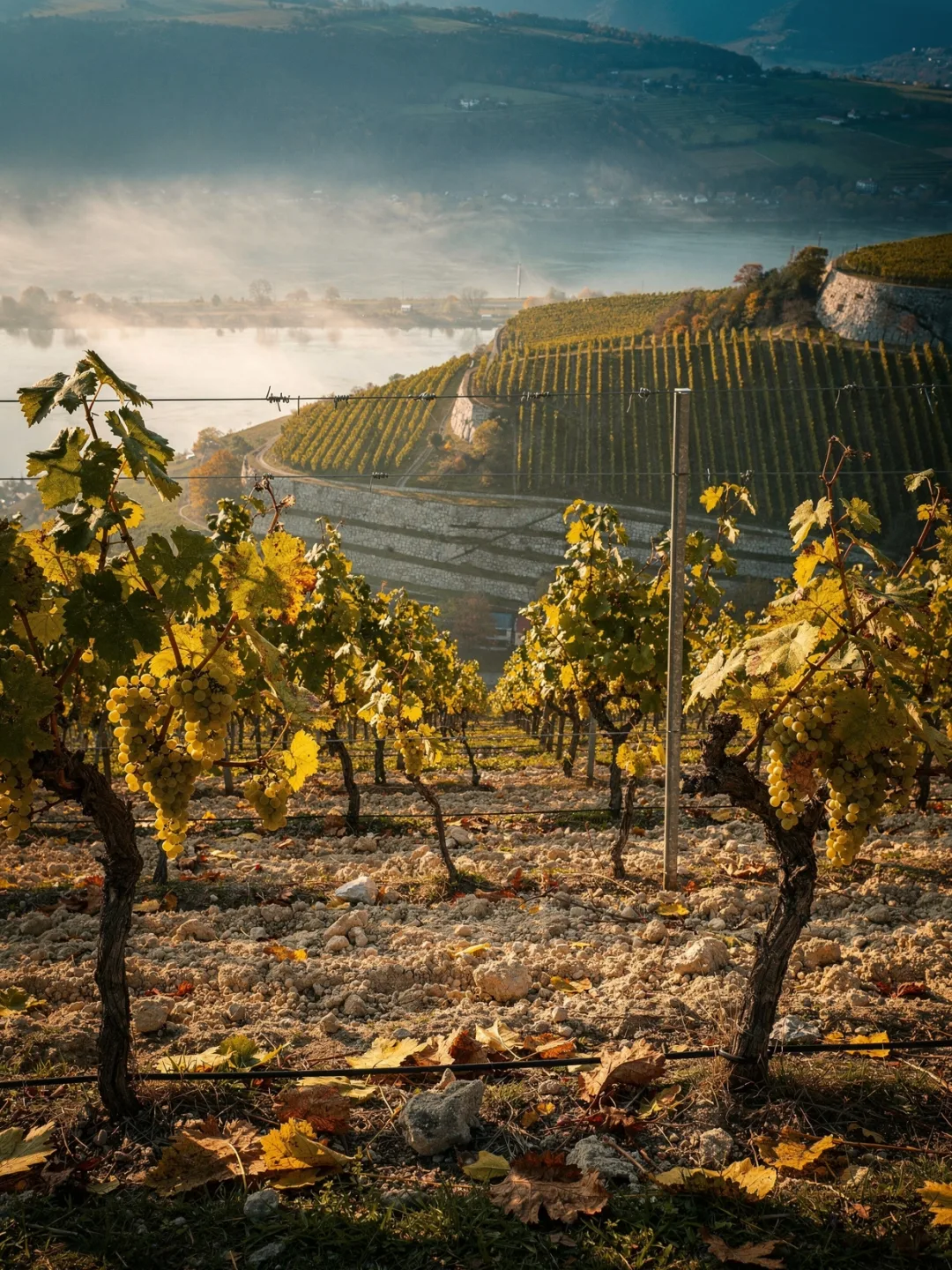
Veltliner & Riesling
Grape Varieties
Two varieties carry the Kremstal name, and the DAC allows no others. Grüner Veltliner covers a good sixty percent of the roughly 2,250 hectares under vine, Riesling about eleven percent. The rest is planted with varieties that may not be bottled under the Kremstal DAC label. So anyone ordering a glass with this label is almost always drinking one of two grapes.
Grüner Veltliner smells of green apple and citrus, and almost always carries a spiciness that many people can't quite place at first: white pepper. The molecule responsible is called rotundone, only identified in grapes in 2008, and the human nose can detect it in the tiniest amounts. Austrian studies have found it in Grüner Veltliner grapes, often at seventeen times the perception threshold of around 16 nanograms per liter. That's considerably more than is found in most Syrah-based red wines, where the compound was first discovered.
Riesling takes a different path. It ripens later, needs more sun, and is therefore planted almost exclusively on the steep terraces close to the Danube, where rock stores the day's warmth and releases it again at night. In the glass, it shows stone fruit, often peach, along with a stony, almost saline note. Connoisseurs call this minerality, even though no actual rock travels into the wine.
Which of the two varieties a winemaker plants where is not a matter of taste but of soil. On the deep loess in the north of the region, Grüner Veltliner ripens into a round, spicy wine, while Riesling grown on the hard gneiss of the terraces along the Danube becomes something leaner and more taut. Estates like Nigl in Senftenberg or the large Winzer Krems cooperative showcase both styles side by side, often from sites only a few hundred meters apart.
A few other varieties are planted in the Kremstal but may not be sold as Kremstal DAC. These include Chardonnay, Sauvignon Blanc, and the occasional red wine. They're simply labeled as Niederösterreich wine instead. This shows just how narrowly the DAC rule is drawn: if you want the origin on the label, you have to stick to the two flagship varieties.