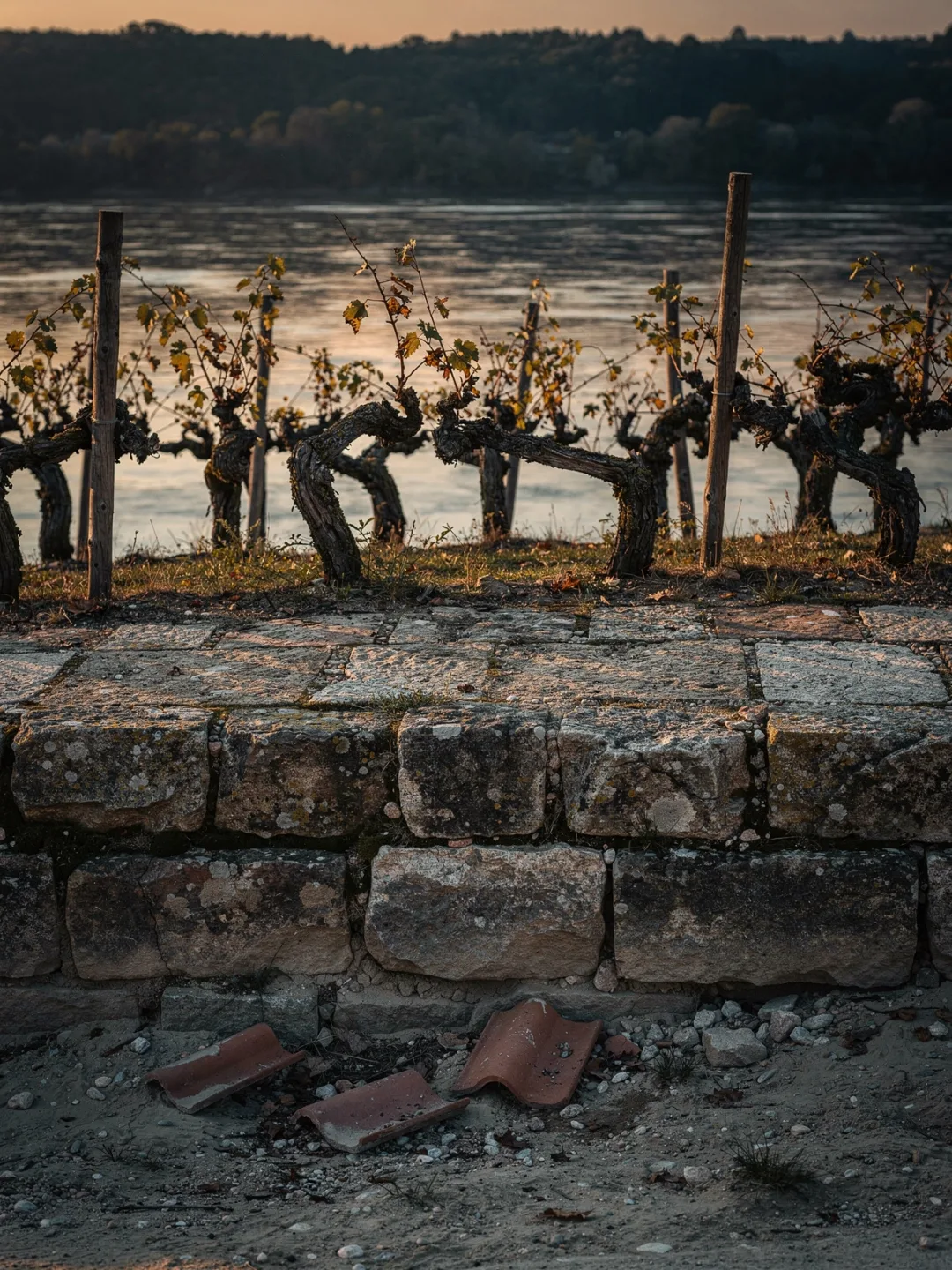
From the Bronze Age to DAC
Region & History
A cutting of wild vine was found as a grave good in a Bronze Age burial ground near Franzhausen, right in the middle of today's Traisental. It is considered the oldest known find of Vitis vinifera on Austrian soil. So wine was already reason enough to send someone off with grave goods, millennia before any border or law existed.
The Celts had long been celebrating in style. A bronze bucket from the fifth century BC, decorated with scenes of a raucous drinking feast, was found in the area. It shows that wine was something special here even before the Romans arrived — not an everyday drink, but one for festivities.
The Romans arrived early. At the start of the first century BC, they brought new cultivation methods into the valley, and with them came the border of an empire. Traismauer lay directly on the Danube Limes, the long frontier fortification along the Danube, and carried a fort for centuries. What the fortress was originally called remains disputed to this day: the Tabula Peutingeriana, a late-antique road map, names a station called Trigisamum, after the river Traisen. Today, the name Augustianis is more commonly used. Mounted troops guarded the crossing from the first to the fifth century, and since 2021 the site has been part of the UNESCO World Heritage Danube Limes.
In the eighth century, the Traisental belonged to the missionary territory of the Archdiocese of Salzburg, and a property register from that time already mentions vineyards near Traismauer and Oberwölbling. So winegrowing had long been established before anyone wrote it down. In 1112, Augustinian canons founded Herzogenburg Priory at the confluence of the Traisen and the Danube. In 1244, the monks moved with their holdings to what is now Herzogenburg, a few kilometers upstream, and remained landlords over large parts of the surrounding vineyards.
The Traisental only became its own wine region in 1995. It is thus one of the youngest and, at around 800 hectares, also one of the smallest wine regions in Austria. Since the 2006 vintage, only wines pressed from Grüner Veltliner or Riesling may carry the Traisental DAC seal; everything else is simply labeled wine from Niederösterreich. The young administrative history is deceptive. Beneath the vines lies a story that reaches back to the Bronze Age.