Gneiss & Loess
Soils
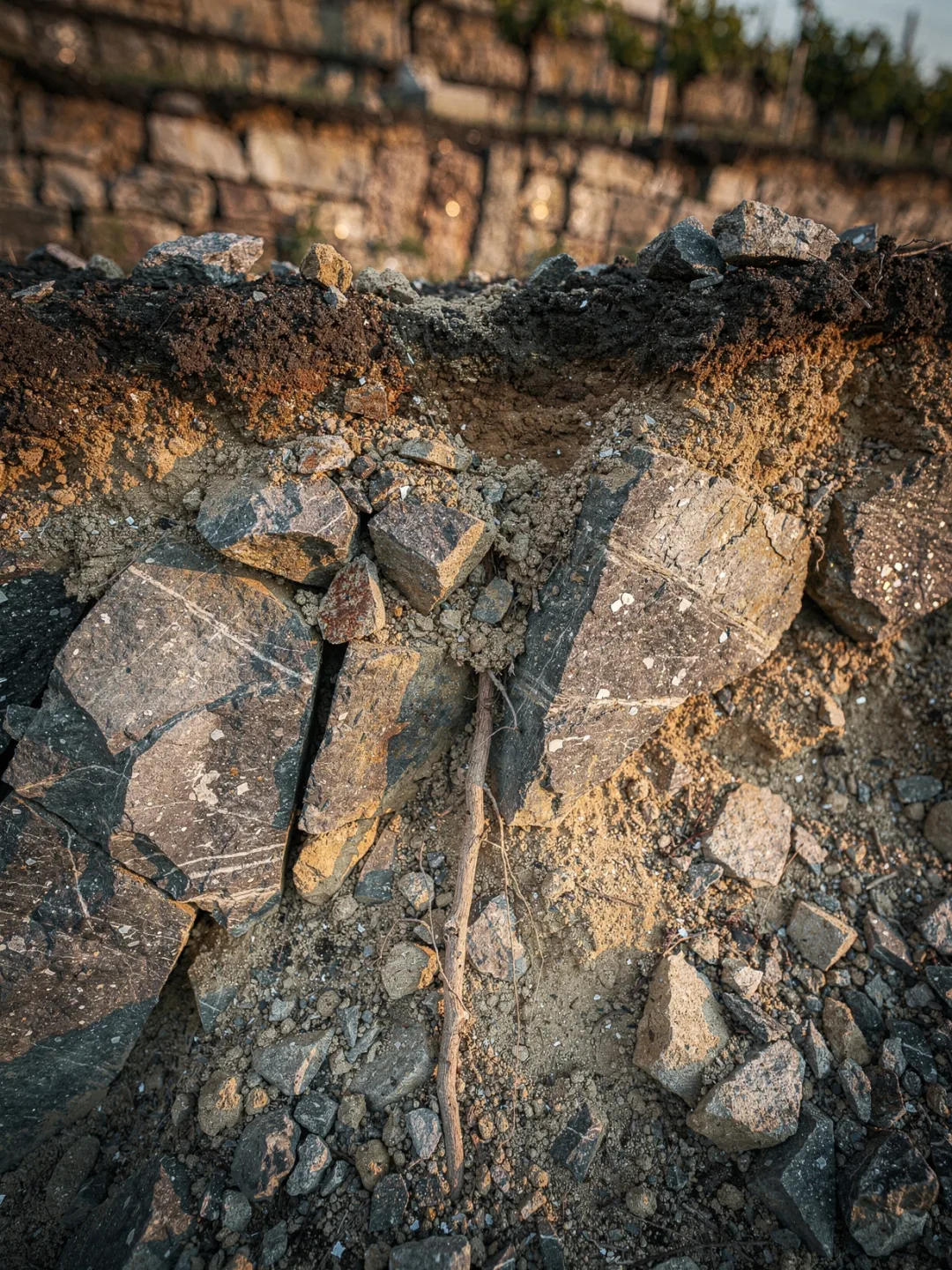
Push a spade into the ground in a vineyard in the Achleiten near Weißenkirchen, and you won't get far. After just a few strokes, you'll hit hard, pale gray rock, its surface glinting with fine streaks of mica. This is Gföhler Gneiss, named after the town of Gföhl in the nearby Waldviertel, where geologists first described it.
Its origins lie deep in geological history, in a mountain-building event that took place several hundred million years ago. Under immense pressure, the crust deformed into layered rock. At the surface, it slowly weathers into coarse, sandy grit interspersed with larger, harder chunks that give the slope its stability. For a vine's roots, this is a tough classroom: they have to force their way through cracks, finding little water and even less in the way of nutrients, and so they dig deep.
A few kilometers to the east, where the valley opens up near Krems and Stein, the soil looks completely different. There you find loess, fine, yellowish dust that the wind piled up meters deep during the ice ages. Loess holds noticeably more water than gneiss, and wines from such sites often come across rounder, less austere. You can taste the difference immediately. Between these two extremes — rock in the west, dust in the east — lies practically the entire spectrum of Wachau wine styles.
Where roots have to work as hard as they do in gneiss, the berries stay small. Small berries carry proportionally more skin than juice, and it's in the skin that aroma compounds like peppery rotundone sit, almost entirely. That's why Riesling and Veltliner from the steepest terraces taste denser and spicier than wines from the flatter valley floor. Nobody in the cellar did anything differently to achieve that.
One idea is widespread yet inaccurate: that the rock somehow flavors the wine directly, because the roots supposedly draw minerals straight from the stone. It isn't that simple. What actually comes in through the roots are dissolved salts in vanishingly small quantities, far too little for anyone to taste. The soil works its influence indirectly instead, through the warmth that dark rock stores by day and releases at night, and through the water it holds — or fails to hold. It's this indirect route that ultimately decides ripeness, acidity and density in the glass.
A thin dark layer of decomposed leaves and root remains, on the terraces often barely a hand's width deep.
The root: This is where the fine roots sit, absorbing the first rain after a dry spell — and the first to dry out again.