Cabbage Meets Wine
Wine & Food
Directly south of the loess terrace, in the flat Tullnerfeld, a vegetable has been grown for centuries that has written its own history. It's called Tullnerfelder Kraut, also known as Donaukraut (Danube cabbage). As early as 1832, its quality was praised in printed sources. After the opening of the Franz-Josefs-Bahn railway in 1870, part of the harvest even traveled as far as Bohemia.
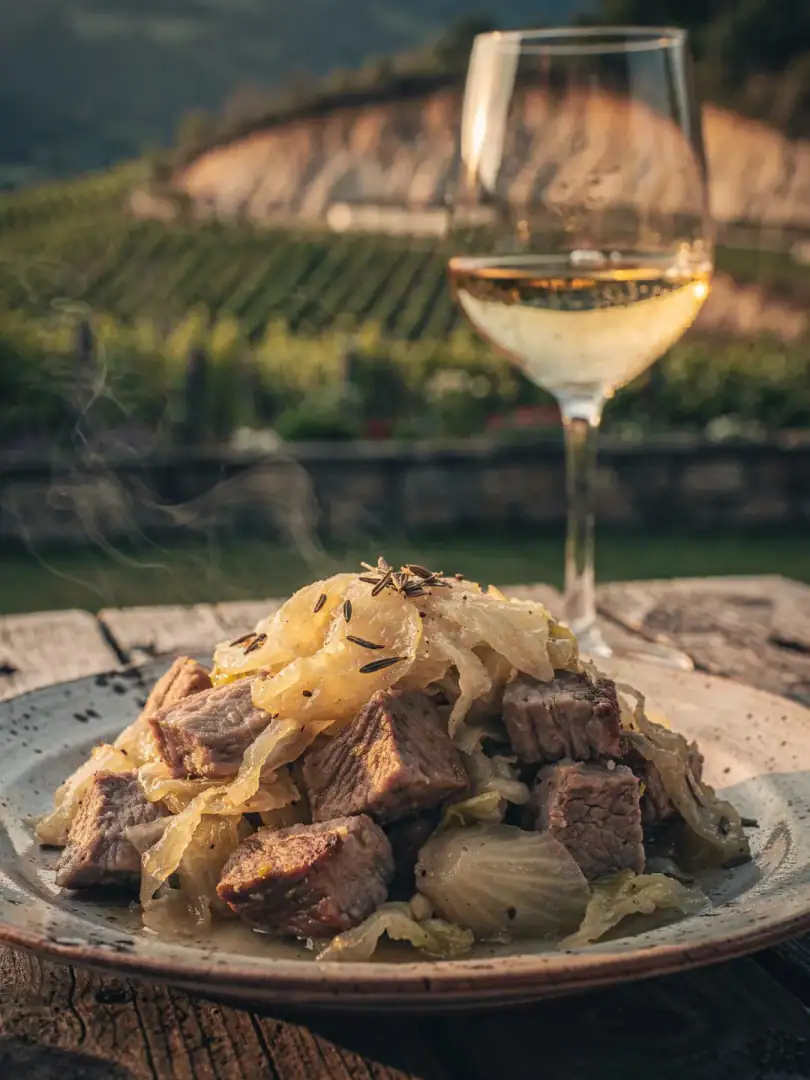
In the taverns around the Wagram, this cabbage is still used today to make Krautfleisch. It's braised pork with plenty of white cabbage, a touch of caraway, and a pinch of sugar to offset the acidity. The fat of the meat and the mild sweetness of the braised cabbage call for a wine that cuts through without feeling heavy itself.
A Grüner Veltliner village wine from the Wagram handles this task effortlessly. Its acidity is pronounced enough to cut through the fat, yet never so sharp that it clashes with the caraway. Its ripe fruit core, shaped by the loess soil, holds its own against the sweetness of the cabbage rather than fading into the background. For a heartier version made with smoked bacon, Roter Veltliner is the better match instead: its nutty character, reminiscent of ripe apple, meets the smoky flavor almost like a second ingredient. Its higher extract also keeps things in balance alongside robust bacon.
As is customary to round off a Presshaus evening at the Wagram, a cold platter often makes its way to the table. Grammelschmalz (crispy pork lard spread) with dark farmhouse bread, hard cheese, and pickles are all part of it. This is exactly what the regional wine was made for. Light and uncomplicated, with noticeable fruit, it refreshes the palate between bites of lard-topped bread and cheese, without ever stealing the evening's spotlight.