Grüner & Roter Veltliner
Grape Varieties
More than half, in some places up to two-thirds, of the vineyard area at Wagram carries the same name. Grüner Veltliner covers as much ground here on the mighty loess terrace as almost nowhere else in Austria except the Weinviertel. Here it usually tastes round and smooth, with ripe stone fruit and little of the green pepper note it's famous for in cooler sites. The reason lies in the soil below: loess stores warmth like a blanket.
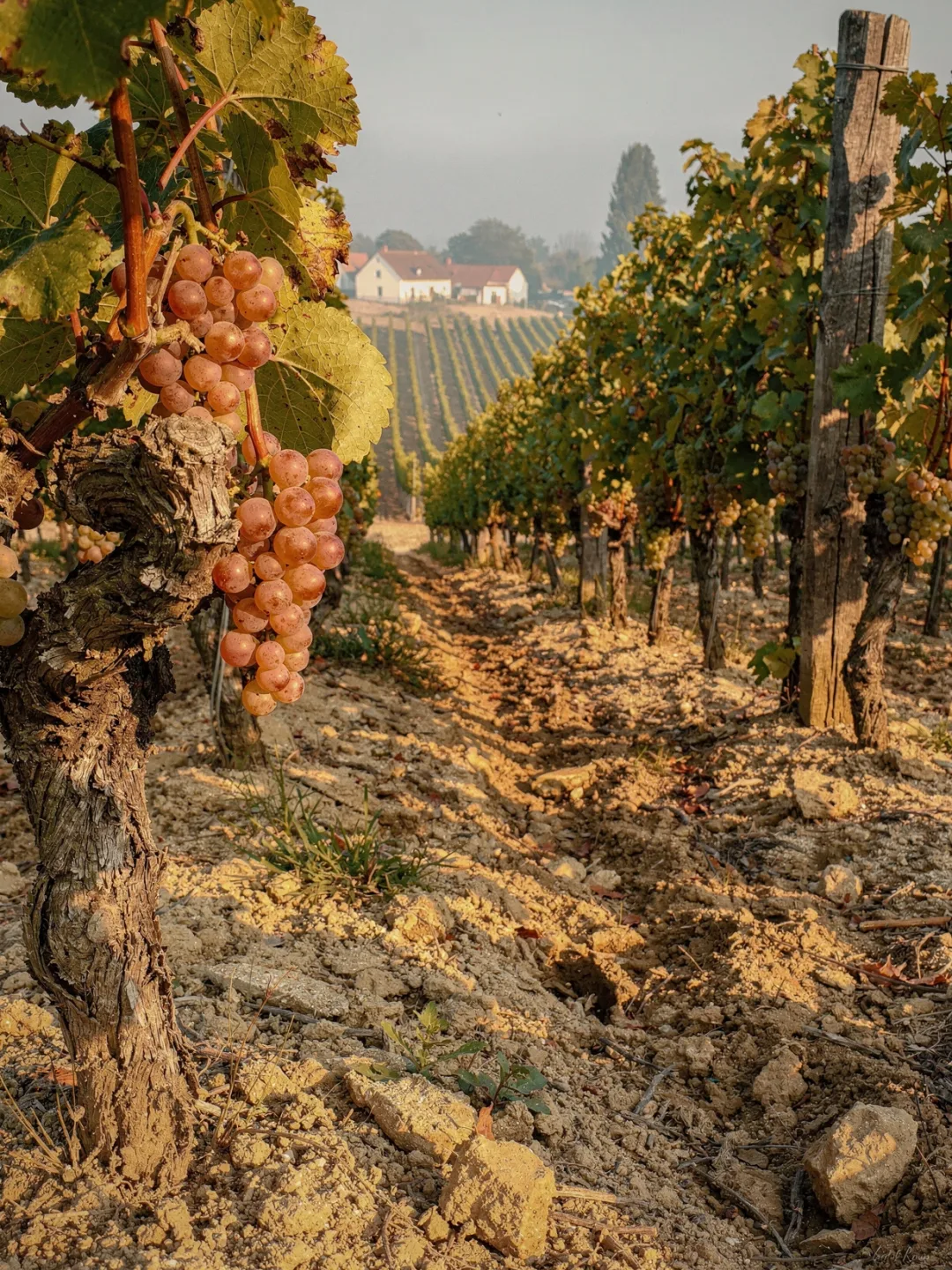
Its namesake tells quite a different story. Roter Veltliner covers only four in a thousand vine rows across Austria, yet almost all of them stand at Wagram, especially around Fels am Wagram. The name is misleading. Despite the similarity, it is not related to Grüner Veltliner. It ripens late, yields little, and its berries turn pink to copper before harvest, hence the name.
This unassuming variety is a genetic giant. Klosterneuburg vine researcher Ferdinand Regner proved via DNA analysis that Roter Veltliner is the parent variety of Neuburger, Rotgipfler, and Zierfandler. All three are white wines usually associated with the Thermenregion. Frühroter Veltliner, too, despite its similar name a distinct variety, arose from a natural crossing of Roter Veltliner with Sylvaner. Without this one vineyard at Wagram, a good part of Austria's grape variety diversity simply wouldn't exist.
In the glass, Roter Veltliner shows more power than its cousin. That demands patience in the vineyard. It brings more color, more extract, and a note of ripe apple and nuts. That makes it a wine that can handle years in the cellar. For a long time, though, it stood on the brink of disappearing, because it demands more vineyard work than it gives back in yield. Only when individual producers at Wagram began deliberately focusing on it again in recent years did it return to wine lists.
Wagram remains distinctive in this respect. At the very top of the DAC pyramid, alongside the two Veltliners, stands a third variety: Riesling. It grows only on a small area, mostly at the warmth-retaining edges of the terrace. Only these three varieties may bear the origin of a single vineyard as Riedenwein. Anyone wanting to understand what sets Wagram apart from its neighbors doesn't need to search for new varieties, just look closely at how differently two plants with almost the same name can taste.