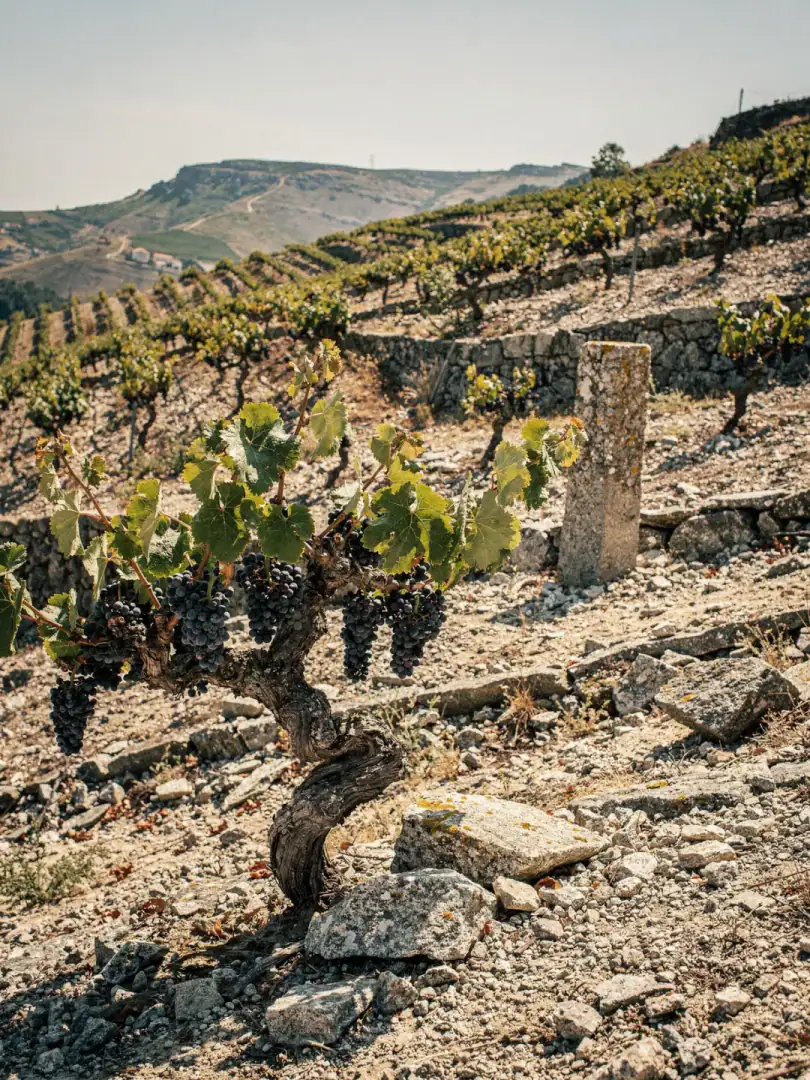
Touriga Nacional & Encruzado
Grape Varieties
One grape carries the reputation of the whole region, and it probably originated here. Genetic studies find the greatest diversity of Touriga Nacional right in the Dão, strong evidence of its origin. An old name gives the same hint: Preto Mortágua, named after the village of Mortágua in the heart of the region.
It nearly disappeared. After the phylloxera catastrophe, the vines had to be grafted onto American rootstock, and the yield of Touriga Nacional dropped by around forty percent as a result. For decades, growers therefore preferred to plant higher-yielding varieties. Only from the 1950s onward did researchers show, through targeted pruning and clonal selection, how to compensate for the low yields without sacrificing quality.
In the glass you can see why the effort paid off. Small, thick-skinned, almost black berries yield plenty of color and tannin, plus that furry coating you feel on your gums after a sip. Then there's the scent of violets and dark berries. In the Dão it comes across finer than elsewhere in Portugal, with more freshness and less power. The law requires at least twenty percent Touriga Nacional in every red Dão.
The rest of the red blend comes from three companions. Alfrocheiro rounds things out and adds color. Jaen, known elsewhere as Mencía, ripens early and tastes juicy, and Tinta Roriz, the Spanish Tempranillo, provides structure and length. None of them replaces Touriga Nacional; each complements it exactly where it would otherwise be weak alone.
Among the white varieties, a single one has taken on the role the reds play. Encruzado grows almost exclusively in the Dão and contributes citrus and white-flower aromas alongside plenty of acidity and unusually full body for a Portuguese white. In barrel it also picks up toasty notes and hazelnut. Bical and Malvasia Fina contribute freshness but remain supporting players next to a variety now compared to white Burgundy.