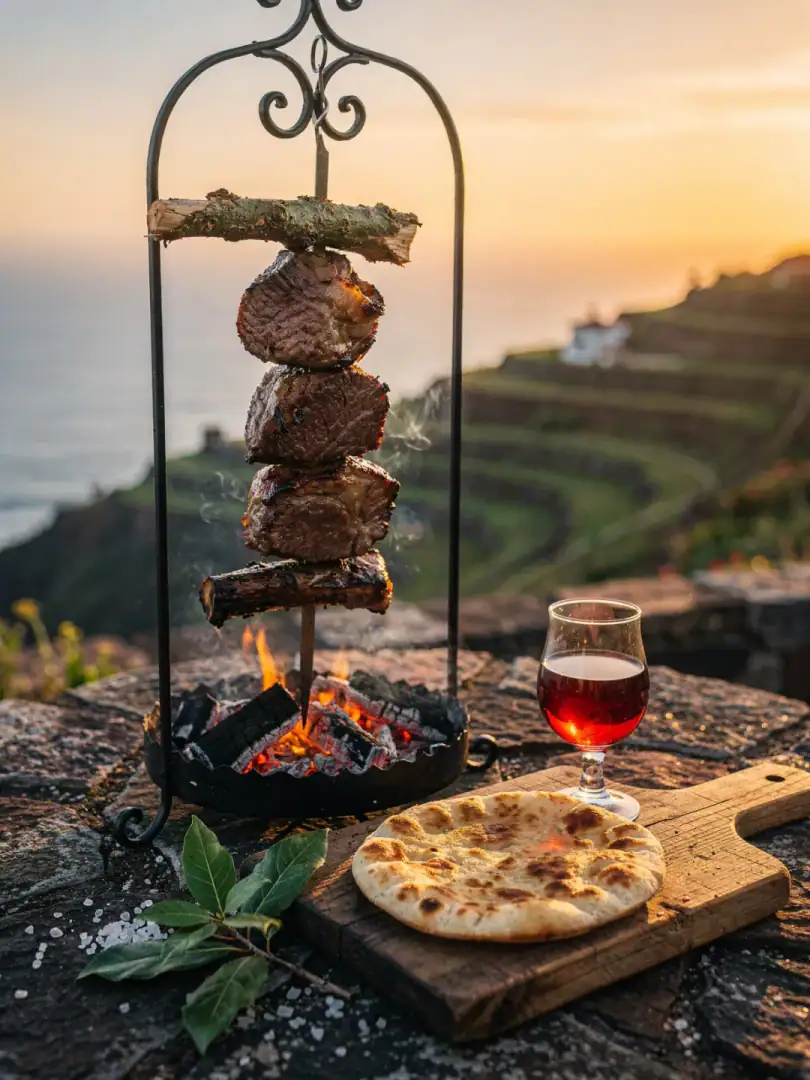
Espetada & Scabbardfish
Wine & Food
The island's most famous dish needs almost no ingredients. Espetada is beef on a skewer, seasoned only with coarse salt, garlic, and bay leaf, grilled over charcoal and traditionally served on a branch of the bay laurel tree that still extends beyond the edge of the plate. It's served alongside Bolo do Caco, a round flatbread with garlic butter, named after the Caco, the flat basalt slab it's baked on. The same basalt bakes the bread here as it forms the Poios, the vineyard terraces on the slopes above.
Just as famous is a fish rarely found outside the island: the black scabbardfish, Peixe-Espada Preto in Portuguese. It's an eel-like creature from depths of up to twelve hundred meters, with enormous black eyes. Sliced into thin fillets, fried, and served with caramelized banana, it makes for a sweet-salty combination that sounds strange at first and wins you over on the very first bite.
A dry Sercial or an off-dry Verdelho pairs best with these dishes. Such dishes are often savory and slightly sweet at once. Both wines taste good well chilled, whether as an aperitif or served directly with the fish. Their acidity cuts through the fat of the banana without competing with its sweetness. A heavy, high-alcohol red wine, on the other hand, would simply overpower the delicate fish flesh.
The meal almost always ends with Bolo de Mel, a dense spice cake made from sugarcane honey, nuts, and cinnamon, whose recipe is already mentioned as far back as the fifteenth century, and which is traditionally not cut but broken by hand. Only one wine really belongs with it. An old, dark Malvasia, itself rich in caramel and dried fruit, doesn't cover up the cake but sets its own decades-old version of the same flavor right alongside it.