Sand & Limestone
Soils
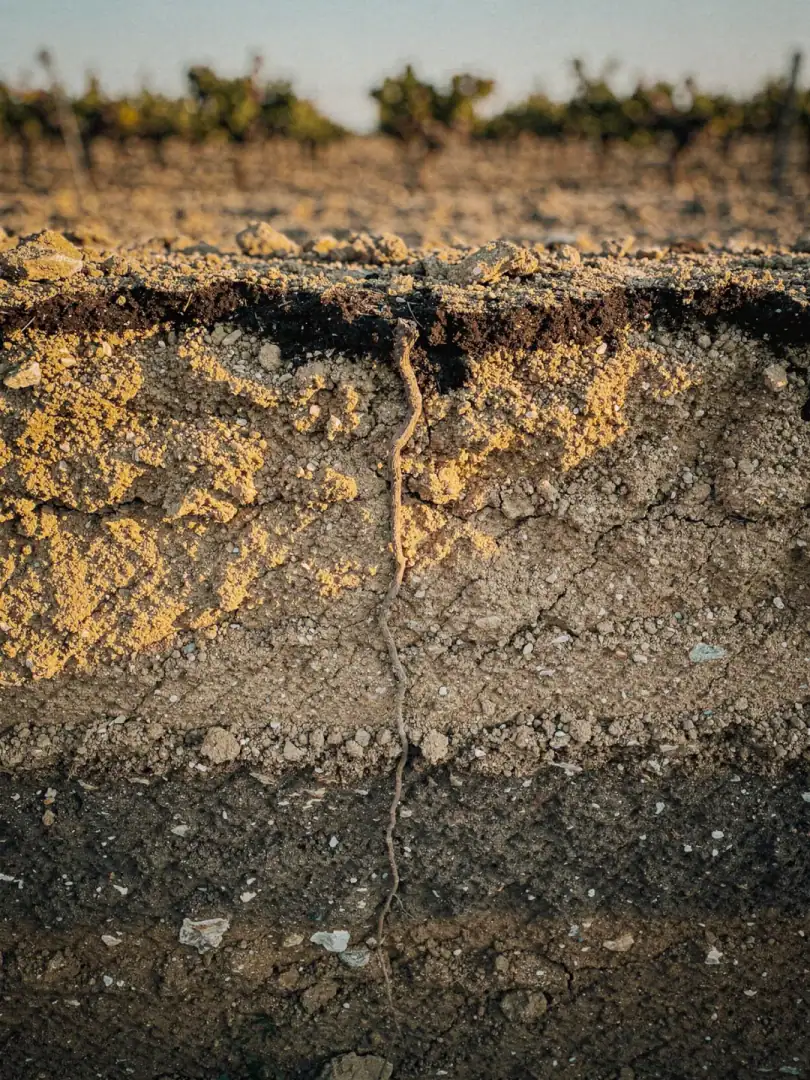
Dig a hole in a vineyard near Palmela and you'll hit nothing but sand — pale, fine, almost beach-like, only drier. This isn't a landscape accident. It's a remnant of the sea: roughly twenty million years ago, in the Miocene, this was seabed, and what remains are loose, deep-reaching layers of sand.
This sand is poor. It holds almost no nutrients and dries out within days of every rainfall. That's exactly what forces the vine to root deep — three, four meters, sometimes more, until it hits moister layers. Up top the plant nearly dies of thirst in August; down below it clings to groundwater.
Just a few kilometers away, on the slopes of the Serra da Arrábida, the earth looks completely different. There lies Jurassic limestone, one hundred fifty to two hundred million years old. A collision between Africa and Eurasia folded it up roughly seven million years ago and pushed it over younger layers. The Arrábida's clay-limestone soil, by contrast, holds water near the surface, where sand would instead force the root downward. That has a drawback: Castelão's roots stay shallow there, instead of building up structure.
That's why the best Castelão grows almost always in sand, not on the limestone that many other regions would celebrate as the finer terroir. Here it's the reverse. The barren plain delivers the concentrated, long-lived grapes, while the Arrábida slopes tend to carry the white Moscatel and lighter wines.
A stubborn myth persists here too: that the sand itself comes through in the glass, because the root absorbs minerals directly. That's not quite right. What actually arrives are trace dissolved ions that nobody can taste. Soil works through water balance and root depth — and that's exactly what determines whether the same grape produces a thin or a dense wine.
A thin, dark layer of decomposed leaves and little organic matter. On lean sand, hardly any of this builds up at all.
The root: This is where the fine roots sit, drawing on the rare rain before it seeps away into the sand.