Choco & Queijo
Wine & Food
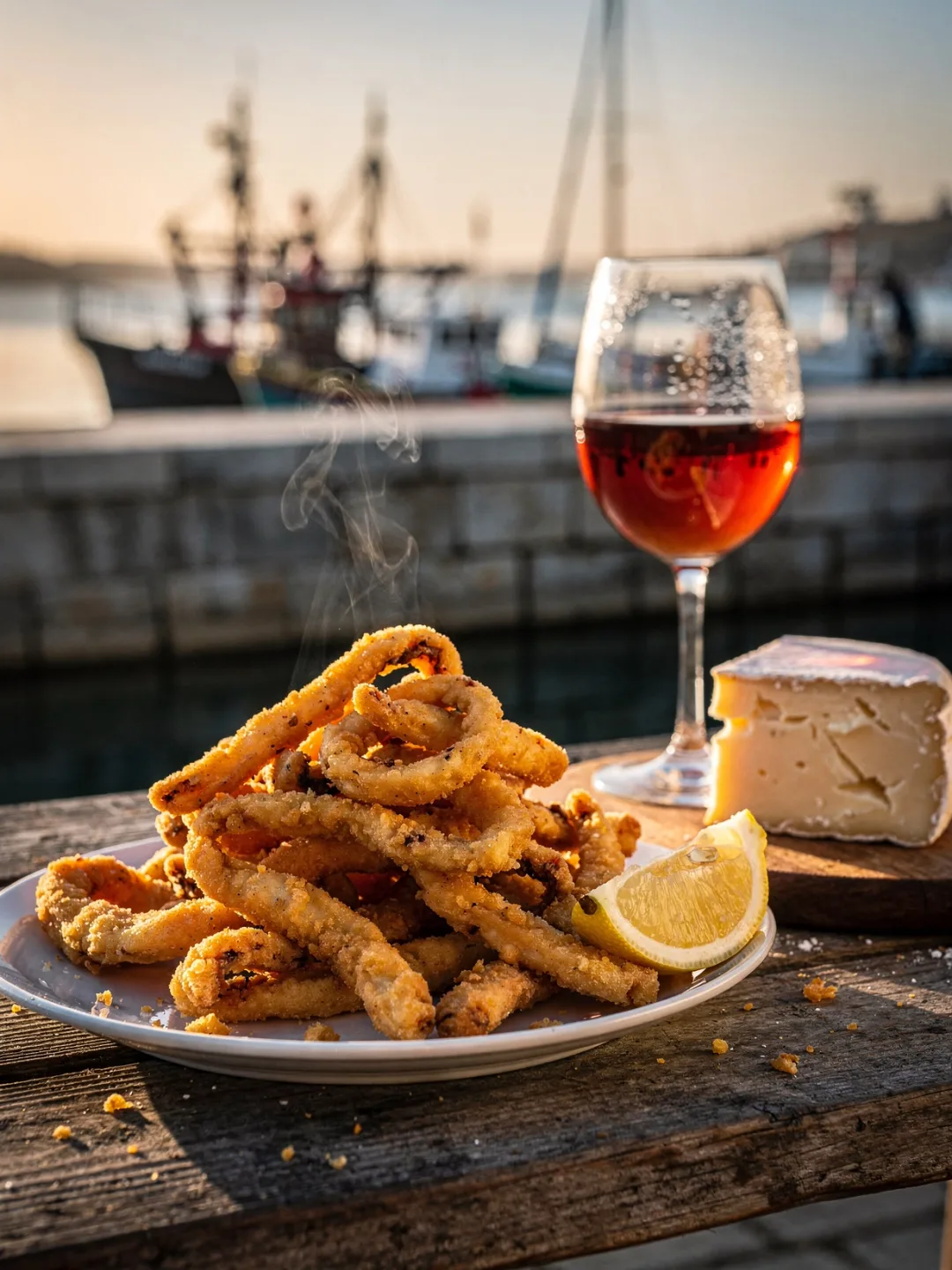
Setúbal is a fishing town. Its most famous dish proves it: Choco frito, cuttlefish sliced into strips, breaded, and fried crisp. Legend has it that fisherman Manuel Coutinho invented it in the 1950s. He served freshly fried choco in his tavern and instantly won over the whole town.
With crispy, fatty Choco frito, a dry, young white wine made from Arinto or Fernão Pires works better than any red. Its acidity cuts through the oil of the breading, much like a squeeze of lemon. It keeps every bite tasting fresh instead of letting the fat coat the palate.
With cheese, the picture flips. Queijo de Azeitão, a creamy sheep's-milk cheese, is set with thistle flower instead of rennet and is both salty and mildly pungent — and it's exactly that salt that makes a young Moscatel de Setúbal more approachable, rather than overpowering it. Sweetness and salt balance each other; that's not an exception at the table, it's a firm rule.
The robust Castelão from Palmela, by contrast, calls for something heartier: braised wild boar stews, or an eel stew from the Sado, whose fat rounds off the wine's tannin. A Choco frito alongside it would get completely lost, just as too heavy a Castelão would overwhelm any delicate fish.
For dessert, finally, an old Moscatel belongs. Best of all with Torta de Azeitão, a paper-thin rolled egg-custard cake from the region's convent kitchens. Sweet pastries next to a dry wine almost always taste sour and thin; Moscatel, however, is sweeter than the torta itself, and that's exactly why the pairing works.