From Cooperative to Quinta
Winemaking
Until just a few decades ago, winemaking in the Tejo followed almost the same path everywhere. Grapes went to the cooperative and ended up in enormous concrete tanks, mixed together with the harvest of a hundred other growers. The result was a uniform, mostly pale wine shipped in barrels for export. There was hardly any individual character, since no one really knew whose grapes were fermenting in which tank.
Today two appellation tiers determine what can appear on the label. Vinho Regional Tejo allows a wide range of varieties and origins across the whole region. DOC do Tejo, by contrast, permits only grapes from six precisely defined zones: Almeirim, Cartaxo, Chamusca, Coruche, Santarém and Tomar. Since 13 May 2024, Regulation (EU) 2024/1143 governs how such geographical indications are protected across Europe. In the cellars of individual producers, though, this changes little.
In the cellar, the real work begins with the harvest, which falls at different times depending on the zone. On the hot Charneca, some producers already pick by late August. Along the cooler river or up in the Bairro, the grapes can hang until well into September. Fernão Pires is usually processed cool and quickly, often fermented below twenty degrees Celsius, so the floral aromas aren't lost to heat.
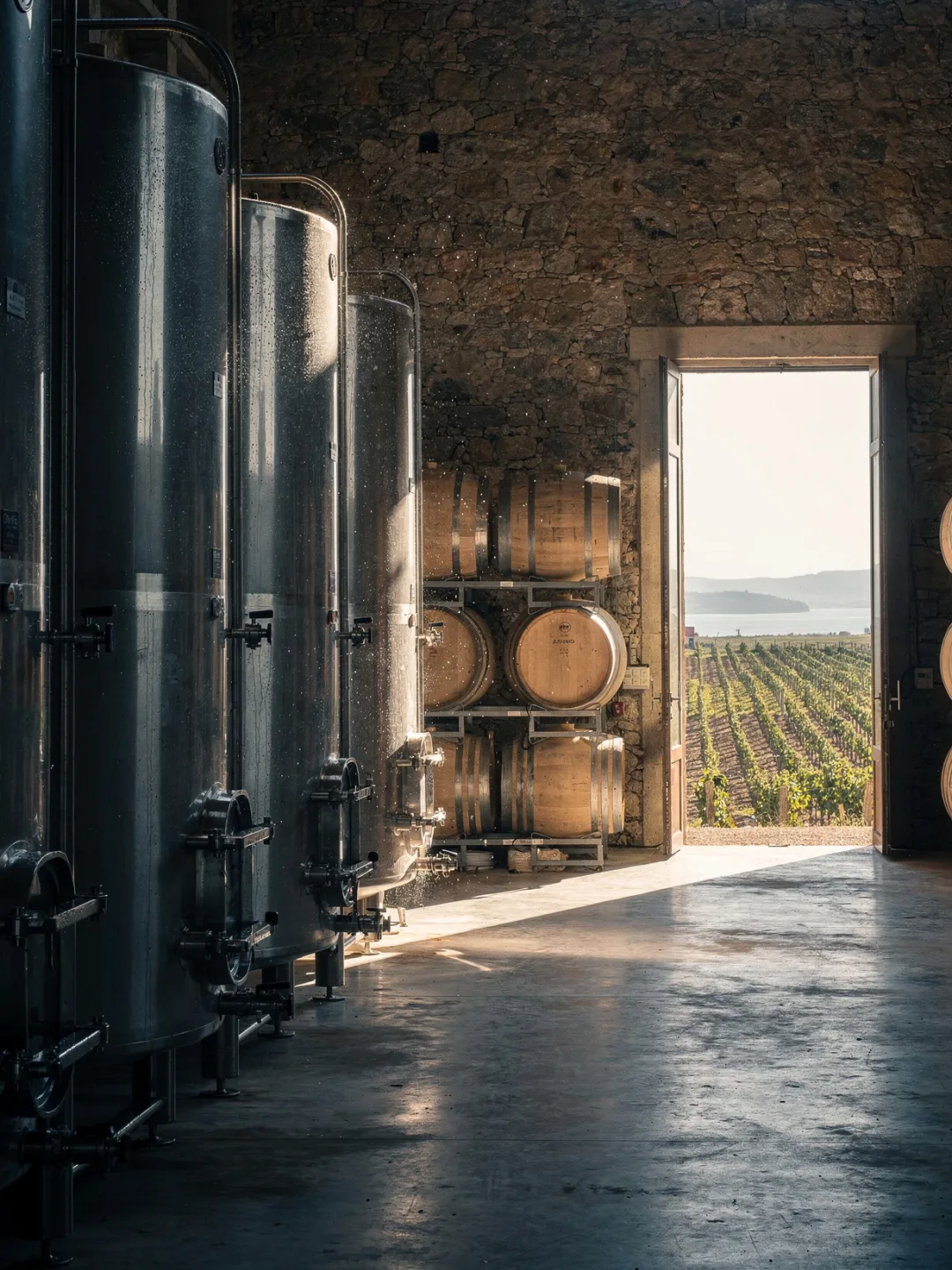
For the red varieties, maceration takes longer. Depending on the style, Castelão and Trincadeira spend two to three weeks on the skins, giving color and tannin enough time to move from the skins into the wine. Afterward, part of the wine ages in stainless steel for freshness, while another part matures in oak barrels, which rounds out tannin that would otherwise remain too angular.
One last, unassuming step concerns cold, not heat. Before bottling, many producers deliberately chill the wine so that tartrate crystals, fine crystals formed from excess acid, settle out in the tank rather than later at the bottom of the bottle. Without this step, some Fernão Pires would still show small, harmless crystals in the glass years later, which many drinkers mistakenly take for a flaw.