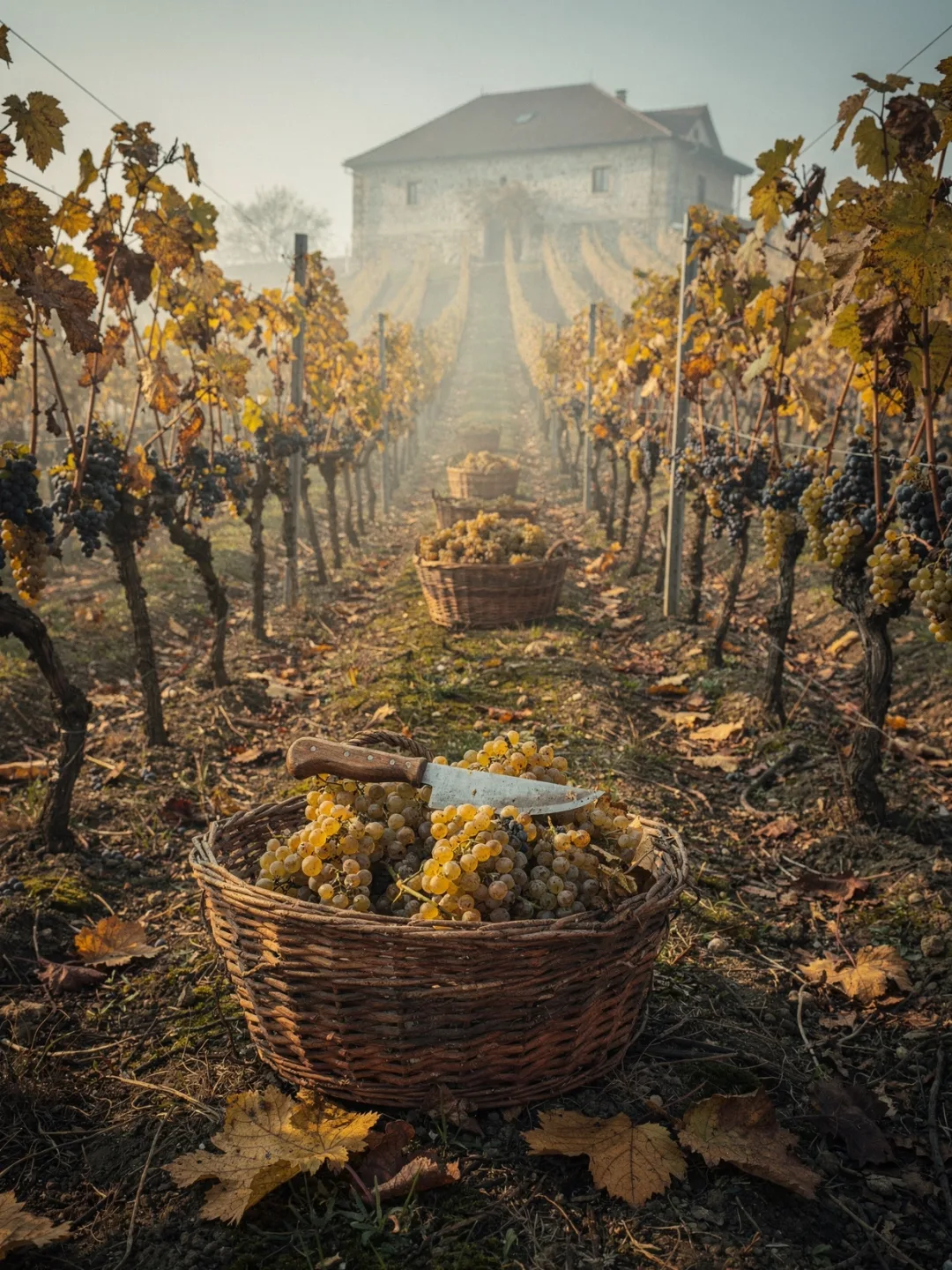
Late, noble-rot harvest
Production
Harvest in Cotnari begins late. Sometimes even later than planned. While the harvest elsewhere in Romania often ends in September, winegrowers here frequently wait until October or even November, until the grapes have reached the right condition. Picking too early sacrifices exactly what the region is famous for.
Romanian wine law recognizes three ripeness levels for DOC wines, based on sugar content at harvest. DOC-CMD requires at least 187 grams of sugar per liter of must, picked at full ripeness. DOC-CT, the late harvest, requires at least 220 grams. DOC-CIB, the level involving noble rot or raisining, requires at least 240 grams—the highest of the three tiers, and the one Cotnari is most known for.
For DOC-CIB, grapes are picked by hand, often across multiple passes through the same vineyard. Only the berries that Botrytis cinerea has already shriveled and concentrated with sugar go into the vat, while unripe or healthy grapes are left to hang until they too reach that point. Unlike orange wine, where extended skin contact drives concentration, here the concentration happens entirely in the vineyard. The cellar work comes only afterward.
In the cellar, such a must ferments only reluctantly. The yeast struggles against the high sugar content, fermentation slows on its own, and eventually stalls out long before all the sugar has converted to alcohol. What remains is a wine with roughly eleven and a half to fourteen percent alcohol, plus often two hundred sixty to three hundred grams of residual sugar per liter—noticeably sweeter than most German Beerenauslese wines.
One rule applies equally to all three tiers: one hundred percent of the grapes must come from the designated DOC zone, a stricter requirement than most other Romanian appellations. Only after fermentation are the four varieties brought together into the classic blend. Each producer fine-tunes the ratio according to their own experience: Grasă de Cotnari for richness, Fetească Albă and Frâncușă for acidity, Tămâioasă Românească for fragrance.