From Tello to Salenegg
Region & History
A bishop's testament from the year 765 mentions a vineyard near Ilanz. Tello, Bishop of Chur, bequeathed it to Disentis Abbey shortly before his death. This terse document is the oldest written mention of wine anywhere in Switzerland. Vines were planted here long before today's cantonal borders existed, in a Graubünden valley that is barely considered wine country now.
Wine from this early era was white, mostly made from the sturdy but hardly thrilling Elbling grape. That changed only around 1630, for a reason that had nothing to do with winemaking at all. Young men from Graubünden returned home from mercenary service in Burgundy and brought back cuttings of a red variety they'd learned to drink there. This became Blauburgunder, which today accounts for over two-thirds of all vines in German-speaking Switzerland — a souvenir that rose to become the leading grape variety of an entire wine region.
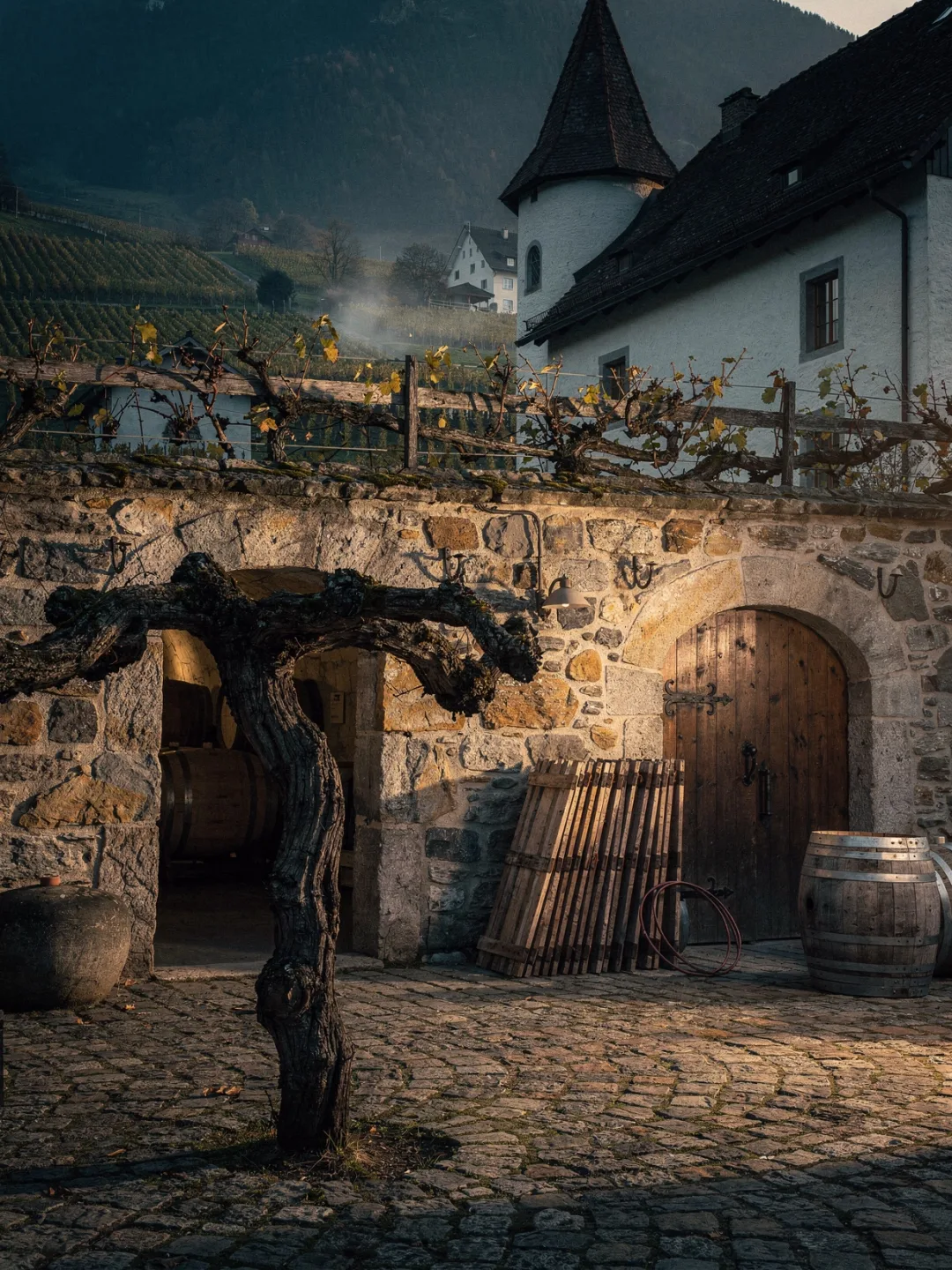
Further north, in Maienfeld, wine has grown on the same patch of earth since 1068. A prior from Pfäfers Abbey planted the first vineyard there. Schloss Salenegg is therefore considered the oldest continuously operated wine estate in Europe. It has belonged to the same family, the von Gugelbergs, since 1654, and eleven hectares of vines still stand there today. Not a museum — an estate that still brings in a harvest every autumn, right in the heart of the Bündner Herrschaft.
Around Lake Zurich, viticulture reached its greatest extent in the 1880s, covering nearly two thousand hectares along both shores. Villages like Stäfa and Erlenbach contributed to this, stretching from the city of Zurich to Rapperswil. Then came the collapse, and it came fast. American powdery mildew attacked the leaves, two consecutive frosts wiped out the harvest, and cheap, chemically faked "artificial wine" pushed prices into the ground. Within a few decades, the area shrank to a fraction of its former size — and with it, the old Räuschling variety, which had once accounted for half of all the vines here, nearly vanished too.
What remained was a fragmented wine country. Today, seventeen cantons belong to the German-speaking Swiss wine region, stretching from Basel to Graubünden, with nearly three thousand winegrowers farming roughly 2,660 hectares. To this day, each canton regulates its own wine law independently. Nine of them, including Schaffhausen, Graubünden, and Thurgau, even permit adding grape must to a wine labeled AOC in order to sweeten it. In French-speaking Switzerland, this has long been banned; here, it remains the law.