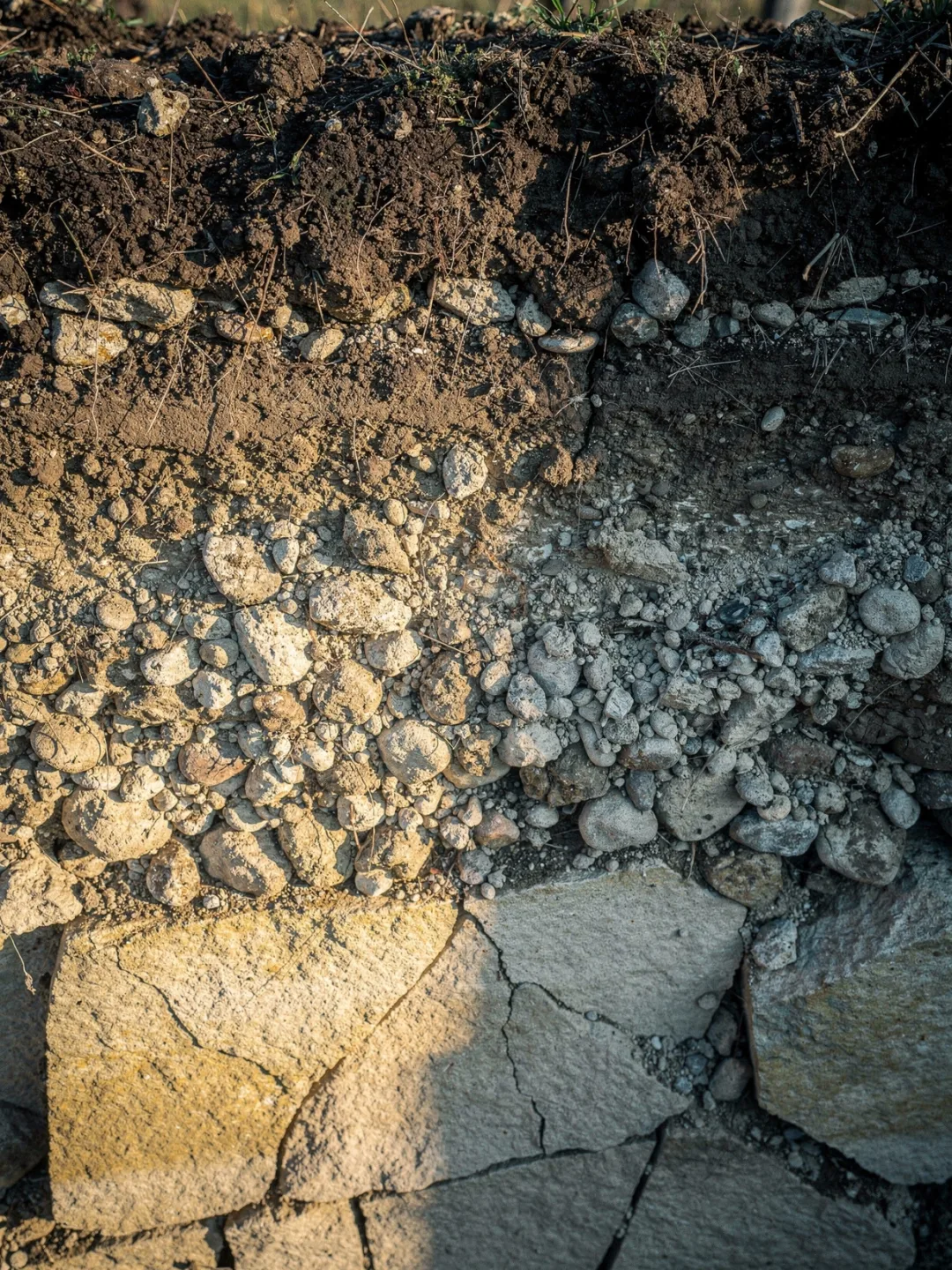
Moraine over Molasse
Soils
Dig a hole in a vineyard near Dardagny, and after just a few spadefuls the earth turns grey and heavy: gravel and clay, tightly compressed together, the legacy of an ice age. This is the moraine. It dates from the Würm glaciation, which pushed a massive glacier across the entire Geneva basin roughly fifteen to seventy thousand years ago and left behind rubble, gravel, and fine clay as it retreated. Beneath it lies a much older rock. Keep digging.
The molasse formed around thirty million years ago, when a shallow sea still covered present-day Geneva and sand, mud, and lime settled layer by layer on the seabed. Later, pressure compacted this into alternating sandstone and marl, sometimes reddish, sometimes grey. Near Peissy, this rock lies especially hard and dense directly beneath the moraine. Roots barely manage to penetrate it there.
This is exactly the point: where the molasse comes close to the surface, as at Dardagny, the soil stays shallow, warm, and permeable, and the vine roots spread sideways rather than downward. Where the moraine lies thick, as in large parts of the Mandement, the roots must work their way through meters of gravel and clay before finding water in summer. Two soils, just a few kilometers apart, produce two rather different wines. The difference is clearly noticeable in the glass.
One misconception nonetheless persists. It's often said that a wine tastes mineral because the roots absorb rock and pass it straight on. That isn't quite true. Only dissolved minerals in tiny, flavor-irrelevant quantities reach the plant through the roots, and what actually shapes the character of the soil is the detour via water and warmth: a gravelly soil stores solar heat and releases it to the grapes at night, while a clay soil retains moisture longer. Both matter, and both work together.
A thin, dark layer of decomposed leaves and grass, rarely more than a hand's breadth deep in the vineyards of the Mandement.
The root: This is where the fine roots sit. After every rainfall, they're the first to be supplied — and the first to dry out again.