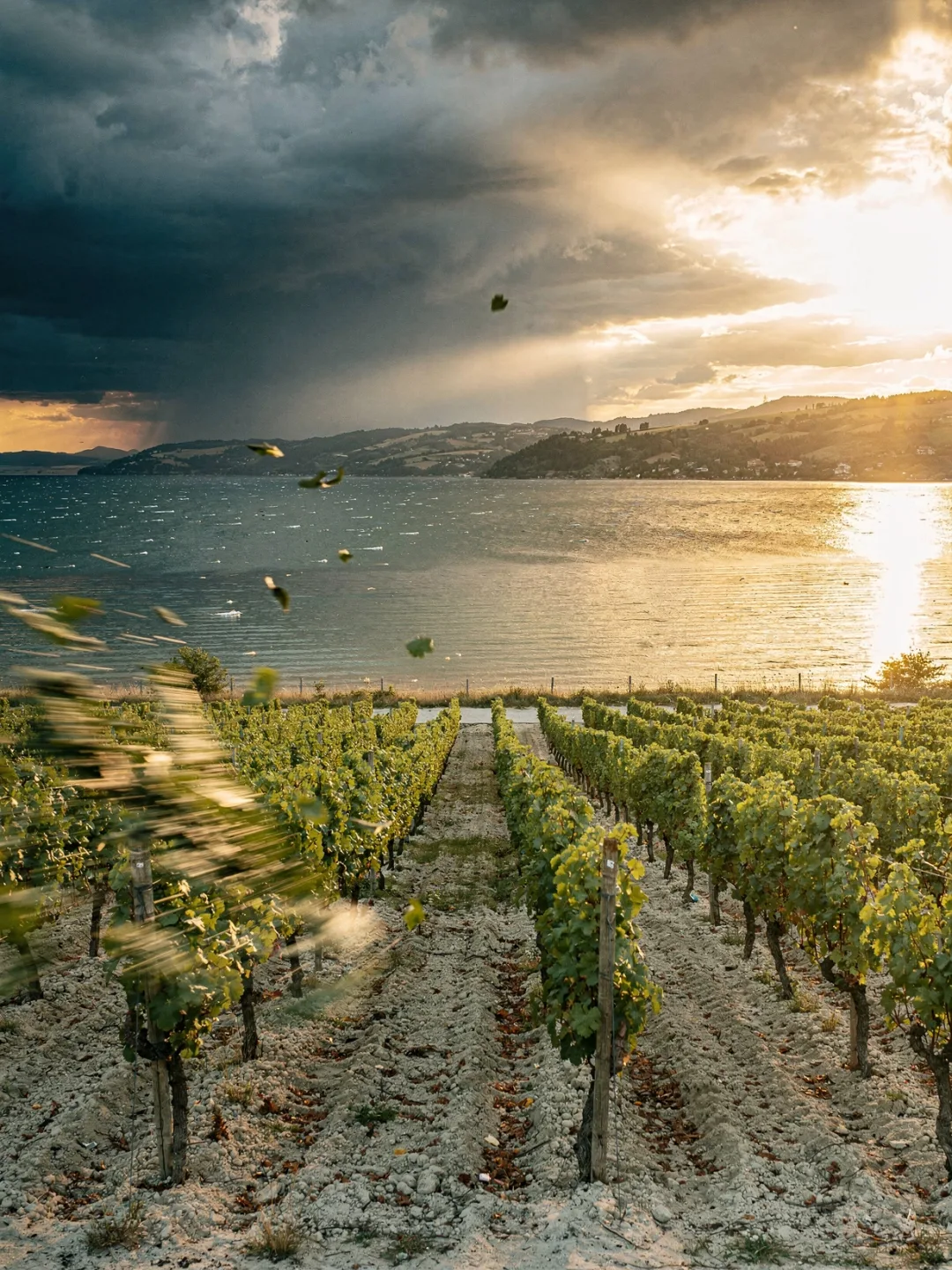
Lake, Bise & Foehn
Climate
Geneva lies at the end of the largest lake north of the Alps, and that lake has a hand in every vintage. It stores warmth in summer and releases it slowly in spring, exactly when late frost could kill the young shoots. Two cold and warm winds blow in opposite directions against this, and both have their own name in Geneva. The Bise comes from the northeast.
It is cold and dry and blows mainly in winter and spring. The Foehn comes from the opposite direction, warm and dry, mostly in spring and autumn. It can raise the temperature by several degrees within just a few hours. How unreliable this interplay can be was shown by the 2024 vintage: a cold snap in spring and persistently wet weather pushed the harvest down to just 62,600 hectoliters, a decline of more than a quarter compared to the two previous years.
The city's weather station records an average of 1,930 hours of sunshine each year, a lot for a region north of the Alps. Still, it's not the annual total that determines quality, but the distribution of warmth and rain. In good years like 2022 and 2023, this added up to 83,000 and 84,000 hectoliters respectively. 2024 was the opposite. For winemakers, this means planning anew each year around a climate that can turn out too warm, too wet, or both at once.
Gamay owes its long-standing status precisely to this climate. It ripens early enough to usually escape the autumn dampness before harvest. Anyone standing today in the Mandement or on the hills of Dardagny will therefore rarely see a single vineyard plot dependent on just one kind of weather all year, but rather a mix of early- and late-ripening varieties side by side. That is entirely intentional.
This spreads the risk across several varieties and several sites. On Lake Geneva, every vintage still remains a gamble, since a single cold April morning can halve the yield, while a dry, sunny September can rescue that same vintage within a few weeks. That is exactly what makes every single vintage different. No two years are ever alike. Anyone drinking Genevan wine is therefore never drinking just a grape variety, but each time also the weather of that particular year.