Longeole & Perche
Wine & Food
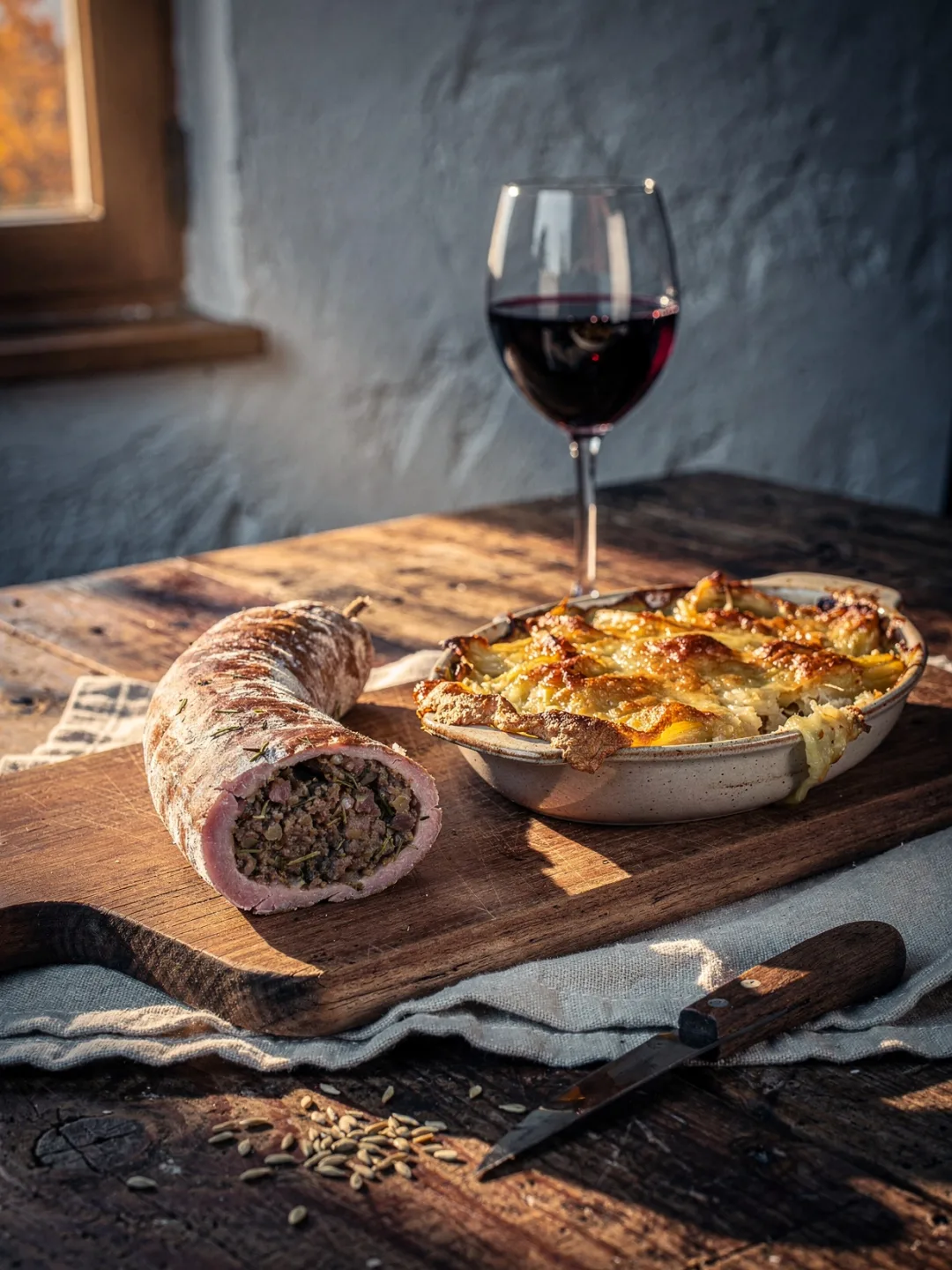
Two dishes represent Geneva's cuisine like no others, and both are centuries old. Both remain very much alive today. One is the Longeole, an unsmoked raw pork sausage made with pork, rind, and fennel seeds, first mentioned in a Geneva glossary in 1820 and a fixture of every cookbook from the city since 1930. It's almost always served with a gratin of cardons, the spiky, thistle-like stalks that carry their own designation of origin in Geneva and traditionally appear on the table at Christmas.
Fat and salt change how a wine behaves in the mouth. The same holds true here. Both soften hard tannin and make it more approachable, much like a spoonful of cream tempers a mustard that's too sharp. That's exactly why a robust, tannin-rich wine pairs best with Longeole and its cardons, a young Gamaret or a bottle of l'Esprit de Genève. A wine that's too light and pale would simply be lost next to this hearty dish.
On the lake, Geneva's second specialty is literally right on the doorstep. Filets de perche, perch fillets from Lake Léman pan-fried in butter, have been the Sunday meal of entire families for generations. The recipe is simple. The flesh is lean and delicate, almost neutral in flavor, and so it can't handle a wine louder than itself. Less is more. A chilled Chasselas or a crisp Sauvignon Blanc from the Mandement accompany the perche without drowning it out.
At the end of a Geneva menu, a very different wine sometimes appears in the glass: Gewürztraminer passerillé, a sweet straw wine for which the grapes are dried on mats for weeks after harvest, until the sugar concentrates intensely. Two rules suffice. Fat and salt soften a hard wine. Sweetness in food, on the other hand, makes any dry wine taste thin, which is why a dessert always needs a wine sweeter than itself.