From Phylloxera to Merlot
Region & History
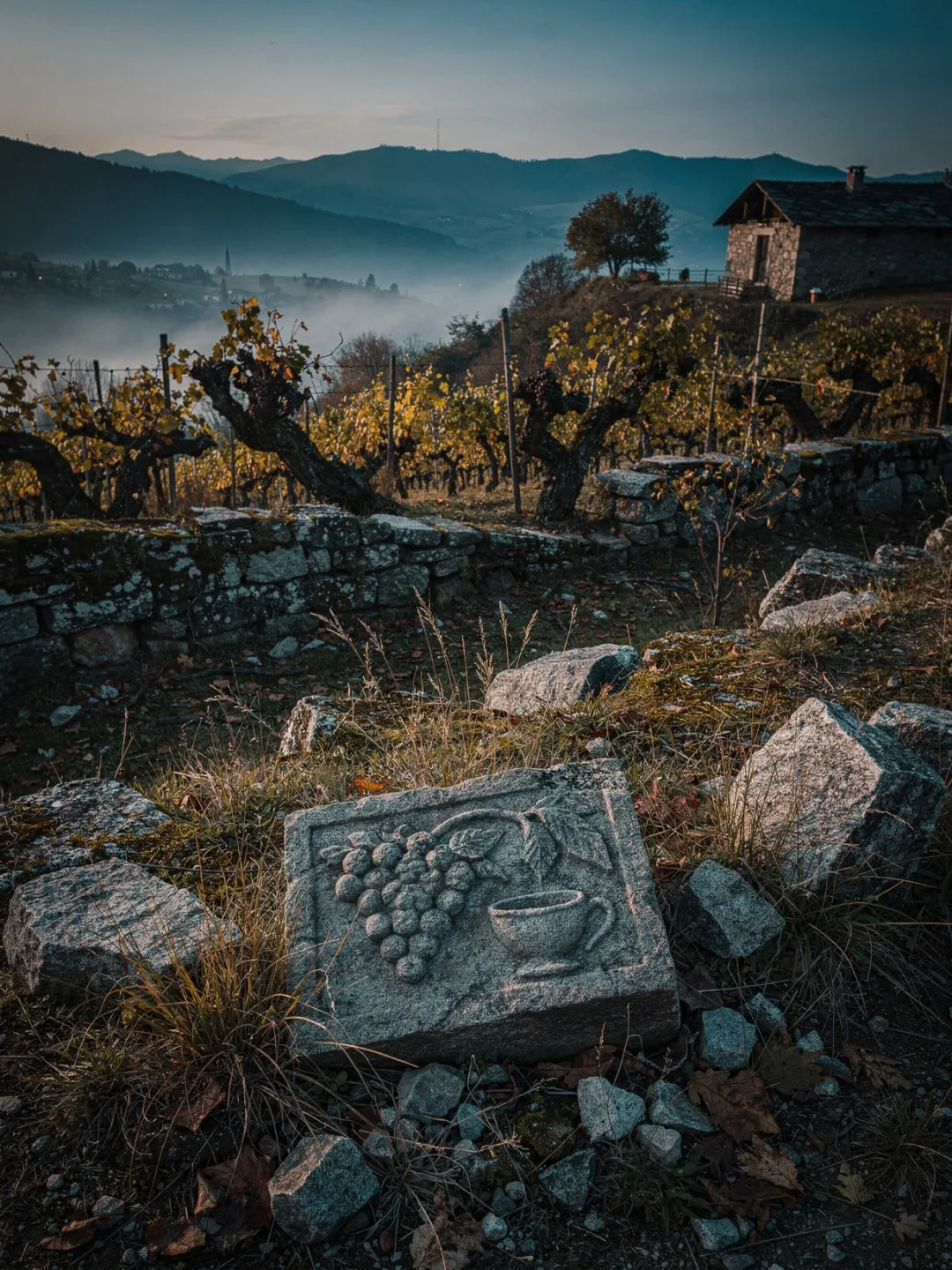
A Roman-era gravestone carved with grapes and a shallow drinking bowl now sits in the museum at Stabio. Wine, then, grew in Ticino long before anyone spoke of Merlot. For centuries a single native variety shaped these slopes: Bondola, a dark, thin-skinned red that the Zurich naturalist Hans Rudolf Schinz first mentioned in writing in 1770. People drank it young, in the Grotto, a cellar hewn into the rock, straight from the cask.
Then came phylloxera, an American louse that devours vine roots from the inside. By around 1900 it had crippled almost the entire Ticino vineyard. In 1902 the canton established a traveling professorship in viticulture and appointed the agronomist Alderige Fantuzzi to the post. In 1904 and 1905 Fantuzzi had the first Merlot cuttings brought in from Bordeaux and planted them on an experimental hillside in the Mendrisiotto, where in 1906 he pressed the very first Ticino Merlot. That same year the cantonal government officially recommended the variety as a replacement for the ruined vineyards.
After the Second World War the canton subsidized the wholesale conversion of vineyards to Merlot, and the old Bondola nearly vanished: between 1916 and 1936 it had still accounted for forty to forty-five percent of all new plantings. Today, together with the related Bondoletta, it covers less than one and a half percent of the vineyard area. The variety very nearly disappeared from the vineyards altogether. Only in 2023 did Slow Food rescue it with its own Presidio, a protection program for heritage varieties. It accepts only winemakers who bottle pure Bondola or Bondola blended with a little Bondoletta.
The next turning point came from the cellar, not the vineyard. In the 1980s red Merlot was selling poorly. In 1986 the cooperative winery of Giubiasco pressed part of its Merlot experimentally like a white wine, pale and with no skin contact, and named the result Bucaneve, Italian for snowdrop. What began as a stopgap became a category of its own: Merlot bianco. Almost simultaneously, in 1985, Luigi Zanini founded the winery Vinattieri Ticinesi in Ligornetto. His aim was to prove that red Ticino Merlot could stand alongside Bordeaux.
Legally, one more step was needed. Only in 1994 did Switzerland and the European Union mutually recognize each other's controlled designations of origin. With the 1997 harvest, the first Ticino wine bearing the DOC quality mark, short for Denominazione di origine controllata, went on sale. Today Merlot accounts for a good three-quarters of the entire Ticino vineyard area. It splits into a cooler north and a warmer south, each with its own story to tell.